



Verdict: A Useful Starter System for Better Decisions
Mental models are most useful when they help you name the kind of problem in front of you. That is the practical value of this system: before rushing into a decision, you pause long enough to ask, “What type of situation is this?”
That small shift can change the quality of the next move. A career problem may call for sunk-cost thinking. A productivity problem may call for Parkinson’s Law. A business problem may call for the 80/20 rule.
Charlie Munger, Warren Buffett’s longtime business partner at Berkshire Hathaway, is often associated with this style of cross-disciplinary thinking. He argued that better judgment comes from collecting reliable ideas from different fields and applying them when the situation fits.
This is not a complete decision-making system, and it will not remove uncertainty. But as a practical review of three beginner-friendly mental models, it gives readers a simple way to make decisions with more structure and less noise.
Who This Is For
This approach is best for people who already have plenty of information but still feel stuck choosing what to do next. It is especially useful for founders, managers, students, creators, and professionals who face recurring tradeoffs.
It is also useful if your default mode is to work harder before asking whether you are working on the right thing. Mental models do not replace effort, but they can help aim that effort better.
This system is less useful for readers looking for a rigid step-by-step formula. Mental models are judgment tools. They point your attention in a productive direction, but they still require context, honesty, and practice.
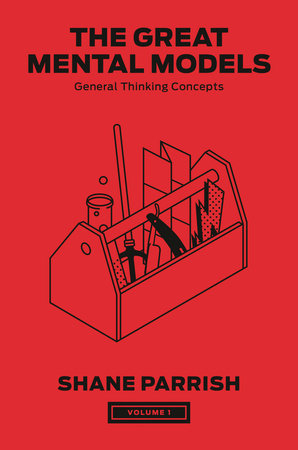
The Great Mental Models, Volume 1
For readers who want more examples beyond Pareto, sunk cost thinking, and Parkinson’s Law, this book gives a broader introduction to general-purpose mental models. It works best as a reference to revisit when framing decisions, not as a rigid formula.
As an Amazon Associate I earn from qualifying purchases.
Model 1: The Pareto Principle
The Pareto Principle, often called the 80/20 rule, says that a large share of results often comes from a smaller share of causes. The exact numbers are not the point. The point is that effort and results are rarely distributed evenly.
Used well, this model helps you separate busy work from high-value work. Instead of asking, “How can I do everything?” you ask, “Which few actions are responsible for most of the progress?”
Useful applications include:
- Business: Identify the clients, products, or channels that create the largest share of revenue.
- Productivity: Find the few tasks that make other tasks easier or unnecessary.
- Stress reduction: Notice which recurring obligations create the most distraction or friction.
A practical daily question is: “What is the one task today that would make the rest of the day easier?” That question is simple enough to use before opening your inbox, starting a meeting, or planning a week.
Model 2: The Sunk Cost Fallacy
The sunk cost fallacy describes the tendency to keep investing in something mainly because you have already spent time, money, or effort on it. The past investment feels like a reason to continue, even when the future case is weak.
This model matters because many expensive decisions are protected by pride. A degree, a project, a strategy, a relationship, or a business line can start to feel too costly to question.
The better question is not, “How much have I already put into this?” The better question is, “Knowing what I know now, would I choose this again?”
That question can be uncomfortable, but it moves the decision back to future value. Past costs may explain how you arrived here. They should not automatically decide what happens next.
This does not mean quitting at the first sign of difficulty. It means separating useful persistence from emotional attachment to a prior investment.
Model 3: Parkinson’s Law
Parkinson’s Law says that work tends to expand to fill the time available for it. Give a task two weeks, and it may consume two weeks. Give it two focused hours, and you may discover that the essential version can be finished much sooner.
This model is especially useful for procrastinators and perfectionists. Procrastinators wait until pressure creates focus. Perfectionists keep polishing because the deadline allows it.
A practical way to apply Parkinson’s Law is to create shorter, self-imposed deadlines:
- Define the outcome clearly.
- Set a time box that feels slightly uncomfortable but realistic.
- Finish a usable version before improving it.
- Review what actually needed more time and what did not.
The goal is not to rush important work. The goal is to prevent low-value expansion from hiding inside generous timelines.

Poor Charlie’s Almanack
Readers who want the original Munger-style approach to multidisciplinary thinking can use this as a deeper follow-up. It is better suited for slow study and reflection than quick tactical checklists.
As an Amazon Associate I earn from qualifying purchases.
How the Three Models Work Together
These models are strongest when used as a quick diagnostic set.
| If the problem is… | Use this model | Ask this question |
|---|---|---|
| Too many priorities | Pareto Principle | Which few inputs create most of the useful output? |
| Hard to walk away | Sunk Cost Fallacy | Would I choose this again today? |
| Work keeps dragging on | Parkinson’s Law | What deadline would force a usable version? |
The common thread is pattern recognition. You are not trying to sound smarter. You are trying to notice what kind of decision you are making before habit takes over.
Final Takeaway
Mental models are tools, not trophies. Reading about them is useful only if they change the next decision you make.
Start with one current problem. If you are overwhelmed, apply the 80/20 rule. If you are staying because of what you already spent, test for sunk cost thinking. If a task keeps expanding, use Parkinson’s Law and tighten the deadline.
That is the practical value of this system: it gives you a small set of prompts that can turn vague stress into a clearer next move.