

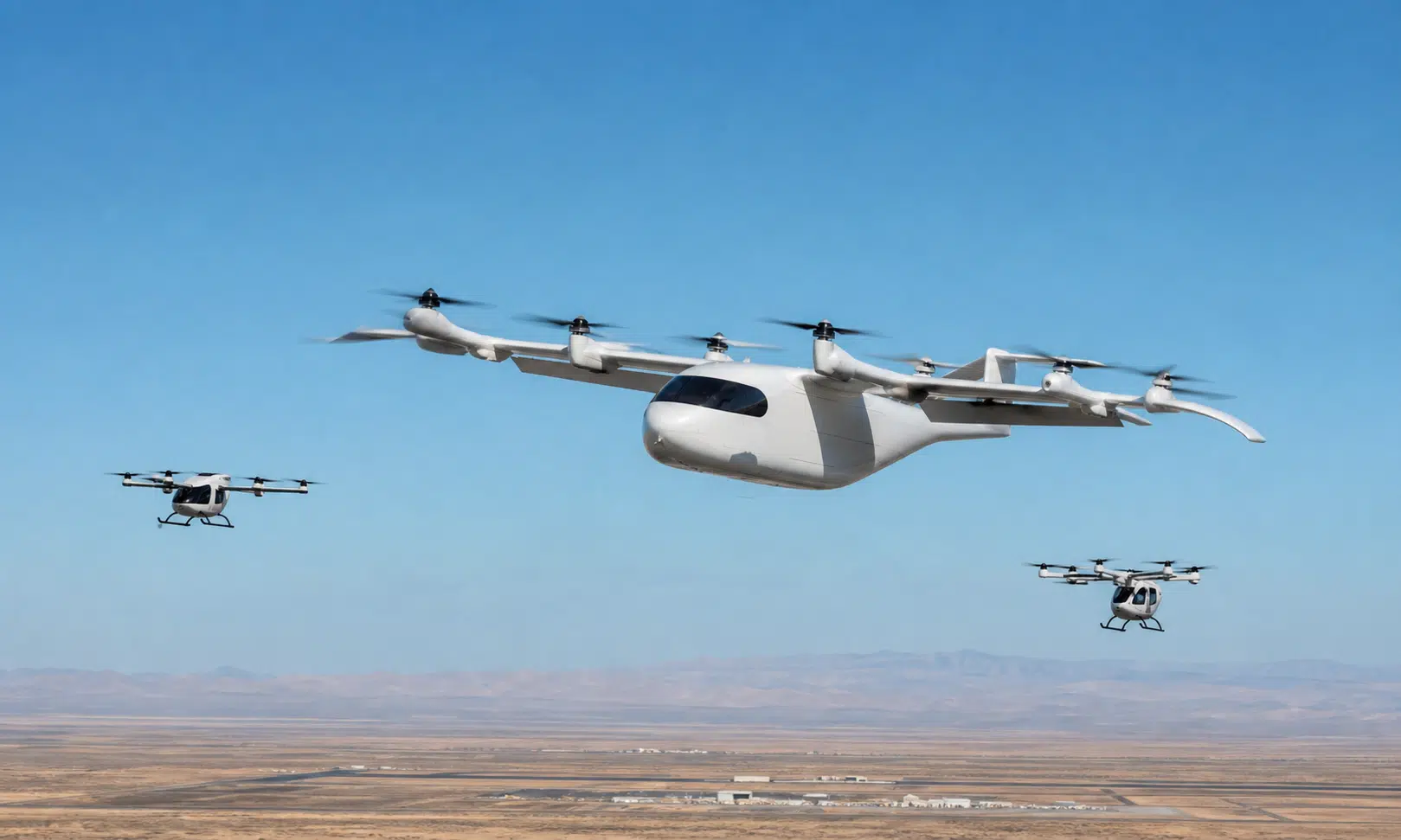

AutoFlight has completed a mixed three-aircraft formation flight using its V5000 Matrix, a large electric vertical-takeoff-and-landing aircraft designed to move the category beyond short urban air taxi routes.
The demonstration paired one V5000 Matrix with two aircraft from AutoFlight’s smaller V2000 series. According to the company, the flight tested cross-platform communication links, route planning, flight coordination, and safety control across different VTOL platforms operating together.
That matters because eVTOL development is no longer only about proving that one aircraft can take off vertically, transition to wingborne cruise, and land safely. For larger aircraft to operate commercially, they will also need to fit into coordinated airspace systems with other vehicles, ground control, and future vertiport infrastructure.
A much larger eVTOL than the usual air taxi
Most eVTOL aircraft discussed in the urban air mobility market are compact designs built around a small number of passengers and short city-to-city or airport-transfer hops. The V5000 Matrix is aimed at a different scale.
AutoFlight lists the aircraft with a 20-meter wingspan, a 17.1-meter length, a height of nearly 3.3 meters, and a maximum takeoff weight of 5,700 kg. That makes it unusually large among publicly discussed crewed eVTOL projects, both in footprint and weight class.
Its size is important because the economics and mission profile change as payload increases. A four-seat air taxi is mainly a premium mobility product. A 5.7-ton platform could support regional passenger service, cargo movement, emergency response, and routes where runways are limited or unavailable.
What the formation test proved
The formation flight was not presented as a range record or a speed run. Its point was systems integration.
Flying one large aircraft alongside two smaller platforms gives engineers a way to test whether different aircraft can exchange data, follow coordinated routes, and maintain safe behavior as a group. Those capabilities are central to any future low-altitude aviation network where multiple aircraft may be operating near each other from shared takeoff and landing sites.
The test also gives AutoFlight a public milestone for the V5000 program after earlier work on transition flight. In February, the passenger version completed a flight sequence at the Kunshan civil drone test base that included vertical takeoff, fixed-wing cruise, and vertical landing. Transition remains one of the defining technical challenges for lift-and-cruise aircraft because the vehicle must move cleanly between rotor-supported and wing-supported flight.
Passenger and cargo versions target different jobs
The Matrix platform is being developed around passenger and cargo configurations rather than a single cabin layout.
The passenger version is described as an all-electric aircraft with seating for up to 10 people in a business-class arrangement, or six in a VIP layout. AutoFlight has also described cabin features such as climate control, lavatories, ambient lighting, and large windows. Its stated electric range is 250 km.
The cargo version, known as V5000CGH, uses a hybrid-electric system intended to extend range for regional logistics. AutoFlight says that version has a 14-cubic-meter cargo hold sized for two AKE aviation containers, a payload of up to 1,500 kg, a cruising speed of 280 km/h, and a maximum range of 1,500 km. The company has also said the V5000CGH has entered the airworthiness certification process.
| Version | Role | Key figures stated by AutoFlight |
|---|---|---|
| V5000 Matrix passenger | Regional passenger transport | Up to 10 seats; 250 km electric range |
| V5000CGH cargo | Regional logistics | Up to 1,500 kg payload; 14 m³ hold; up to 1,500 km hybrid range |
Lift-and-cruise design with heavy redundancy
The V5000 uses AutoFlight’s lift-and-cruise configuration, a design approach the company has also used on earlier aircraft. Separate lift rotors handle vertical takeoff and landing, while fixed wings provide lift in forward flight.
For the Matrix, AutoFlight says six rotor rows provide vertical thrust and 20 lift motors operate in parallel. The company says the aircraft is designed to remain safe even if two of those lift motors fail at the same time.
That redundancy is not a small detail. Larger eVTOL aircraft carry more people, more cargo, and more energy onboard. As the payload increases, the certification burden and public tolerance for failure shrink. A 10-passenger aircraft or a 1.5-ton cargo aircraft will have to prove more than basic flight capability before it can enter regular service.
Why this milestone matters
The formation flight does not mean the V5000 Matrix is ready for commercial operation. Certification, production maturity, operating rules, charging or fueling infrastructure, and airspace integration all remain major hurdles.
Still, the test points to where the market is heading. The first wave of eVTOL attention centered on small air taxis. AutoFlight is using the V5000 program to argue for a larger role: regional passenger routes, cargo corridors, and operations from purpose-built VTOL infrastructure, including floating or waterfront landing platforms the company has previously shown.
If aircraft in this weight class can meet safety and certification requirements, eVTOLs may become more than short-hop city shuttles. The V5000 Matrix is still in development, but this mixed-fleet flight shows AutoFlight is already thinking about how larger electric aircraft will operate alongside other vehicles, not just how they fly alone.