

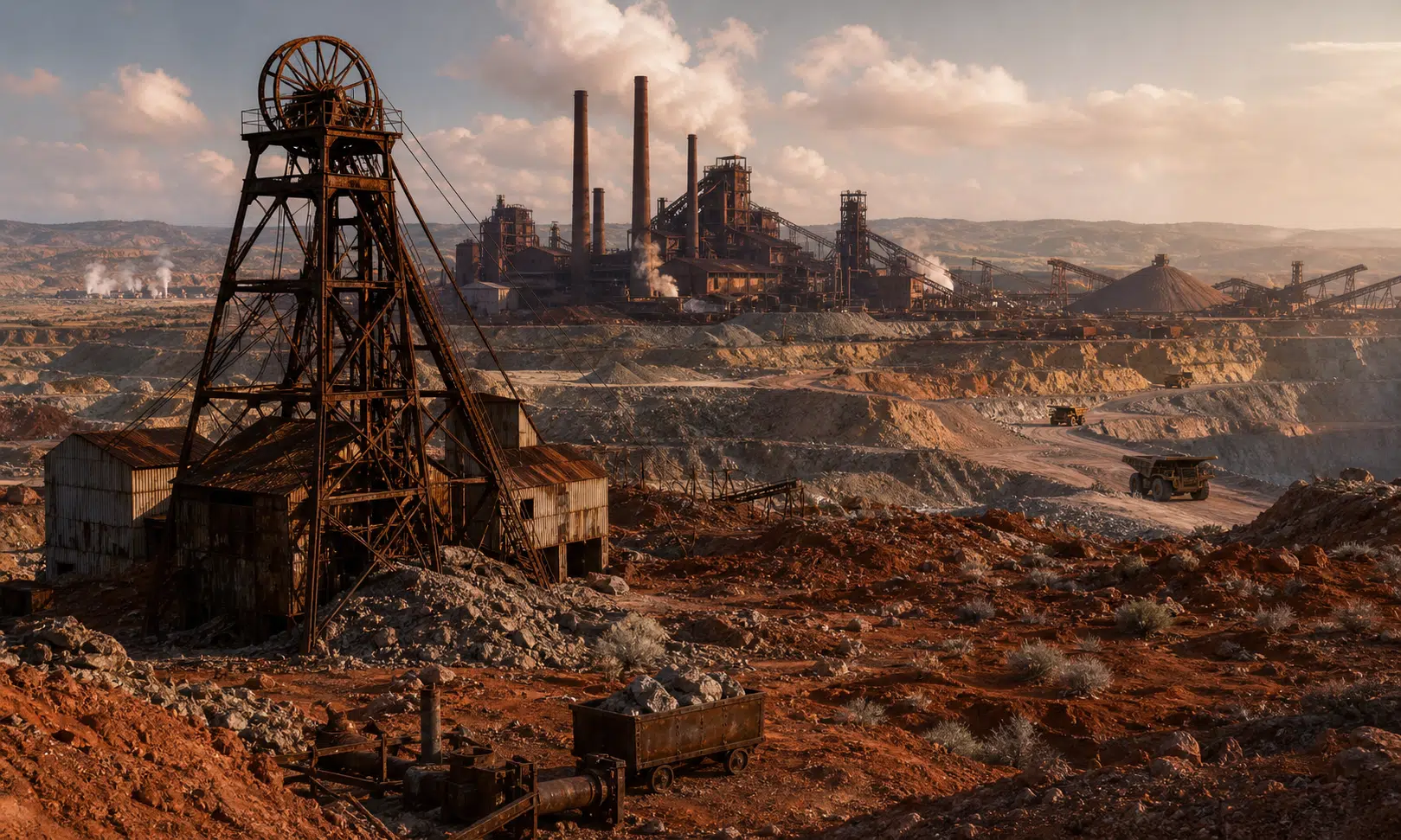

From Broken Hill to BHP
BHP’s story starts in 1885, with the Broken Hill Proprietary Company Limited and a major silver, lead, and zinc deposit in New South Wales. The company that would later become BHP did not begin as a diversified resources group. It began with one place, one discovery, and the difficult work of turning ore in the ground into a business that could survive.
The early operation helped establish Broken Hill as one of Australia’s most important mining centres. It also gave BHP a pattern that would repeat across its history: build around a major resource, then change before the old model becomes too narrow.
That matters because BHP’s rise was not a straight climb. Mining is exposed to accidents, commodity cycles, capital pressure, labour risk, and changing industrial demand. A company that depends too heavily on one asset or one market can look strong right up until conditions move against it.
The Steel Bet
One of BHP’s most important shifts came when it moved into steel. The Newcastle Steelworks opened in 1915, giving the company a larger role in Australian industry and a business line beyond its original mining base.
It is easy to make diversification sound obvious in hindsight. At the time, it required capital, confidence, and a willingness to operate in a different part of the value chain. Steel gave BHP exposure to domestic industrial demand and helped turn the company into more than a mining house.
That move also shows a practical lesson for operators and investors: diversification is most useful before it is urgent. Waiting until a core business is already under pressure usually means making expensive decisions from a weak position. BHP’s steel expansion came early enough to shape the company’s identity for decades.

Capital Returns: Investing Through the Capital Cycle
For readers interested in why mining, steel, and resource businesses move through boom-and-bust investment cycles, this book is a useful companion. It focuses on how capital flows can shape long-term industry returns.
As an Amazon Associate I earn from qualifying purchases.
From Australian Industrial Company to Global Miner
Over the twentieth century, BHP continued to change with the market. Steel remained important for many years, but the company also built positions in petroleum, iron ore, coal, copper, and other resources. By the late twentieth century, BHP had become one of Australia’s most significant companies.
The next major reshaping came in 2001, when BHP merged with Billiton, a UK-listed resources company with roots in mining and metals. The combined company became BHP Billiton, with a broader international portfolio and greater exposure to global commodity markets.
Scale brought advantages, but it also brought complexity. Large mining groups often collect assets across different commodities, geographies, and return profiles. Some strengthen the core business. Others absorb management attention without moving the company’s best opportunities forward.
BHP’s 2015 spin-off of South32 was a clear example of portfolio discipline. The company separated a group of non-core assets into a new business, allowing BHP to concentrate on larger, higher-priority operations. For buyers, investors, and business owners studying the company, that decision is a reminder that focus can be more valuable than simply owning more things.
What Business Buyers Can Learn
BHP is now known simply as BHP, after simplifying its name from BHP Billiton. The rebrand reflected a broader effort to streamline the company and make its identity easier to understand.
The company’s recent reporting also shows the scale of the business. In FY2023, BHP reported US$54.2 billion in total direct economic contribution and US$13.8 billion in tax, royalty, and other payments to governments. In Australia, it described itself as one of the country’s largest corporate taxpayers, not merely a mining operator with a large balance sheet.
The useful lessons are not abstract. They are operational:
- Diversify before the market forces your hand.
- Keep the company’s story understandable as the business grows.
- Put commercial functions close to customers, capital, and decision-making flows.
- Be willing to separate good assets if they distract from better ones.
BHP’s history is not just a rags-to-riches story. It is a long record of changing shape when the market, the asset base, or the company’s own complexity demanded it. That is the real buyer-aware takeaway: durable businesses are rarely static. They survive because leadership keeps asking what should stay, what should grow, and what should be let go.
The Outsiders: Eight Unconventional CEOs
This fits readers who want to connect BHP’s portfolio decisions with broader leadership patterns around focus, reinvestment, and disciplined asset ownership.
As an Amazon Associate I earn from qualifying purchases.