

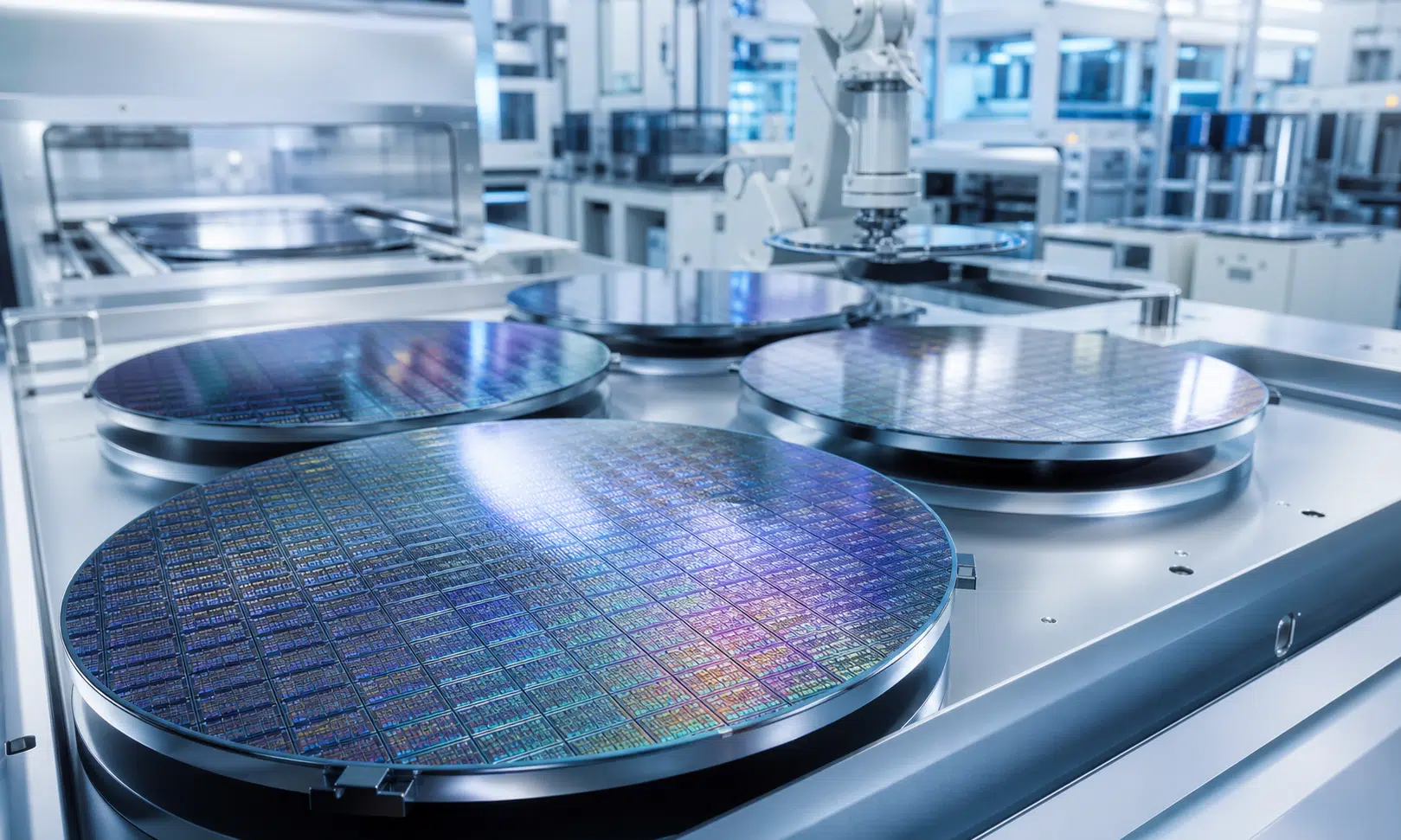

China’s semiconductor self-sufficiency campaign is moving deeper into the supply chain, with silicon wafers now becoming a priority target.
A new report says Beijing wants more than 70% of the silicon wafers used by Chinese chipmakers this year to come from domestic suppliers. The target is not described as a formal public rule, but sources cited in the report say it is being treated inside the industry as a clear expectation: when Chinese fabs can use locally made 12-inch wafers, they are being pushed to do so.
That matters because wafers are not a small supporting detail in chip production. They are the base material on which logic chips, memory chips, power semiconductors, and many other devices are built. China has spent years trying to localize chip design, manufacturing equipment, packaging, and AI accelerators. A stronger domestic wafer base would give that effort another layer of insulation from export controls and geopolitical supply risk.
Why 12-inch wafers are the strategic target
China is already much closer to self-reliance in 8-inch wafers, which are commonly used for older manufacturing processes, power electronics, and a wide range of mature chips. Those markets still matter, especially for automotive, industrial, consumer electronics, and infrastructure applications. They do not, however, represent the most difficult part of the wafer supply chain.
The harder prize is the 12-inch, or 300 mm, wafer market. These larger wafers are essential for modern semiconductor manufacturing because they support higher-volume production and are used across advanced logic and memory manufacturing. For fabs trying to make chips in more demanding process classes, wafer quality, uniformity, defect control, and consistency become much harder to get right.
The report frames China’s 70% goal as most achievable in mature and legacy chip production, where local wafer suppliers are said to be increasingly capable of meeting domestic requirements. The more advanced portion of the market appears less settled. Chinese chipmakers pursuing more advanced production still rely on established foreign suppliers in some cases, especially where wafer quality requirements are tighter.
That distinction is important for buyers and supply-chain planners. A higher domestic sourcing target does not mean every category of Chinese chip production can immediately switch away from foreign wafers without trade-offs. It points instead to a split market: domestic suppliers gaining ground quickly in mature and mainstream applications, while foreign wafer leaders may remain relevant for the most demanding production lines.
Eswin is emerging as a key supplier
Xi’an Eswin Material Technology is described as one of the most aggressive companies in China’s 12-inch wafer buildout. The company is reportedly targeting monthly capacity of 1.2 million 12-inch wafers by 2026. If reached, that would be enough to cover a large share of domestic demand and would make Eswin a much more visible player in the global wafer market.
The expansion is not limited to one factory. Eswin is said to be adding hundreds of thousands of wafers per month through facilities in Xi’an and Wuhan. Other Chinese wafer producers, including National Silicon Industry Group, Zhonghuan Advanced, and Hangzhou Lion Microelectronics, are also part of the broader capacity push.
For China, this is not only about replacing imports. It is also about giving new fabs a domestic supplier base from the start. The report says Eswin already supplies major Chinese chipmakers, including SMIC, and is increasingly positioned as a default supplier for new domestic fabs. It also says some international chipmakers are evaluating or validating Eswin wafers, though that does not necessarily mean broad adoption is already complete.
If Eswin can scale while maintaining the quality levels required by large fabs, it could become one of the most important companies in China’s materials supply chain. Capacity alone is not enough in wafers. Customers need predictable defect rates, stable specifications, and reliable delivery over long production runs. That is why validation by large chipmakers can take time, particularly for more advanced processes.
Foreign suppliers still control much of the top end
The push also highlights how concentrated the global wafer market remains. Japan’s Shin-Etsu Chemical and SUMCO are among the most important suppliers of semiconductor silicon wafers worldwide. Their long track records, technical depth, and customer relationships give them strong positions in advanced production.
China’s challenge is therefore different from simply adding new factory capacity. Domestic wafer producers must prove they can supply high-volume fabs consistently, across multiple product grades, without creating yield problems downstream. A wafer defect or inconsistency can become expensive once it moves through a production line, particularly in advanced manufacturing.
That is why foreign suppliers may keep meaningful business in the Chinese market even if the 70% domestic target is approached or reached. The report suggests the remaining share open to overseas suppliers will be concentrated in the higher-end segment, where some Chinese chipmakers still need support from established wafer makers.
For foreign wafer companies, the practical risk is clear: the addressable Chinese market could shrink in mature and mainstream chip production, even if advanced applications continue to require their materials. For Chinese fabs, the trade-off will be between policy pressure, supply security, cost, and manufacturing yield.
AI demand and export controls are accelerating the shift
The timing is not accidental. AI demand has made advanced chips more strategically important, while U.S. export restrictions have increased pressure on China to reduce dependence on foreign technology. Those restrictions have primarily focused on advanced AI accelerators and chipmaking tools, but the effect reaches further into the supply chain.
If access to high-end chips is constrained, China has stronger incentives to expand local alternatives. If access to advanced manufacturing tools is constrained, domestic fabs need to make the most of the supply chains they can control. And if materials such as wafers remain dependent on foreign suppliers, then even local chip production can carry outside risk.
The report says Chinese foundries and Huawei-linked firms are increasing production of chips in the roughly 7 nm to 5 nm class to meet AI demand. That work remains difficult under export controls, and some production is still said to depend on foreign wafers. The broader direction, however, is consistent: wherever China can substitute domestic suppliers without unacceptable yield or performance penalties, it is trying to do so.
Bernstein Research estimates cited in the report suggest China met about half of its 12-inch wafer demand by 2025. The same estimates put Chinese companies’ global wafer capacity share at about 28% in 2025, up sharply from 3% in 2020, with a possible rise to 32% by 2026.
Those figures show why the 70% domestic sourcing target is being treated differently from some earlier self-sufficiency goals. It is ambitious, but not detached from the capacity already being built.
What this means for chip buyers and suppliers
For companies buying chips from China, the wafer shift is not just a policy story. It can affect supply resilience, component qualification, and long-term sourcing strategy.
In mature chips, more domestic wafer supply could reduce China’s exposure to foreign disruption and may support steadier local production. That could matter for buyers of power components, industrial chips, display drivers, microcontrollers, and other parts where leading-edge process technology is not the main concern.
In advanced chips, the picture is more complicated. If Chinese fabs are still qualifying domestic wafers for demanding processes, buyers should expect a more gradual transition. The presence of a domestic wafer supplier does not automatically mean the entire production flow is insulated from foreign constraints.
For equipment makers, materials suppliers, and chip customers, the main takeaway is that China’s localization effort is becoming more granular. The focus is no longer only on headline items such as GPUs, lithography systems, or foundry nodes. It now reaches the base materials that determine whether a fab can run at scale.
That makes the 12-inch wafer market a useful signal to watch. If Chinese suppliers can scale capacity, pass customer validation, and hold quality across large production volumes, the global semiconductor materials map will start to look different. If they struggle at the high end, foreign suppliers will remain difficult to replace in the most demanding parts of the market.
For now, the reported 70% target shows the direction of travel. China wants fewer weak points in its chip supply chain, and wafers are too central to leave outside that strategy.