

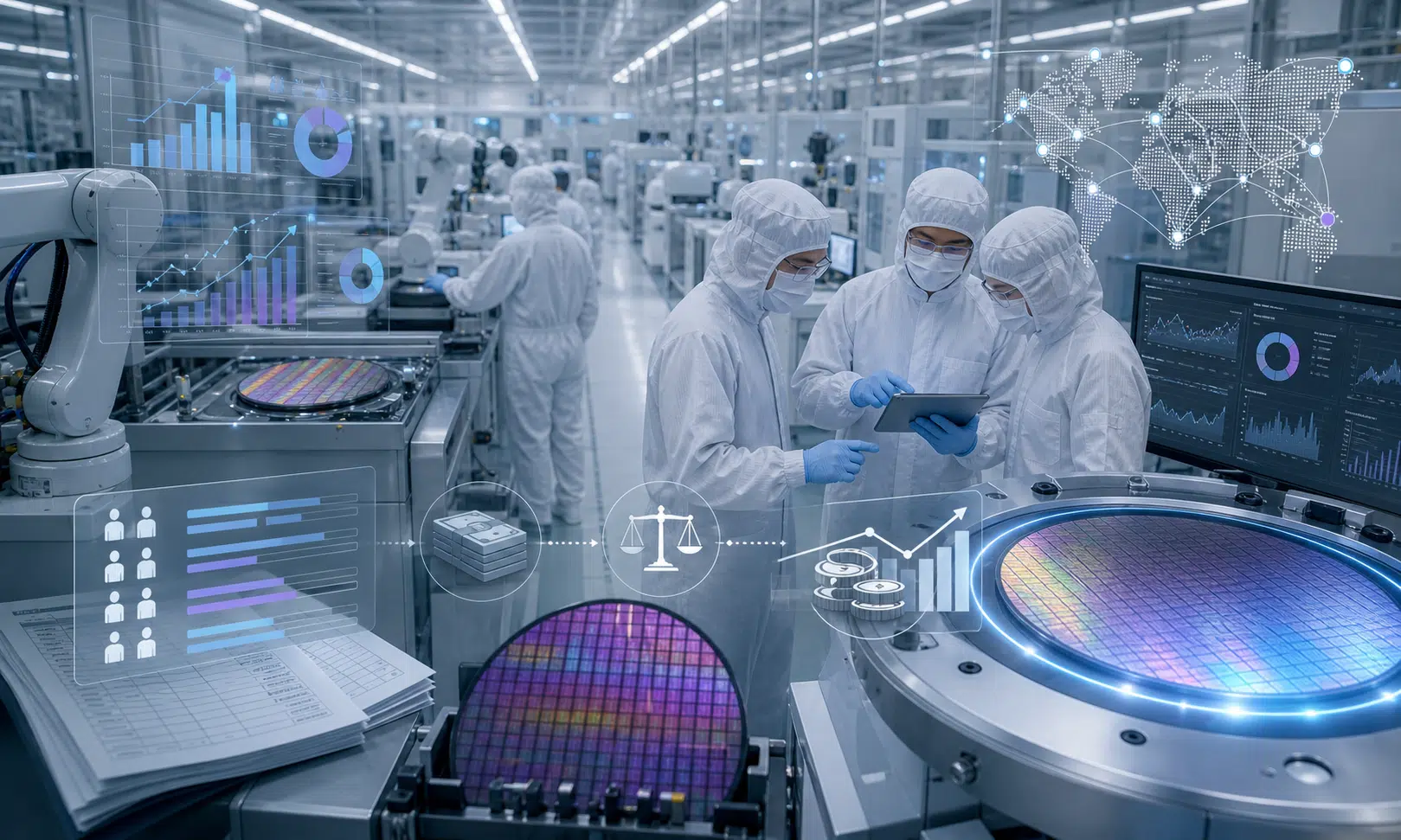

TSMC employees are reportedly discussing unionization and possible strike action after rumors spread that the company may reduce performance-related bonus payouts by about 15%. The anger is not coming during a weak year. TSMC just reported first-quarter 2026 net income of roughly NT$572.5 billion, up about 58% year over year, as demand for AI processors keeps pushing the foundry business to record levels.
The dispute matters beyond Taiwan’s tech labor market because TSMC is the manufacturing backbone for much of the advanced chip industry. Apple, Nvidia, AMD, and many other chip designers rely on TSMC capacity, especially at leading-edge nodes. Even talk of labor action at that level is enough to make hardware buyers and supply-chain planners pay attention.
Why the bonus dispute is escalating
The reported issue centers on whether TSMC will effectively trim employee bonus payouts even as profits rise. Workers have pointed to the company’s history of returning a meaningful share of earnings to employees through bonuses and profit sharing. Reports from Taiwan have said the 2025 employee bonus pool was about NT$206.1 billion, with a portion scheduled for distribution in July 2026.
TSMC has pushed back on the idea that employee rewards are shrinking. The company has said it expects employee profit-sharing bonuses to grow faster in 2026 than in 2025, while also acknowledging its broader responsibilities in Taiwan. That leaves the argument in a gray zone: employees appear focused on whether individual or departmental payouts will fall short of expectations, while the company is speaking in terms of broader bonus growth.
The tension is sharpened by TSMC’s capital spending. The company has guided for roughly $52 billion to $56 billion in 2026 capex as it expands advanced manufacturing, packaging, and overseas production. Its buildout includes major investments in Taiwan, the U.S., Japan, and Germany, with the U.S. program alone framed as a long-term strategic commitment.
How TSMC compares with Samsung and SK hynix
The timing is awkward for TSMC because South Korean chip workers have recently won or pursued more formal profit-linked bonus structures. That gives TSMC employees an obvious comparison point, even though the companies have different business models, labor systems, and capital needs.
| Company | Reported employee bonus issue | Why it matters |
|---|---|---|
| TSMC | Employees are reportedly reacting to rumors of an effective bonus reduction of around 15%, while TSMC says profit-sharing bonuses should grow faster in 2026 than in 2025. | TSMC is the leading advanced foundry, so labor unrest could become a supply-chain concern if it moves beyond online discussion. |
| Samsung Electronics | Reports say Samsung reached tentative terms with its union that would allocate 10.5% of semiconductor operating profit as stock-based bonuses plus 1.5% in cash over a 10-year structure, but those details should be treated as reported terms rather than independently confirmed final outcomes. | The Samsung case gives workers at other chipmakers a visible template for demanding profit-linked compensation. |
| SK hynix | Reports have described a similar structure setting aside 10% of operating profit for employee bonuses, though the exact terms should be treated cautiously unless confirmed in company filings or union documents. | SK hynix has become a reference point for semiconductor employees who want bonuses tied more directly to operating results. |
The comparison is especially sensitive because TSMC has not operated with a labor union since its founding in 1987. Employee frustration has reportedly surfaced on Taiwanese workplace forums and social media pages, with some workers asking whether organizing a union would be legally possible.

Lenovo Legion 5i RTX 4070 Laptop
A laptop with an NVIDIA RTX GPU can be useful for local model testing, development, and GPU-accelerated creative or engineering workloads before committing to larger server purchases.
As an Amazon Associate I earn from qualifying purchases.
What hardware buyers should watch
For buyers, the near-term takeaway is not that TSMC production is suddenly at risk. The current reports describe employee frustration, online discussion, and calls for collective action, not a confirmed shutdown. Still, the dispute adds another labor variable to an already stretched AI hardware market.
Companies planning AI workstation, server, GPU, or accelerator purchases should watch three practical signals: whether TSMC management gives more detail on July bonus payouts, whether employee organizing moves from online complaints to formal action, and whether customers or suppliers begin flagging labor risk in delivery timelines.
The bigger tradeoff is straightforward. TSMC is spending heavily to keep its manufacturing lead and support global demand for AI chips. Employees are asking why that investment should come at the expense of compensation expectations during a record profit cycle. Those two pressures can coexist for a while, but they become harder to balance when rival chipmakers are tying worker payouts more visibly to operating profit.
The bottom line
TSMC’s bonus dispute is best read as an early warning sign, not a supply-chain crisis. The company remains highly profitable, its capex plan is central to future AI capacity, and its official position is that profit-sharing bonuses are still growing. But the Samsung and SK hynix comparisons have changed the labor conversation across advanced chipmaking.
For buyers and investors, the key question is whether TSMC can keep expanding at record speed while preserving the employee trust that makes that expansion possible. In a market where one foundry sits at the center of so many AI hardware roadmaps, compensation policy is no longer just an internal HR issue.
NVIDIA RTX 6000 Ada Workstation GPU
A professional RTX workstation GPU is relevant for teams that need high-VRAM local compute for AI development, rendering, simulation, or engineering workloads.
As an Amazon Associate I earn from qualifying purchases.