


A water dispute in Fayette County, Georgia, has become a useful warning for communities weighing large data center projects before their utility systems are ready to monitor them.
According to local reporting cited in the original account, a Quality Technology Services facility used nearly 30 million gallons of water that was not initially billed to the company. The county later treated the issue as a billing and monitoring failure rather than as a deliberate improper draw, and QTS has said its water use followed applicable rules.
The number is striking, but the larger issue is more practical than dramatic: local governments are being asked to approve industrial-scale facilities while some water systems still depend on aging meters, thin staffing, and billing processes that can miss unusual consumption for months.
That is a problem for residents, utilities, and the data center companies themselves. When a large customer becomes hard to monitor, even an administrative error can quickly turn into a public trust crisis.
What Happened In Fayette County
The Fayette County case centers on two industrial water connections at the QTS data center site. Local utility officials found that one connection had reportedly been installed without the utility’s knowledge, while another was not properly tied to the company’s billing account.
QTS later paid roughly $150,000 after the issue was identified, according to the reporting cited in the source article. Because that amount and the county’s handling of the matter have not been independently confirmed here, the safest reading is that the company was retroactively billed for water the county says had not been properly captured in its system.
County officials did not impose a fine, and that decision became one of the sharpest points of public frustration. The county appears to have blamed its own process at least in part, including the transition from older water meters to a newer cloud-based metering system.
The timing also mattered. Residents in the area had been receiving drought-related notices asking them to reduce water use. Some residents also reported water-pressure problems, though county officials and QTS disputed any connection between those complaints and the data center’s water use. The county has said the residents who raised pressure concerns relied on wells, while QTS was not drawing from groundwater.
That distinction may be technically important, but it does not erase the political problem. When households are asked to conserve water while a major industrial user appears to have gone unbilled, residents are likely to ask whether the rules are being applied evenly.
Why Metering Failure Matters
The Fayette County dispute is not just about one company’s bill. It shows how quickly infrastructure oversight can fall behind the scale of new development.
Data centers can require heavy water use during construction, and some facilities also use water for cooling once operating. QTS has said the Georgia facility’s long-term water needs should be much lower after construction, and the company has pointed to a closed-loop cooling approach for operations. A firm public timeline for that reduction has not been independently confirmed here, so it should be treated as the company’s position rather than a settled outcome.
For counties and cities, the lesson is straightforward: a large data center should not be approved on paper without matching upgrades to metering, billing, inspection, and public reporting. A promised peak-use limit is only useful if the utility can actually measure peak use in near real time.
That means local governments need to ask operational questions before construction begins:
- Are all temporary and permanent water connections mapped, permitted, and tied to a billing account?
- Can the utility detect sudden consumption spikes quickly?
- Who reviews large-customer water use during drought restrictions?
- What penalties apply if approved limits are exceeded?
- How will residents see whether large users are following the same conservation rules as households?
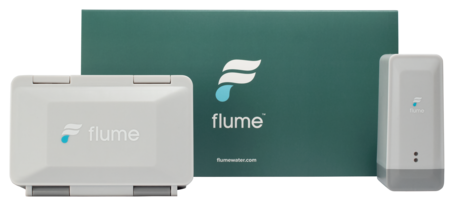
Flume Smart Water Monitor
A smart water monitor can help property owners or facility managers spot abnormal use before it turns into a billing surprise or damage issue. It is a practical consumer-scale example of the monitoring gap discussed in the article.
As an Amazon Associate I earn from qualifying purchases.
For buyers and public agencies looking at utility technology, the Georgia case also makes the business case for smarter metering easier to understand. Smart meters and leak-detection systems are often sold as efficiency tools, but their value also comes from accountability. They make unusual use harder to miss and easier to explain.
The AI Buildout Has A Water Problem Beyond Data Centers
The water question around AI infrastructure is broader than the water used directly inside data centers. Chip factories, power plants, and cooling systems all place demand on water supplies in different ways.
Industry researchers and water technology companies have warned that AI-related water demand could rise sharply over the coming decades, though precise long-term forecasts should be treated cautiously unless independently verified. The same caution applies to claims about the share of data centers or chip fabs located in water-stressed regions: the concern is credible, but specific figures vary by methodology and source.
Even when a data center uses little water directly for cooling, the electricity needed to run servers can still have a water footprint. Power generation often requires water, especially where thermal power plants are part of the grid mix. That is why communities increasingly want a full accounting of both direct and indirect water impacts before approving major projects.
The tradeoff is especially visible in drought-prone regions. A facility that reduces onsite cooling water may increase electricity demand. If the local grid depends on water-intensive generation, the burden does not disappear; it shifts.
Communities Are Asking For More Than Promises
Public resistance to data center projects has grown in several states, especially where residents believe deals are moving faster than public review. Water is now part of the same conversation as electricity rates, noise, land use, tax incentives, and air quality.
The concern is not simply that data centers use water. Many industrial users do. The concern is that hyperscale facilities can arrive with enormous utility needs, long construction timelines, and negotiated terms that residents may not see until late in the process.
That is why some advocacy groups have pushed for environmental reviews before permitting large data centers. Their argument is that water supply, wastewater, chemicals used in cooling systems, grid demand, and drought resilience should be evaluated together rather than handled as separate technical details.
In Utah, residents recently opposed a proposed water transfer connected to a hyperscale data center project, and the applicant withdrew that request. That does not settle the broader debate, but it shows how water rights can become a decisive local issue.
For developers, the message should be clear: communities are not only evaluating whether a facility can be built. They are evaluating whether the process is credible.
What Local Officials Should Require Before Approval
The practical fix is not to stop every project by default. It is to make sure public infrastructure is ready before a large facility begins drawing resources at industrial scale.
A serious approval process should include at least five requirements:
- A complete inventory of all water hookups, including construction-phase connections and temporary lines.
- Real-time or near-real-time monitoring for large users, with alerts for abnormal consumption.
- Clear billing responsibility before water service begins, not after a discrepancy is found.
- Publicly defined drought rules for industrial customers, including consequences for exceeding limits.
- Separate review of direct facility water use and indirect water demand from electricity consumption.
These requirements are not hostile to data center development. They are basic risk management. Large customers should want them too, because unclear utility oversight can turn an ordinary construction or billing issue into a reputational fight.

DAE Pulse-Output Water Meter
A pulse-output water meter can support submetering for facilities, construction connections, or separate water-use zones when paired with compatible reading hardware. It fits the article’s point that oversight depends on measurable connections, not promises.
As an Amazon Associate I earn from qualifying purchases.
The Fayette County case also shows why understaffed utilities need tools and budgets, not just policy language. A single inspector or outdated metering process is a weak match for infrastructure projects that can consume water at a scale more typical of industrial plants than office parks.
Smart Water Systems May Help, But They Are Not A Shortcut
Some technology companies and water vendors argue that AI-assisted leak detection, sensor networks, and smart meters can help utilities find leaks, theft, and abnormal usage faster. That may be true in many cases, and it is one reason utilities are interested in modern monitoring systems.
But those tools do not replace governance. A smart meter can flag an anomaly; it cannot decide whether a county should fine its largest customer, pause construction, notify residents, or change drought rules.
Water utilities have also been cautious about adopting AI-heavy systems because water infrastructure is critical infrastructure. Cybersecurity, reliability, vendor lock-in, and staffing all matter. A cash-strapped utility that cannot inspect meters consistently may also struggle to procure, secure, and maintain a complex digital monitoring platform.
The best near-term approach is likely a practical one: improve metering and alerts, document every large connection, set clear enforcement rules, and publish enough information that residents can see whether conservation burdens are being shared fairly.
The Real Risk Is Losing Public Trust
The Georgia dispute may ultimately be remembered less for the water bill than for the way it exposed a trust gap.
QTS says it did not use water improperly and paid once the billing issue was identified. County officials appear to have treated the matter as a procedural problem. Residents, meanwhile, saw drought restrictions, a powerful corporate customer, and a large volume of unbilled water in the same story.
Those facts create a difficult perception problem even if no rule was intentionally broken.
For communities reviewing new AI infrastructure, the takeaway is direct: water planning cannot be a side document. It needs to be part of the public approval process from the start, with measurable limits, visible monitoring, and consequences that apply to large users as clearly as they apply to households.
Data centers are becoming core economic infrastructure. Water systems are already core civic infrastructure. When the two collide, local governments need more than optimism and after-the-fact billing corrections. They need monitoring that works before the first major draw begins.