

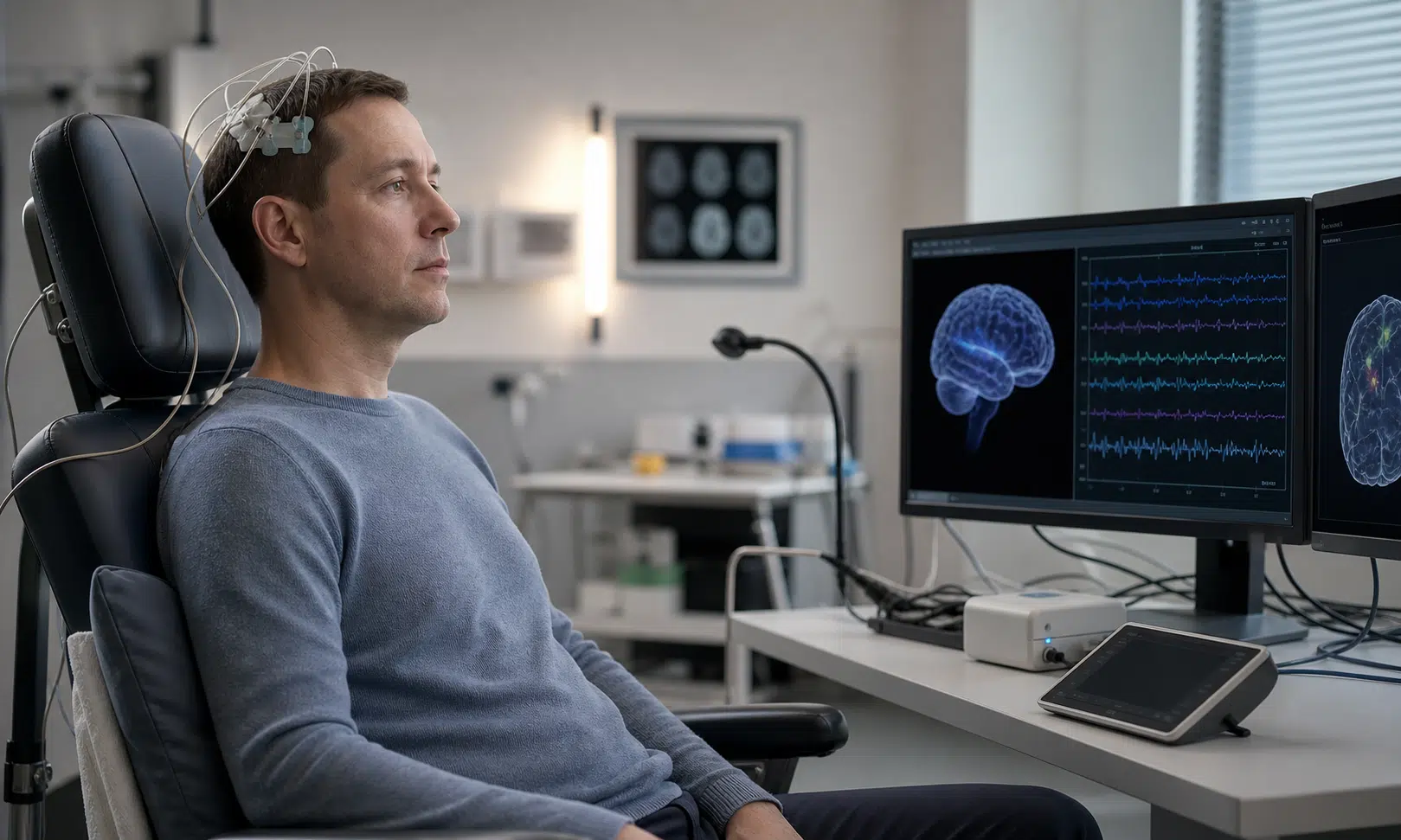

Brandon Patterson has not been able to move his fingers for years. After a 2017 Jeep rollover left him with a severe spinal cord injury, the connection between his brain and much of his body was cut off.
Recently, though, Patterson felt something unexpected: the sensation that his fingers were moving.
His hand had not physically moved. The signal came through a brain-computer interface, or BCI, implanted as part of a clinical research effort at UCHealth and the University of Colorado Anschutz Medical Campus. Patterson, 41, is participating in a study that places the implant in higher-level areas of the brain involved in intention, planning, decision-making, and sensory-motor control.
That location matters. Many BCI systems focus on the primary motor cortex, the brain region most directly tied to muscle movement. The Colorado team is testing whether recording from higher-level cortical regions can capture a broader picture of what a person wants to do, not only which muscle command would normally follow.
For people with paralysis, that difference could be important. A system that understands intent more naturally may eventually make it easier to control a cursor, a robotic limb, or other assistive technology with less effort and more useful feedback.
Why this BCI surgery is different
The procedure has been described by the research team and local reporting as a world-first effort to implant a BCI in higher-functioning brain areas for a paralyzed patient. The work is still early, and it is research rather than an available treatment, but the placement of the device gives scientists a rare way to study how complex thoughts become usable actions.
The implant records electrical activity from Patterson’s brain. A connected computer system then analyzes those signals and learns how they relate to what he is trying to do. Over time, the goal is for the system to translate intention into commands for external devices.
That could include actions such as moving a computer cursor, selecting items on a screen, or controlling a robotic device. Just as important, the system is also being used to study sensory stimulation, which may help reconnect the brain with touch-like feedback from parts of the body Patterson cannot currently move.
Daniel Kramer, MD, a neurosurgeon at UCHealth and assistant professor of neuroscience at the CU Anschutz School of Medicine, has framed the surgery as both a patient-focused step and a neuroscience study. By looking beyond purely motor regions, the team hopes to learn more about how the human brain plans and carries out everyday behavior.

AbleNet BIGtrack 2 Adaptive Trackball Mouse
A large trackball can make pointer movement easier for users who have limited fine motor control or who find a standard mouse difficult to use. Compatibility and positioning should be checked with an occupational therapist or assistive technology specialist.
As an Amazon Associate I earn from qualifying purchases.
From thought to digital action
Patterson’s implant is not a cure for paralysis. It does not repair the damaged spinal cord pathway that once carried signals between his brain and hands. Instead, it creates a new route: brain signals are recorded, decoded by a computer, and used to control something outside the body.
That process takes training on both sides. The computer must learn which neural patterns correspond to Patterson’s intended actions. Patterson must also learn how to produce reliable brain activity that the system can read.
In practical terms, the work can involve tasks such as imagining movement, attempting to direct a cursor, or mentally rehearsing more complex physical actions. Researchers then use that data to improve decoding systems that may one day support more fluid control of digital tools or assistive devices.
The early sensory result is what makes Patterson’s case especially striking. Shortly after the procedure, he reported feeling as if his fingers were moving. That kind of feedback is often described as phantom sensation because the physical movement is not happening in the paralyzed limb.
For researchers, the moment suggests that stimulation and recording may be able to do more than produce one-way control. A useful BCI for daily life may need to send information back to the brain as well as read commands from it. Touch, pressure, position, and movement cues are all part of how people normally use their hands.
What the implant may help researchers learn
Because the device is expected to remain implanted for years, the study may produce unusually detailed long-term data. Researchers can observe how Patterson’s brain signals change from day to day, how they respond to stimulation, and how they represent higher-level tasks such as planning, rule learning, and decision-making.
That long view is valuable because BCIs are not just hardware problems. They are learning systems built around a living brain that adapts. A decoder that works in a lab session has to become reliable across fatigue, mood changes, attention shifts, and normal daily variation.
The study involves UCHealth, CU Anschutz, Caltech, and the University of Southern California, with the broader aim of improving independence for people with spinal cord injuries, ALS, and other disorders that interrupt movement.
Several research goals sit inside the project:
- Decode high-level intention rather than relying only on direct muscle-related signals.
- Test whether sensory stimulation can create more useful feedback for people who cannot feel or move affected limbs.
- Track how neural signals change over months and years in a long-term implanted system.
- Use the findings to improve future assistive devices for people with paralysis or motor-neuron disease.
The possible applications extend beyond cursor control. If researchers can better understand how higher-level cortical regions coordinate intention, movement, and feedback, future therapies could also inform work on cognitive control, decision-making, and some neurological or psychiatric conditions. Those possibilities remain speculative, but the data could help define what is realistic.

AbleNet Jelly Bean Wired Accessibility Switch
A wired accessibility switch can be used with compatible switch-adapted devices or interfaces for simplified input. It is most useful when matched to the user’s range of motion, activation force, and mounting needs.
As an Amazon Associate I earn from qualifying purchases.
What this means for patients and families
For now, this is not something patients can shop for, schedule, or compare like a commercial medical device. It is an implanted research system used under clinical study conditions, with neurosurgery, monitoring, training, and long-term follow-up.
That distinction matters for anyone following BCI news. The field is moving quickly, with companies and university labs testing different implant designs, decoding approaches, and surgical methods. But most implanted BCIs remain experimental, and the gap between a successful study milestone and a widely available therapy can be large.
For patients and caregivers evaluating neurotechnology claims, the useful questions are practical ones:
- Is the device part of a regulated clinical trial or a commercial product?
- What functions has it demonstrated in people, not only in lab models?
- Does it provide sensory feedback, motor control, or both?
- How invasive is the implant procedure, and how long is the device intended to remain in place?
- What training, equipment, and clinical support are required after surgery?
Patterson’s case is promising because it focuses on independence, not spectacle. The near-term goal is not to make paralysis disappear. It is to help a person regain useful control over digital tools and, potentially, receive meaningful sensory feedback after years without it.
A careful step toward more natural control
The most important part of the study may be its shift in emphasis. Instead of treating the brain as a source of simple movement commands, the researchers are trying to read from areas where intentions are formed and organized.
That could make future BCI systems feel less like operating a machine and more like acting through an extension of the body. The technology is not there yet, and Patterson’s progress will depend on training, decoding improvements, and the limits of the implanted system. Still, the early result gives researchers a new way to study how thought, movement, and sensation can be reconnected when the spinal cord can no longer carry the message.
For Patterson, the sensation of finger movement was not the return of normal hand function. But after nearly a decade of paralysis, even a signal that the brain can feel a hand again is a meaningful place to start.
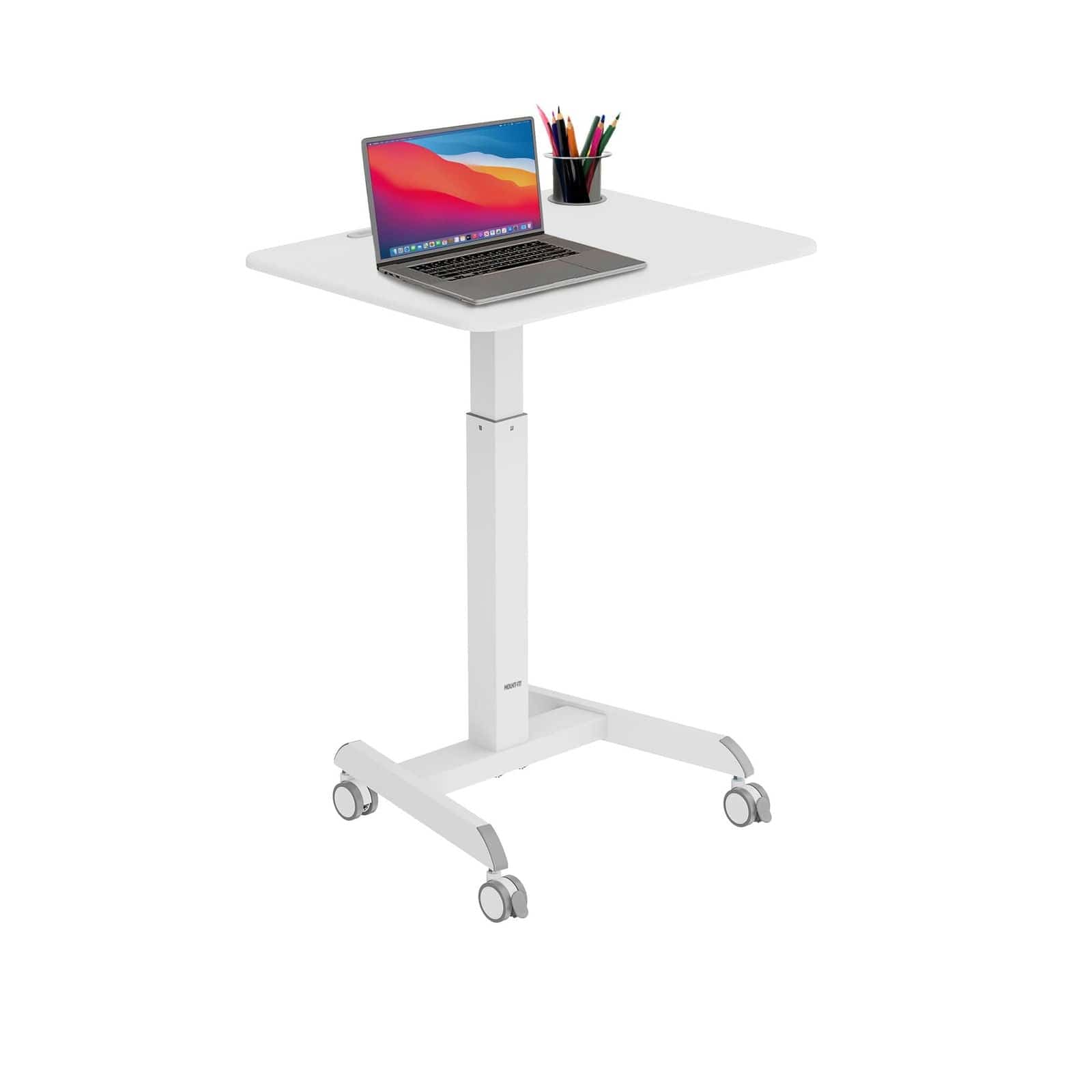
Mount-It! Height-Adjustable Mobile Laptop Cart
A height-adjustable rolling laptop cart can help position a computer, keyboard, trackball, or communication device within reach. Check base clearance, lockable wheels, and tabletop size against the user’s chair and room layout.
As an Amazon Associate I earn from qualifying purchases.