

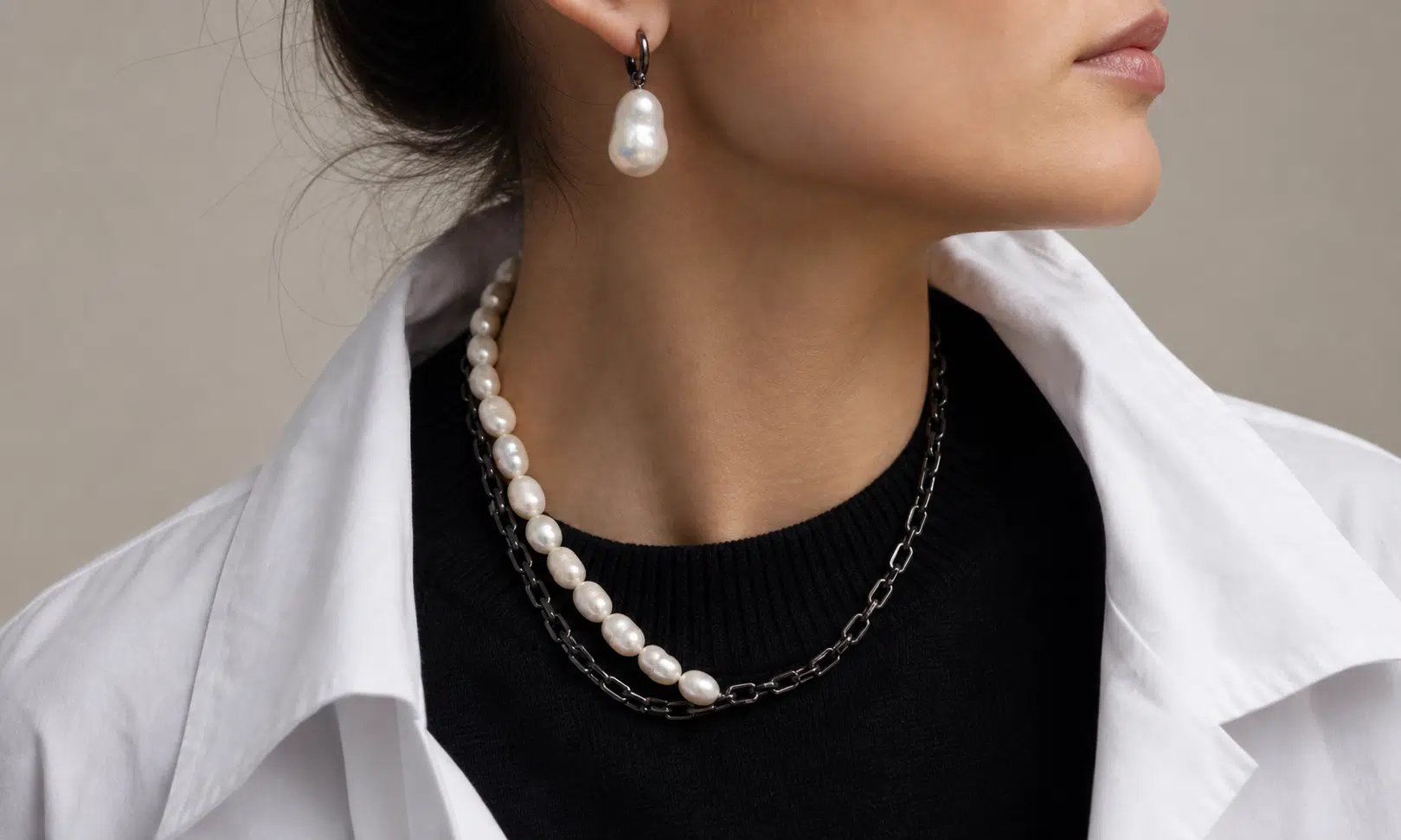

Pearls have always carried a double meaning. They can look pristine and ceremonial, but they can also look strange, organic and slightly rebellious when a designer lets their irregularity lead the piece.
That tension is what makes them useful now. The most interesting pearl jewellery is not limited to the neat single strand. It appears in sculptural rings, asymmetrical earrings, black pearl necklaces, garden-like collars, heirloom pieces reset with new hardware and simple freshwater designs made for daily wear.
The practical question is not whether pearls are back. It is how to wear them without letting the old associations do all the talking.
Start With The Kind Of Pearl Mood You Want
Before choosing a necklace, bracelet or pair of earrings, decide what you want the pearl to do in the outfit. Pearls can soften tailoring, sharpen a plain knit, make eveningwear feel less predictable or add texture to a minimal look. They do not have to announce themselves as formal jewellery.
A classic white strand still works, especially with a T-shirt, shirt or black dress, but it is only one option. Baroque pearls, black pearls, grey pearls, Tahitian tones and freshwater pearls arranged in uneven sizes all change the effect. The less regular the pearl, the less it reads as traditional polish.
For a cleaner look, keep the line simple: one pearl bracelet, a small drop earring or a single strand worn close to the neck. For a stronger look, choose contrast: pearls against dark metal, pearls with a plain tank, pearls with denim, pearls beside a heavy chain or pearls set into a shape that does not feel symmetrical.
Use Contrast So Pearls Do Not Feel Too Sweet
The easiest way to make pearls feel current is to avoid styling them only with soft fabrics and polite silhouettes. Pearls already bring light, curve and smoothness. They usually become more interesting when the rest of the outfit adds some resistance.
Try them with a black crewneck, a crisp cotton shirt, a leather jacket, a simple blazer or a clean column dress. A pearl earring can look more deliberate with bare skin and pulled-back hair than with a fully styled evening look. A bracelet of small pearls can feel less precious beside a watch or a plain gold chain.
If the jewellery itself is already elaborate, keep the clothes quiet. Sculptural pearl earrings, oversized baroque pearls or a necklace with strong motifs need room. Let the piece carry the detail instead of competing with patterned fabric, heavy embellishment or several other statement jewels.
- For everyday wear, choose a modest scale and let the pearl sit close to the body.
- For evening, use pearls with sharper clothes rather than only romantic ones.
- For a less formal effect, mix pearls with plain metal, black, denim or tailoring.
- For a cleaner effect, wear one pearl piece at a time and keep the rest of the jewellery restrained.
Look At Shape Before You Look At Shine
A pearl’s shape often matters more than its shine. Round pearls tend to look orderly and traditional. Baroque pearls feel more individual because their surfaces and outlines are uneven. Black pearls and grey pearls can make a piece feel moodier, while small freshwater pearls can look relaxed when arranged with space around them.
This is why many of the strongest pearl designs rely on placement. Pearls can appear to float on an earring, sit off-centre on a chain, cluster around a gemstone or interrupt a simple gold line. Those choices shift the pearl away from ceremony and toward design.
If you are buying or resetting a piece, ask what the setting does to the pearl. A heavy, decorative mount may make it feel vintage. A fine chain may make it feel lighter. A lock, clasp or mixed-metal detail can make inherited pearls easier to wear with a modern wardrobe.
When To Wear A Single Strand
The single strand is not the problem. The problem is styling it as though it can only belong to a formal outfit.
A short strand can look sharp with a white shirt left slightly open at the neck. A longer strand can work over a black knit or simple dress. A strand with an unusual clasp can be turned so the fastening becomes part of the look. If the pearls are inherited, restringing them at a different length or adding a more practical closure can make them feel less like an occasion piece.
The most wearable strand is usually the one that does not fight your clothes. If your wardrobe is minimal, choose clean spacing and a straightforward length. If your style is more eclectic, a baroque strand or mixed-size arrangement may sit more naturally.
How To Wear Statement Pearl Jewellery
Statement pearls need proportion. A large pearl ring, dramatic brooch or sculptural earring looks best when the outfit gives it a clear job.
With earrings, consider the neckline first. A crewneck or strapless shape can frame larger pearl earrings well. A busy collar or embellished neckline can make them feel crowded. With brooches, placement is everything: a lapel, shoulder, waistline or scarf can make a pearl brooch feel intentional rather than decorative for its own sake.
For necklaces, decide whether the pearl piece is the centre of the outfit or a texture within it. A garden-like necklace, black pearl strand or irregular collar should usually be the centre. A slim pearl chain can sit more quietly with other jewellery.
Do Not Ignore Heirloom Pearls
Old pearls often sit unworn because the format feels wrong, not because the pearls themselves are unusable. A strand may be too short, too formal, too fragile or attached to a clasp that no longer suits the wearer.
Restringing can change that. Hand-knotting, adjusting the length or pairing pearls with a different clasp can turn a sentimental piece into something easier to wear. The important point is to keep the integrity of the pearls while changing the way they function in a wardrobe.
If the pearls have personal or material value, use a qualified jeweller rather than treating the update as a casual repair. Organic gems need careful handling, and older strands may need more than a cosmetic refresh.
A Practical Way To Choose
Use the outfit you wear most often as the test. If you live in shirts, knits and tailoring, a clean pearl earring, bracelet or short strand may work harder than an ornate necklace. If your wardrobe is dark or architectural, black pearls, grey pearls or sculptural settings may make more sense. If you like softness and movement, smaller freshwater pearls on fine chains can feel more natural.
The best pearl piece should not require a special version of your style. It should make your existing clothes look more considered.
| Pearl style | Best use | Styling note |
|---|---|---|
| Classic white strand | Shirts, knits, simple dresses | Keep the outfit relaxed so the strand does not feel too formal. |
| Baroque pearls | Modern, textured or offbeat looks | Use their irregular shape as the point of interest. |
| Black or grey pearls | Darker wardrobes and sharper silhouettes | Pair with clean clothes rather than competing details. |
| Small freshwater pearls | Daily bracelets, slim necklaces and light earrings | Look for spacing, proportion and a setting that feels easy. |
| Heirloom pearls | Personal jewellery that needs updating | Consider restringing, a new clasp or a different length. |
The Bottom Line
Pearls work best when they are treated as material, not manners. Their brightness can be elegant, but their organic shape can also be strange, modern and expressive. That is the useful part.
Wear them with contrast. Pay attention to scale. Let irregular pearls be irregular. Reset inherited pieces if the old format keeps them in a box. Most of all, choose pearls that fit the way you actually dress, rather than the version of pearls you think you are supposed to wear.