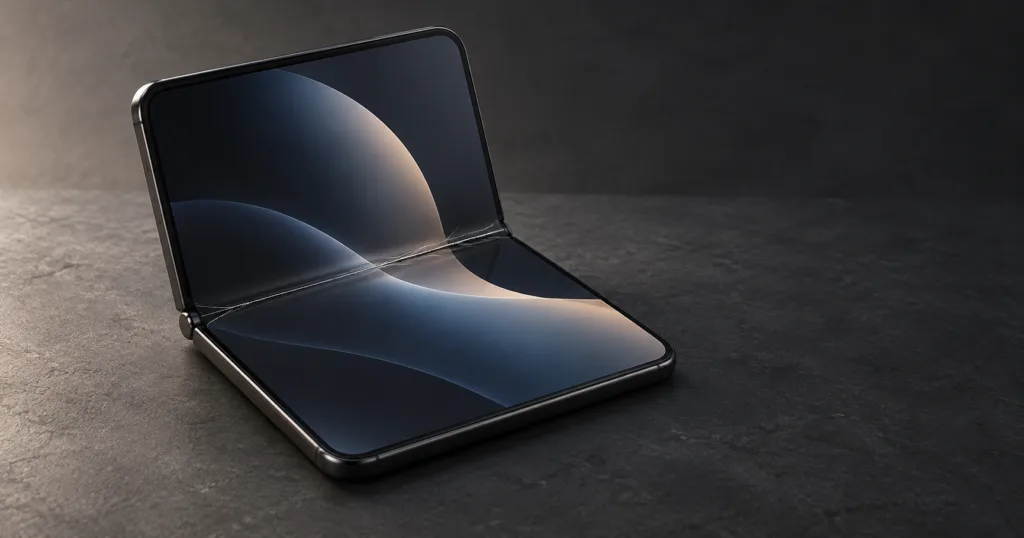
An iPhone Duo undergoing an automated folding test stopped opening fully within the machine’s cycle, lab director Matthew Murray reported. He said the phone remained operational after roughly 20 days of continuous testing, with the counter past 451,000 folds, despite changes in its hinge action.
Murray said the screen stopped about 5 to 10 degrees short of fully open. It could still be moved the rest of the way by hand, although the hinge had lost its earlier snapping sound and feel. The behavior had not met the test’s established conditions for declaring the device a failure.
Changes began before the 451,000-fold mark
The foldable phone durability test used the Fold-a-Phone, a custom rig intended to keep opening and closing the handset until it broke. Murray described approximately three weeks of testing, with the machine operating around the clock.
Murray said he first noticed looseness in the hinge during an afternoon livestream. The phone was no longer making the firm opening sound he had become accustomed to, though it was still opening completely flat when he left the office at 6 p.m.
A subsequent examination of sensor readings, photographs and video led the testing team to trace changes in opening force and motion to around 390,000 folds, Murray reported. Those changes developed gradually before the screen began stopping short during the automated cycle.
The rig uses a wire to pull the screen open. In Murray’s description, the wire would withdraw before the phone was fully unfolded, leaving the screen to complete the remaining movement on its own. For a period, that movement was enough to bring the device into a flat position.
At around 440,300 folds, between 12:30 and 1 a.m. during the overnight testing period he described, the screen stopped completing that movement before the machine began closing it again. That marked a change from looser hinge action to an opening movement that no longer finished within the rig’s allotted time.
The reported behavior concerned how the hinge completed its movement under the automated test. Because the screen could still be opened flat manually, it did not establish that the hinge had become physically incapable of reaching the fully open position.
Device remained below the test’s failure threshold
Murray said the partial opening was insufficient to end the test under its predefined failure conditions. Those conditions included:
- Loss of power.
- Sensors failing to detect the screen in the required position within the specified time.
- A screen blackout.
He also reported that the phone continued to operate and hold other screen positions. His inspection found no cracking, no more visible display crease and no other failures. The findings describe the condition of the single handset on the rig.
Murray characterized the altered hinge action as a significant step toward failure, although it had not triggered the test’s stopping conditions. He did not identify a final failure count and said testing would continue.
At an assumed 100 folds per day, 451,000 folds represents approximately 12.4 years’ worth of opening and closing cycles. That calculation compares fold counts; it does not demonstrate that the phone would deliver the same performance over 12.4 years of ownership. The reported test accumulated those cycles continuously over about three weeks.
Apple’s September 9, 2026, announcement described a hinge with more than 100 components that regulate opening and closing. The company said the mechanism supports the center of the inner display so it can lie flat when open. Murray said Apple had not publicly specified an anticipated fold-endurance figure for the Duo when he described the test results.
The ongoing test had not established the handset’s ultimate folding limit. Murray’s observations documented how its opening action had changed while the phone remained usable.