

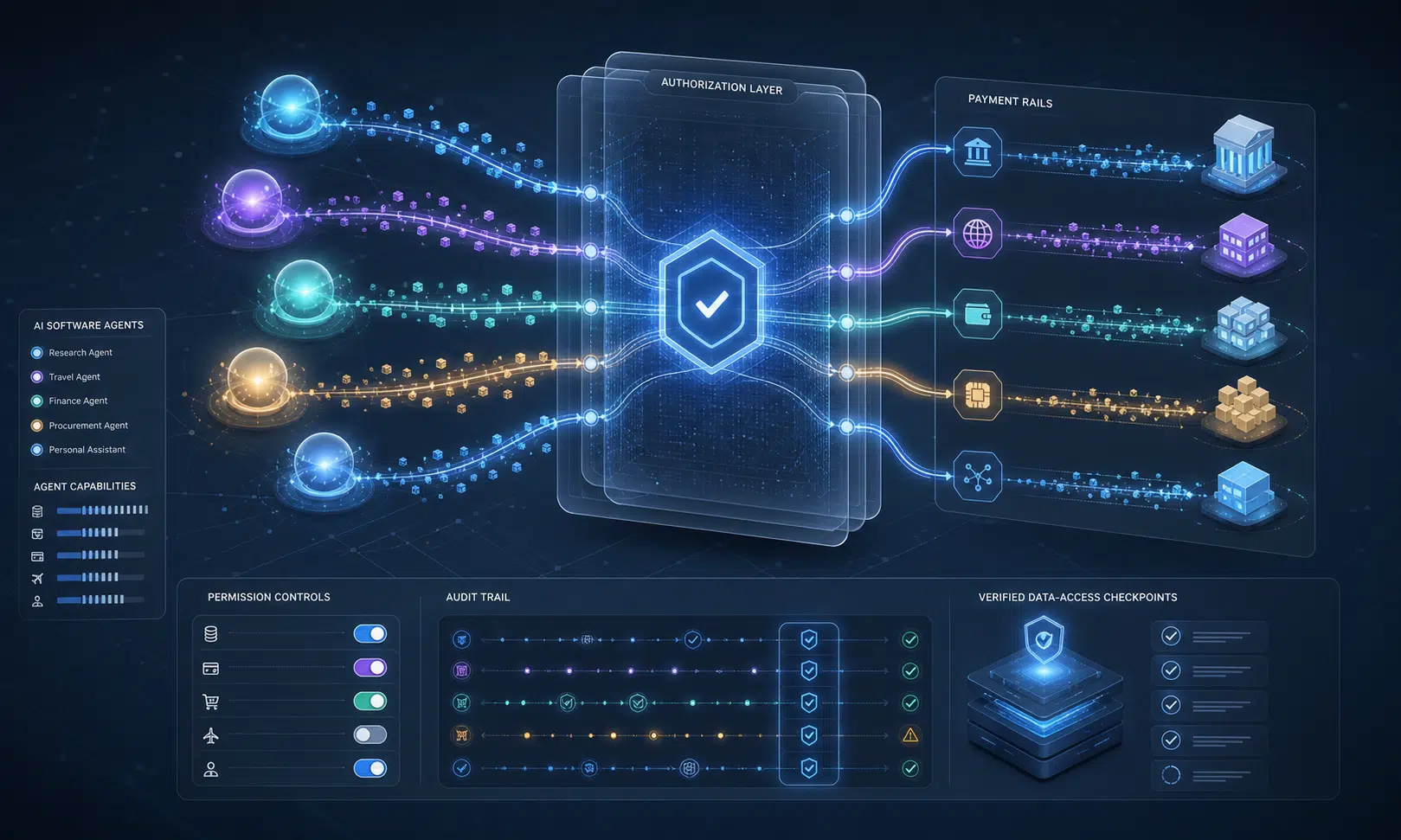

Mastercard is reportedly pushing further into AI payments with a protocol designed to help software agents handle smaller transactions and, eventually, make payments to one another. The reported product, called Agent Pay for Machines, is aimed at a narrow but important problem: how to let automated agents pay for digital resources without turning every request into a full traditional checkout flow.
For businesses watching agentic commerce, the immediate takeaway is not that AI agents are about to replace normal payments. The more useful question is whether payment networks, cloud providers, fintech platforms, and crypto infrastructure companies are beginning to settle on the plumbing that would make those transactions easier to authorize, audit, and charge for.
What Mastercard Is Reportedly Building
According to the report, Agent Pay for Machines is intended to support cases where an AI agent needs to pay for access to a service, dataset, web resource, or other digital unit of value. One example described in the source is an agent accessing data from a website in smaller pieces rather than buying a larger bundle or going through a consumer-style payment page.
The protocol is also described as a way to record permissions granted by humans to their AI agents. Instead of relying only on a private internal database, those permissions would be logged in a way that multiple parties could check when deciding whether an agent is acting within its approved limits. The report names Polygon, Solana, and Base among the blockchains initially involved in that permissions layer, though that detail should be treated as source-reported rather than independently confirmed here.
That distinction matters. The commercially important issue is not the brand name of any one chain. It is whether merchants, data providers, platforms, and payment processors can verify that an automated agent has permission to spend, request access, or complete a transaction. Without that verification layer, AI payment systems risk becoming either too risky for sellers or too restrictive for buyers.
Why Micropayments Matter For AI Agents
Traditional card payments work well for many consumer and business purchases, but they are not always a natural fit for tiny, frequent, machine-triggered transactions. If an AI agent needs to pay a few cents or fractions of a dollar for a specific resource, the economics and user experience can become awkward.
Agent Pay for Machines appears to be aimed at that gap. A useful AI payment system would need to handle several jobs at once:
- Confirm that the agent is authorized to act for a person or business.
- Set spending limits, allowed merchants, or approved categories of activity.
- Make small payments economically practical.
- Give counterparties a way to verify permissions before releasing a service or data access.
- Create enough records for dispute handling, compliance, and internal accounting.
For buyers, the practical value would depend on controls. A business would need to know who authorized an agent, what the agent is allowed to buy, how much it can spend, and how quickly that permission can be revoked. A protocol that makes payments easier but leaves governance unclear would be a hard sell for finance, procurement, and security teams.
Who Is Involved
The report says Mastercard is working with several companies on the protocol, including Adyen, Coinbase, and Cloudflare. Each name points to a different part of the potential stack.
| Company | Reported role in the broader picture | Why it matters for buyers |
|---|---|---|
| Mastercard | Payment network and protocol sponsor | Could connect agent payments to existing payment relationships and enterprise controls. |
| Adyen | Fintech and payment processing infrastructure | Could matter for merchants already using payment orchestration or global acquiring tools. |
| Coinbase | Crypto and blockchain infrastructure | Could support blockchain-based payment or verification components. |
| Cloudflare | Web infrastructure and access layer | Could be relevant where agents pay for or request access to online resources. |
This is still an early-market comparison rather than a finished buying guide. The source does not provide pricing, technical documentation, merchant eligibility, launch regions, or a production availability timeline. Those missing details are exactly what business buyers should look for before treating the protocol as more than an emerging infrastructure effort.
How It Compares With Other AI Payment Efforts
Mastercard is not the only large company exploring payments for AI agents. The source points to activity from Visa, Stripe, Coinbase, and Google, while also noting that the broader market has not yet reached mainstream transaction volume. The safest reading is that several major players are preparing for agent-driven commerce before the demand curve is fully visible.
For decision-makers, the comparison is less about which announcement sounds most ambitious and more about which model fits the job. Some systems may focus on consumer shopping agents. Others may lean toward machine-to-machine transactions, API access, digital content, or blockchain-native payments.
| Decision factor | Why it matters | What remains unclear from the source |
|---|---|---|
| Authorization | Businesses need proof that an agent can spend or request access. | How permissions are created, changed, revoked, and audited. |
| Payment size | Micropayments require different economics than ordinary checkout. | Fees, settlement approach, and minimum practical transaction size. |
| Counterparty trust | Sellers need confidence before serving data, access, or digital goods. | How many platforms will accept the protocol. |
| Compliance | Finance teams need records, controls, and accountability. | How disputes, fraud, and regulated use cases would be handled. |
| Integration | Adoption depends on developer and merchant effort. | Whether implementation will be simple enough for mainstream use. |
The Buyer-Aware View
For companies evaluating AI commerce, the reported Mastercard protocol is worth watching, but it is not enough on its own to justify a platform change. The source does not establish that agent payments are already a major revenue stream, nor does it show that machine-to-machine payments have reached broad adoption.
That makes the near-term use case more investigative than operational. A product, payments, or finance team could use this development as a signal to review where automated purchasing might enter its own workflows. Examples might include data access, software services, usage-based APIs, internal procurement agents, or customer-facing AI assistants that eventually need payment capability.
The key questions are practical:
- What can the agent buy, and who approves that authority?
- Can spending be capped by user, department, merchant, category, or time period?
- Can the business inspect and revoke permissions quickly?
- Will existing processors, banks, and accounting systems recognize the transaction cleanly?
- Does the system reduce friction without creating a new compliance burden?
Until those answers are clear, this category should be treated as early infrastructure rather than a finished replacement for existing payment systems.
What To Watch Next
The most important next step is evidence of real usage. Announcements from major payment companies show interest, but business buyers need to see merchant adoption, developer documentation, pricing, fraud controls, and examples of live transaction flows.
Mastercard’s reported framing is cautious enough to be notable. The source quotes the company’s chief product officer, Jorn Lambert, as saying he does not expect the protocol to be a major revenue driver next year, while suggesting it could become a meaningful addressable market over a longer period. That is a more grounded signal than a claim that agentic payments are already a large business.
For now, Agent Pay for Machines sits in the same broader category as other agentic commerce and machine-payment efforts: promising infrastructure for a market that is still forming. Companies with near-term exposure to AI agents, paid data access, usage-based APIs, or automated procurement should monitor it closely. Everyone else can treat it as an early sign of where payment networks believe commerce may be heading.