

Mildred Howard has long made art from the materials of memory: glass, keys, furniture, photographs, domestic objects, architectural forms and the histories that gather around them. At the Oakland Museum of California, that lifelong practice is being gathered into a major museum survey, Mildred Howard: Poetics of Memory, opening June 12, 2026.
The exhibition is described by OMCA as the first major museum survey of Howard’s work. It spans five decades of practice, including collage, found-object sculpture, public art, installation and archival material connected to the artist’s life and studio. The museum’s official dates list the show from June 12 through October 11, 2026.
For Howard, the occasion is not being framed as a tidy career ending. The San Francisco-born artist, who has worked across the Bay Area for decades, continues to make work in which public history and private life are closely bound. Her own way of putting it is direct: art is not separate from who she is.
A Survey Built Around Memory
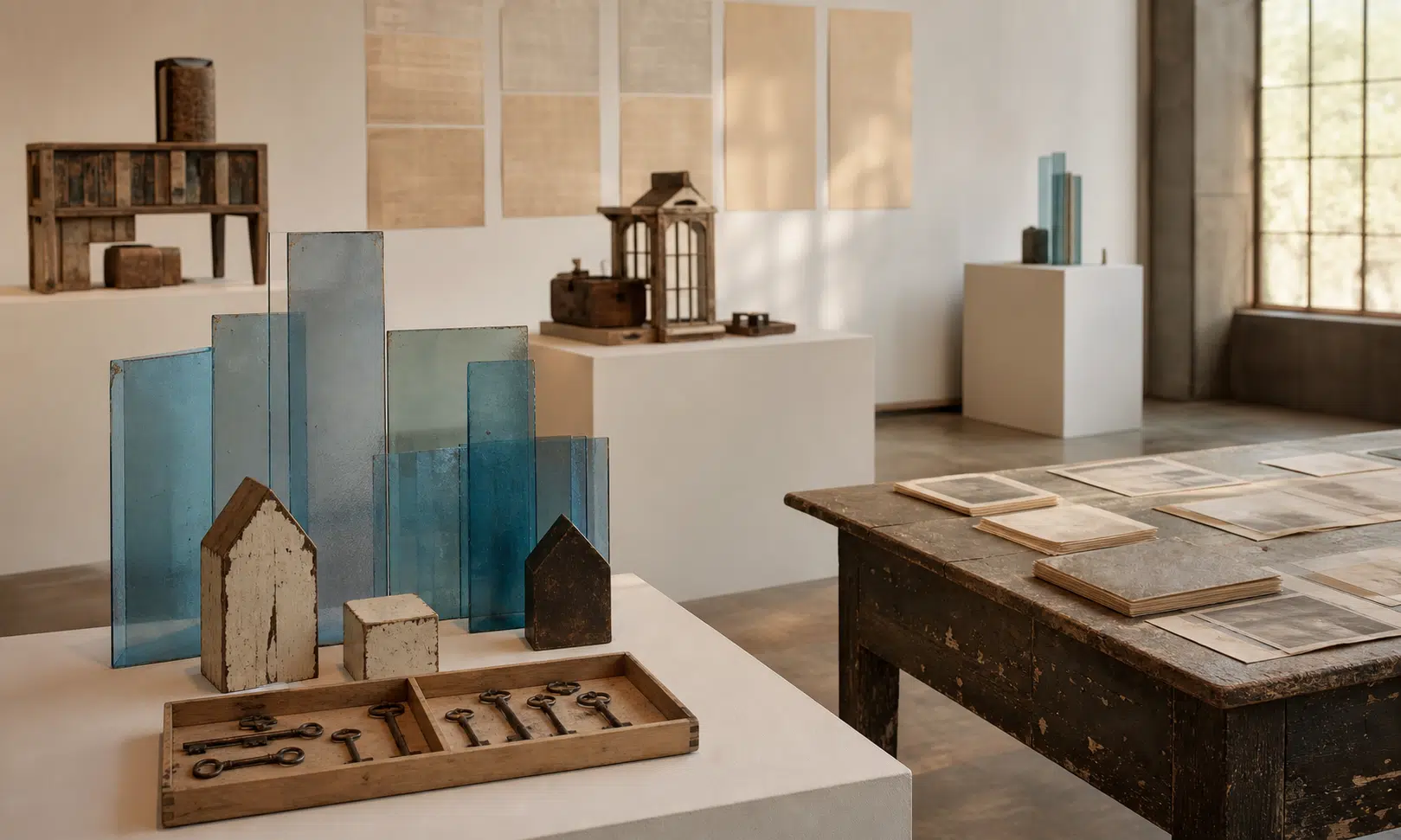
Poetics of Memory looks at Howard’s career through the recurring forms and questions that have shaped it. Houses, locks, keys, vessels, windows and fragments of the built environment appear across her work, often carrying layered meanings about migration, family, displacement, labor and belonging.
The exhibition includes work from different periods of her practice, along with materials from Howard’s studio and archive. That archival presence matters because Howard’s art often begins close to home. Personal objects, family history and everyday materials become part of a larger conversation about African American life, civic memory and the way public spaces preserve, distort or erase the past.
Howard is especially associated with public art in the Bay Area. One of her best-known projects, Three Shades of Blue, was installed along San Francisco’s Fillmore Street Bridge and used blue glass and poetry to honor the neighborhood’s jazz history. Another public work, Locks and Keys for Harry Bridges, honored the labor leader through a monumental lock-and-key form. In the new museum context, works and related materials from projects like these can be seen not only as public commissions, but as part of a wider practice concerned with access, memory and civic power.
The Studio as Part of the Story
Accounts of Howard’s West Oakland studio describe a space where living, making and storing art are deeply intertwined. The building has been described as a large warehouse that functions as home, studio and archive, though some details of its size and timeline are best treated as part of the reported profile rather than as independently established public record.
That blurred boundary between studio and home helps explain the shape of the retrospective. OMCA curator Carin Adams has described Howard’s life and work as closely connected, and the exhibition draws on that relationship by including personal and archival material alongside finished artworks. The point is not simply to decorate the gallery with biography. It is to show how Howard’s materials, habits and surroundings feed the work.
In Howard’s practice, domestic objects rarely stay domestic. A key can point toward labor history. A house can become a vessel for loss and endurance. A piece of glass can carry the memory of a neighborhood. Her use of ordinary forms gives the work its accessibility, but the objects often open into questions that are much larger than the things themselves.
Houses, Family and Displacement
Howard was born in 1945 in San Francisco and is closely associated with Berkeley and Oakland. The source profile describes her as the youngest of 10 siblings and traces her family’s long ties to South Berkeley, where relatives lived near one another for decades. Those family details come from the reported interview and should be understood in that context.
Her mother, Mable Howard, is remembered in Berkeley civic history for activism around the Bay Area Rapid Transit route through the city. In accounts of that struggle, community members pushed for BART tracks to be placed underground rather than run as an elevated line through Berkeley. That history gives useful context for Mildred Howard’s attention to place, neighborhood change and the politics embedded in architecture.
The house has become one of Howard’s most persistent forms. Works such as Blackbird in a Red Sky, also known as Fall of the Blood House, and her smaller glass house works return to the idea of the home as shelter, memory-holder and fragile structure. Howard has described houses as vessels of information, a phrase that fits much of her work: a building is never only a building, and a room is never only a room.
The source article also links this theme to Howard’s own experience of leaving a longtime South Berkeley live-work space after a rent increase. The exact personal circumstances are drawn from the reported profile, but the broader pressure is familiar in the Bay Area: artists and families rooted in a neighborhood can find themselves pushed out as property values rise. In Howard’s work, that experience does not become a simple message. It becomes material, form and atmosphere.
Recognition After Decades of Work
Howard’s retrospective arrives after a period of increased institutional attention. OMCA identifies her as a 2025 Guggenheim Fellow, and the museum’s survey frames her practice as a five-decade body of work. The source profile also reports honorary doctorates in 2023 from California College of the Arts and California State University, East Bay, and says her archive was acquired by the Bancroft Library at UC Berkeley. Where those details are not fully confirmed in the provided material, they are best read as reported elements of the profile rather than as independently verified claims.
What is clear is that Howard’s work has been visible in the Bay Area for many years, particularly through public art, and that the OMCA survey gives museum audiences a broader chance to see how those public projects connect to her smaller works, studio objects and personal archive.
Adams, OMCA’s senior curator of art, has described Howard as part of a group of artists whose work has not always received the level of institutional attention it deserved. The retrospective responds to that gap by presenting Howard not as a late discovery, but as an artist whose career has been unfolding in public view for decades.
Art and Daily Life
One of the strongest ideas running through the profile is Howard’s refusal to separate creative work from ordinary living. The article describes her cooking while discussing art, with food presented as another form of care and making. It also describes works, photographs and objects by people in her personal circle, including her longtime partner John Moore, who died in 2025 according to the source profile.
Those domestic details help explain the emotional register of Howard’s art. Her work is political, but not in a flat or slogan-like way. It moves through lived experience: family, neighborhood, labor, food, architecture, grief and the slow accumulation of objects. The public and private sit beside each other.
That may be why a retrospective is a particularly fitting format for Howard. A single work can carry force, but the larger arc shows how insistently she has returned to certain questions. What does a place remember? Who gets honored in public space? What happens when a home disappears? How can an object hold both beauty and injury?
Mildred Howard: Poetics of Memory appears designed to let those questions gather weight. By placing five decades of work in conversation with studio and archival material, the exhibition treats Howard’s art as a lived practice rather than a sequence of isolated objects. It also makes a case for her importance to Bay Area art history, where her work has long connected public space, personal memory and the unresolved histories built into the landscape.