

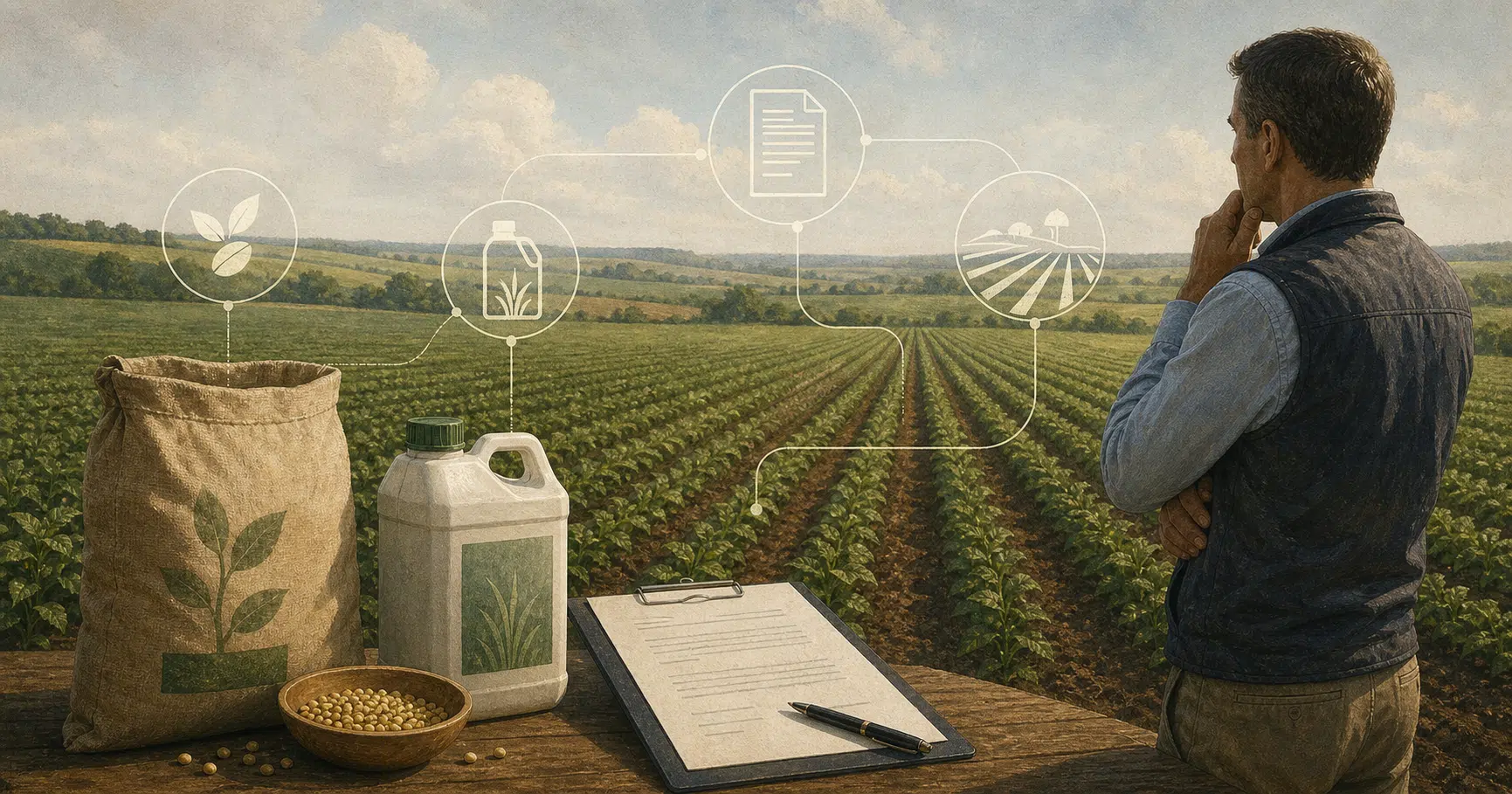

Monsanto’s business model matters less as a corporate success story than as a lesson in how agricultural products can become interconnected systems. The company started with saccharin, struggled to break even in its early years, and eventually built its identity around herbicides, biotechnology, patented seeds, and licensing agreements.
For agricultural buyers, that history raises a practical question: are you purchasing a useful product, or committing to a wider system with recurring costs and limits on how it can be used?
The product was only one part of the purchase
Roundup, introduced in 1976, became one of Monsanto’s defining products. The company’s later agricultural strategy connected its herbicide business with genetically modified seed technology. Monsanto presented Roundup and Roundup Ready crops as complementary parts of a broader approach to weed control, although the precise chronology and early development claims surrounding that strategy are not independently established here.
That distinction matters to buyers. A seed may promise a specific agronomic benefit, but its value cannot be judged in isolation when it is designed for use within a broader crop-management program.
Before committing to any comparable seed-and-herbicide package, buyers should examine the entire operating model:
- The purchase price of the seed and related inputs
- The terms of the seed license or technology agreement
- Restrictions on saving or replanting harvested seed
- The cost of remaining within the same crop-management system
- The availability of practical alternatives if performance or economics change
Patents changed the buyer relationship
Monsanto patented genetically modified seeds and required farmers to accept agreements restricting seed saving and replanting. The company also pursued legal action involving the use of patented seed technology.
From a business perspective, those protections supported repeat sales and helped defend Monsanto’s intellectual property. From a buyer’s perspective, they changed the transaction. The farmer was not simply acquiring seed as a physical product; the purchase also came with contractual conditions governing future use.
That makes the license as important as the product specification. Buyers should understand what they may retain, reuse, transfer, or plant in a later season before calculating the real cost of ownership.
Convenience can create dependency
Monsanto’s integrated approach offered a clear commercial appeal: products designed to operate within one recognizable system can simplify purchasing and planning. The tradeoff is dependence. When seeds, crop-management practices, and intellectual-property rules are closely connected, changing one part of the operation may require reconsidering the rest.
Critics also accused Monsanto’s model of contributing to herbicide-resistant weeds and concentrating power in the seed market. Those disputes underline why buyers should evaluate long-term flexibility rather than relying only on first-season convenience.
A sensible purchasing review should therefore ask three questions:
- Does the system deliver enough operational value to justify its full recurring cost?
- What contractual or technical barriers make switching difficult?
- Which alternative seeds and weed-control methods remain workable?
The broader business lesson
Monsanto’s late-1990s shift toward life sciences included selling much of its chemical business and concentrating on biotechnology. The Bayer acquisition closed in 2018, ending Monsanto’s existence as an independent company.
Its lasting lesson is not simply that recurring sales or strong patents produce growth. It is that bundling products, technology, and legal terms can reshape the customer relationship. Buyers evaluating any similar agricultural platform should look beyond the headline benefit and price the whole system—including its restrictions, dependencies, and exit options.