

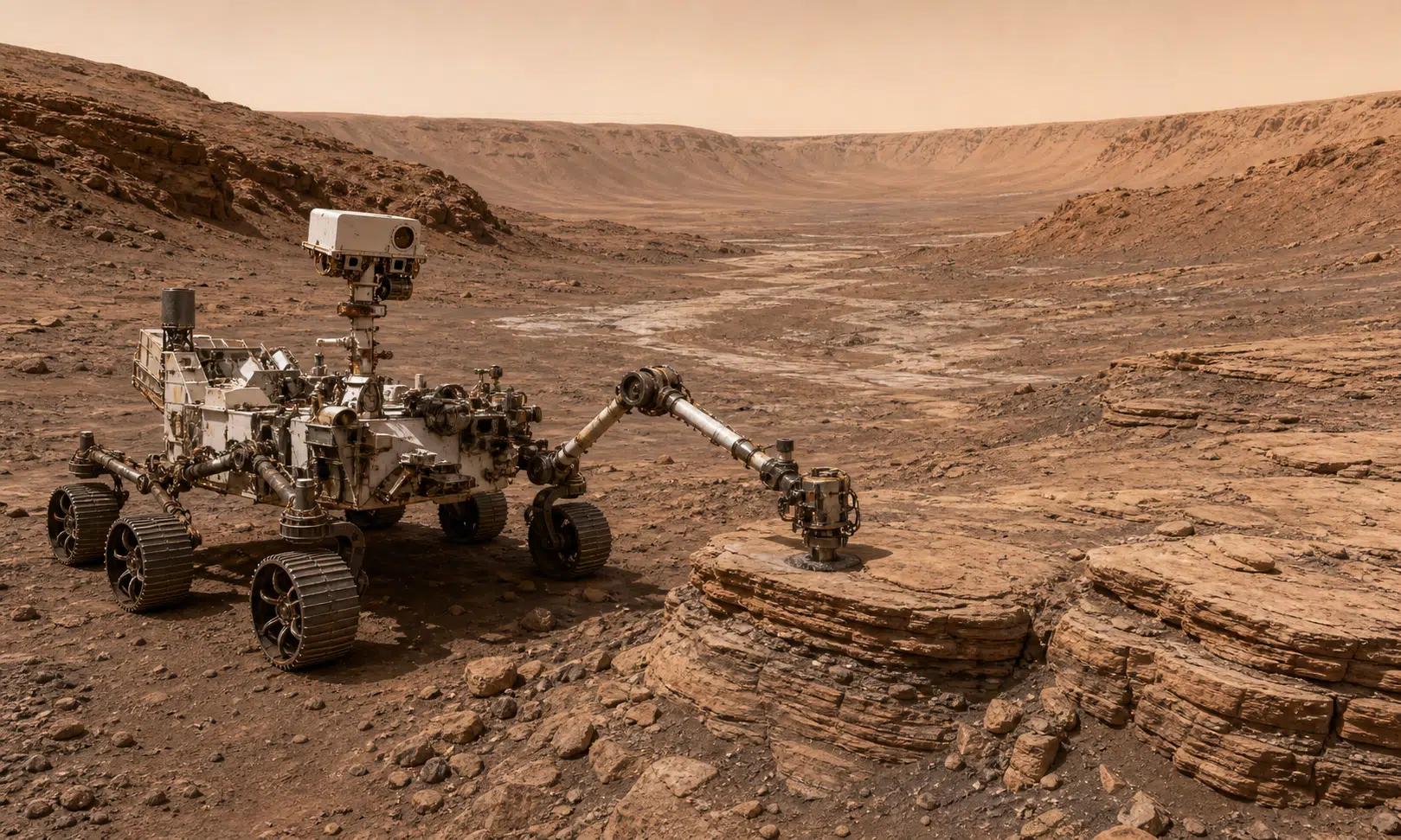

NASA’s Perseverance rover has found one of the more intriguing chemical clues yet in the long search for ancient life on Mars: complex organic matter preserved in rocks from Jezero crater.
The finding centers on mudstones in a formation known as Bright Angel, an area inside the crater’s ancient river system. Researchers analyzing data from Perseverance reported detections of macromolecular carbon, or MMC, in two Martian rocks. That is a meaningful result because MMC refers to large networks of carbon atoms, a form of organic matter that can be associated with fossilized biological carbon on Earth.
It is also not proof of life.
That distinction matters. Organic molecules are often described as the building blocks of life, but they can be produced by processes that have nothing to do with biology. Meteorites, cosmic dust, hydrothermal chemistry, and other non-living reactions can all leave behind carbon-rich material. The Bright Angel finding makes Mars more interesting, not settled.
What Perseverance Actually Detected
Perseverance used SHERLOC, short for Scanning Habitable Environments with Raman & Luminescence for Organics & Chemicals, to examine the rocks. The instrument uses an ultraviolet laser to probe the composition of rock surfaces and look for organics and minerals at fine scales.
In the Bright Angel mudstones, the rover’s measurements showed hundreds of organic detections. Researchers described the result as the strongest organic detection yet in Jezero crater, and the detection of macromolecular carbon on a natural Martian rock surface is especially notable because it appears close to the surface rather than buried deep underground.
That is part of what makes the finding scientifically awkward in a useful way. Mars is harsh on organic material. Radiation and oxidizing chemicals at the surface tend to break organics down over time. If MMC is still present near the surface, it may be unusually resistant to degradation, shielded by minerals such as clays or iron-rich soil, or exposed relatively recently in geological terms.
The rocks themselves appear to fit the kind of environment astrobiologists care about. Bright Angel sits within Jezero crater, a site NASA selected because it once held water and includes remnants of an ancient lake and river delta system. Fine-grained sediment carried by water through an ancient river channel is thought to have hardened into the mudstones Perseverance later examined.
Why This Is Interesting, But Not a Life Detection
The strongest version of the Mars life question is not whether the planet has carbon chemistry. It clearly does. The harder question is whether any of that chemistry was shaped by biology.
That is where Perseverance’s limits become important. The rover was built to identify promising rocks, study their context, and collect samples for possible return to Earth. It was not designed to conclusively separate organics made by living systems from organics formed by non-biological chemistry.
The Bright Angel material may have a biological origin, but it may also come from meteorites, cosmic dust, or reactions between water and rock. On Earth, macromolecular carbon can appear in rocks containing fossilized biological material, but that comparison is not enough to declare ancient Martian microbes. Mars has its own chemistry, its own radiation environment, and a long history of impact delivery from space.
That is why the finding lands in a familiar but important middle ground: it strengthens the case that Jezero crater preserved habitable environments and interesting organic chemistry, while leaving the central question unanswered.
The Bigger Pattern Across Mars
The Bright Angel detection does not stand alone. Perseverance previously drew attention for a rock nicknamed Cheyava Falls, which showed features described as potential biosignatures, including striking “leopard spot” markings. Those features were compelling because similar patterns on Earth can be associated with microbial activity, but they also required caution because non-biological reactions can sometimes mimic biology.
Far from Jezero, NASA’s Curiosity rover has also detected organic molecules in Gale crater. Taken together, the results suggest that organic chemistry may have been widespread across ancient Mars, particularly in places shaped by water.
That is a big deal for habitability. It does not mean life existed across Mars, or even at all. But it does suggest that the planet had multiple environments where the ingredients and preservation conditions astrobiologists look for could overlap.
A simple way to frame the current state of the evidence is this:
- Perseverance has detected complex carbon-rich material in ancient Martian mudstones.
- The rocks formed in a water-shaped environment that is relevant to the search for past habitability.
- The organics could have biological or non-biological origins.
- Rover instruments cannot settle that origin question on their own.
- Laboratory analysis on Earth would be the strongest path to a clearer answer.
The Sample Return Problem
The obvious next step is also the hard one: get the samples back to Earth.
Perseverance has been collecting and caching carefully selected rock cores with the idea that a later mission could return them for laboratory analysis. Earth-based instruments could examine isotopes, molecular structures, mineral relationships, and contamination risks in ways a rover cannot. That kind of testing would not automatically prove life, but it would give scientists a far better shot at distinguishing biology from geology.
The problem is that Mars Sample Return has become one of NASA’s most difficult planning challenges. The mission concept has faced cost growth, schedule pressure, redesigns, and political uncertainty. A firm path for returning Perseverance’s samples has not been publicly settled in a way that guarantees a near-term answer.
That leaves the Bright Angel discovery in a frustrating place. The rover has done exactly what it was sent to do: find rocks that look scientifically valuable enough to bring home. The system for bringing them home is the part still in question.
What This Means for the Search for Life
The discovery of complex organic matter on Mars is not a dramatic alien-life reveal. It is something more technical and, in some ways, more useful: another sign that ancient Mars preserved chemically rich environments where life could have had a chance, if it ever emerged there.
The strongest takeaway is restraint. Perseverance has not found a fossil, a microbe, or a confirmed biological signature. It has found a carbon-rich clue in the right kind of place, inside rocks formed in an ancient watery setting, with chemistry that deserves closer scrutiny.
That may sound less cinematic than a declaration of life on Mars, but it is how this search is likely to move forward: one carefully constrained result at a time, with each discovery narrowing what scientists should test next. For now, Bright Angel gives researchers a better target and a sharper question. The answer probably depends on whether those Martian samples ever make it back to a lab on Earth.