

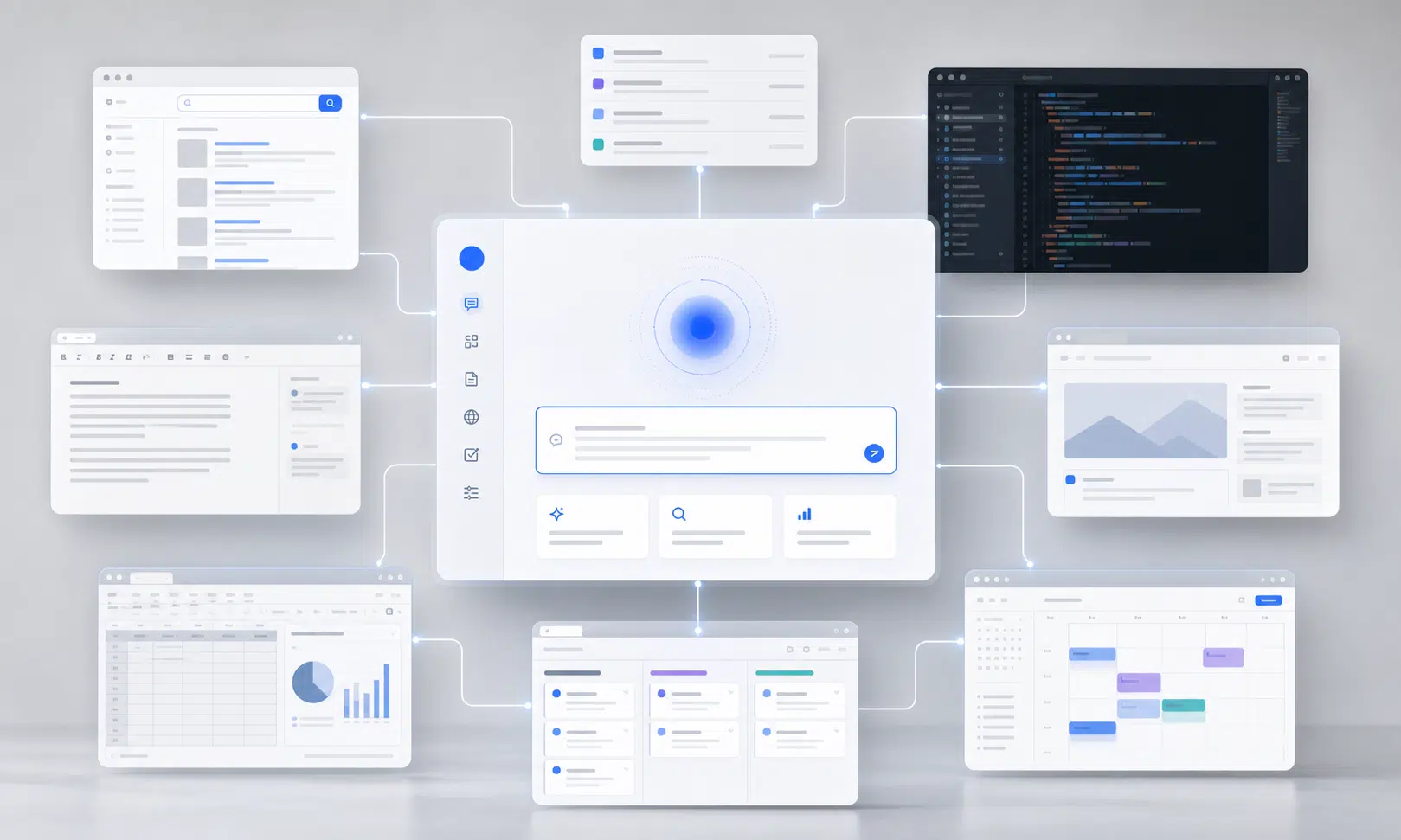

OpenAI’s next act is not simply about making ChatGPT answer questions more fluently. The company is trying to move AI from a place people visit for help into a layer that sits closer to the work itself: search, coding, browsing, planning, shopping, document handling, and the growing category of software-driven tasks now being grouped under AI agents.
That shift matters because it changes the buyer question. For individuals and businesses, the issue is no longer just whether ChatGPT is good at generating text. It is whether OpenAI can make AI useful enough, reliable enough, and integrated enough to become a default starting point for digital work.
The company’s public vision leans heavily on that idea. OpenAI has been presenting its future around more capable systems, broader access, and tools that can move beyond passive conversation. The big promise is that AI will help people make better decisions and get more done, rather than simply automate everything out of sight.
That is a neat framing, but it also sets up the central tension. The more useful an AI system becomes, the more power it has over the workflows, defaults, and decisions around it.
ChatGPT is becoming a platform, not just a chatbot
The clearest way to understand OpenAI’s direction is to stop thinking about ChatGPT as a single-purpose app. In its earliest consumer form, ChatGPT was mainly a conversational interface: ask a question, get an answer, revise the answer, move the result somewhere else.
OpenAI’s broader ambition is more active. The company wants AI to help carry out tasks across different surfaces, including coding environments, web browsing, search-like interactions, and agentic workflows.
That is the meaningful product shift. A chatbot waits for a prompt. An agent is supposed to take a goal and help move it forward. In practice, that can mean researching a topic, comparing options, drafting or editing files, navigating websites, generating code, or coordinating a chain of smaller actions that would normally require switching between apps.
For buyers, the distinction is important. A strong writing assistant can save time. A dependable agent can change how a team structures work. But an unreliable agent can create new review burdens, security risks, and operational mess.
That is why OpenAI’s next phase is less about spectacle and more about execution. The company has already shown that a large audience will try general-purpose AI. The harder task is convincing people and organizations to trust AI with more of the steps between intention and completion.
The “personal AI” pitch is powerful, but still undefined
OpenAI’s long-running mission language has centered on artificial general intelligence that benefits humanity. In product terms, that vision increasingly sounds like a personal AI assistant that can understand context, work across tools, and become useful in both consumer and professional settings.
The appeal is obvious. A personal AI could help a student plan research, a developer debug code, a small business owner write sales copy, or an employee summarize a messy document trail. The same underlying habit can travel from home use to workplace use and back again.
That is also where the term AGI becomes slippery. There is no single public definition that buyers, researchers, companies, and regulators all use in the same way. One organization’s AGI milestone may sound to another like a powerful but still limited software system. That makes any roadmap around AGI more useful as a direction of travel than as a product specification.
The more practical question is what OpenAI can ship along the way. If the company can make ChatGPT a reliable hub for everyday tasks, it does not need everyone to agree on a formal AGI definition before the product becomes influential.
AI research is becoming part of the roadmap
OpenAI has also been pointing toward AI systems that help with AI research itself. The idea of an automated AI researcher is significant because it suggests a loop in which AI tools assist the people building the next generation of AI tools.
A firm public timeline for how much research could be handled by AI systems should be treated cautiously. What is clear is the strategic direction: OpenAI wants increasingly capable models to accelerate development, not only serve end users.
That has consequences beyond product features. If AI systems become more useful inside research and engineering workflows, the pace of model development could depend less on conventional software cycles and more on how effectively companies can combine compute, talent, data, infrastructure, and AI-assisted experimentation.
For customers, that may translate into faster feature releases and more capable tools. It may also mean more frequent changes to pricing, product boundaries, governance policies, and enterprise controls.
What this means for businesses considering OpenAI tools
For companies evaluating OpenAI’s ecosystem, the upside is clear: a single AI platform that spans chat, coding, browsing, search-like tasks, and agents could reduce tool fragmentation. It could also make it easier for employees to use AI without constantly moving between separate apps and workflows.
But buyers should be careful about treating the roadmap as a finished product. The strategic direction is not the same as a mature deployment plan. Agentic AI still needs guardrails, monitoring, permission controls, auditability, and clear escalation paths when the system gets something wrong.
A practical evaluation should focus on where the tools already perform well and where human review remains essential.
| Buyer question | Why it matters |
|---|---|
| Does the AI improve an existing workflow? | Useful AI should reduce repetitive work without adding constant correction and supervision. |
| Can users control what the agent can access? | Agentic tools become riskier when they can browse, act, or interact with sensitive data. |
| Is the output easy to verify? | AI-generated work is more valuable when teams can quickly check sources, assumptions, and changes. |
| Does the tool fit existing software habits? | Adoption depends on whether AI feels like part of the workflow rather than another place to copy and paste. |
The best near-term use cases are likely to be bounded tasks: drafting, summarizing, coding assistance, structured research, workflow triage, and internal knowledge work where humans can review the result. Fully autonomous business processes remain a much higher bar.
The dependency problem is real
OpenAI’s vision becomes more compelling as ChatGPT becomes more central. It also becomes more complicated.
If users begin their work inside an AI assistant, that assistant does more than answer questions. It influences which options appear first, how tasks are framed, which services are suggested, and how much effort people spend checking alternatives. That can be convenient, but it also creates a new kind of dependency.
This is the same pattern that made search engines, app stores, operating systems, and productivity suites so powerful. The tool that becomes the default starting point can shape the market around it.
For OpenAI, that is the opportunity. For buyers, it is the risk to manage. A unified AI workspace can be efficient, but organizations should avoid building critical processes around any system they cannot govern, export from, or replace.
Verdict: promising direction, unfinished buyer case
OpenAI’s next phase is best understood as a platform strategy. ChatGPT is the front door, but the company’s larger goal is to make AI a practical layer for tasks, tools, and decisions.
That direction makes sense. Chat alone is useful, but limited. Agents, coding tools, browsing, and research assistance point toward something more durable: AI as a work surface rather than a novelty window.
For individuals, the value will depend on whether these tools save time without creating too much cleanup. For businesses, the decision is more demanding. OpenAI’s ecosystem is worth watching and testing, especially for knowledge work and software-heavy teams, but it should be adopted with clear boundaries around data access, human review, and workflow ownership.
The company’s vision is ambitious. The buyer decision should be more grounded: use the tools where they already make work faster and more manageable, but do not confuse a sweeping roadmap with a finished operating model.