


PowerColor has listed its Radeon AI PRO R9600D, a compact workstation and AI graphics card built around AMD’s RDNA 4-based Radeon AI PRO R9000 series. The card is notable less for gaming-style clock talk and more for its physical layout: 32GB of GDDR6 memory, passive cooling, a single-slot form factor, and a 12V-2×6 power connector on a board rated far below the connector’s headline capacity.
The model appears in PowerColor’s catalog as the AI PRO R9600D 32G-P. Because this is a partner listing rather than a broad retail launch, buyers should treat the page as a product listing rather than evidence of wide availability.
PowerColor Radeon AI PRO R9600D Specs
The PowerColor Radeon AI PRO R9600D follows AMD’s lower-tier R9600D configuration within the Radeon AI PRO R9000 lineup. AMD positions this class of card for local AI development, professional workloads, and dense multi-GPU systems where memory capacity and system airflow matter more than RGB coolers or gaming aesthetics.
On paper, the important figures are straightforward: 3072 stream processors, 48 compute units, 96 AI accelerators, and 32GB of GDDR6 memory on a 256-bit bus. AMD also lists 64MB of Infinity Cache and 640 GB/s of peak memory bandwidth for the R9600D.
| Specification | PowerColor Radeon AI PRO R9600D |
|---|---|
| GPU family | AMD Radeon AI PRO R9000 series |
| Architecture | AMD RDNA 4 |
| Stream processors | 3072 |
| Compute units | 48 |
| AI accelerators | 96 |
| Memory | 32GB GDDR6 |
| Memory interface | 256-bit |
| Memory speed | 20 Gbps |
| Peak memory bandwidth | 640 GB/s |
| Infinity Cache | 64MB |
| Board power | 150W |
| Power connector | 12V-2×6 16-pin |
| Minimum PSU recommendation | 450W |
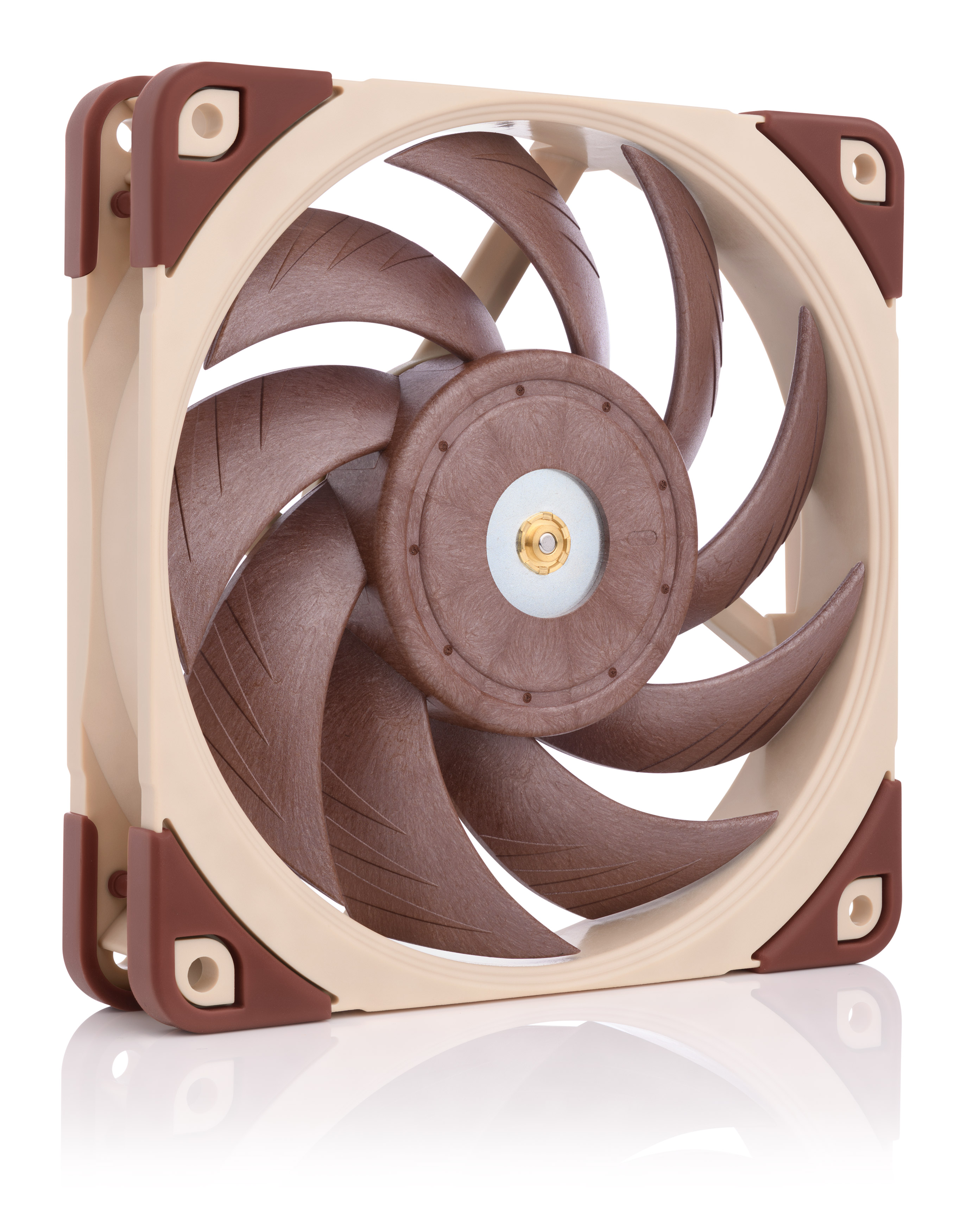
Noctua NF-A12x25 PWM 120mm Case Fan
A passive workstation GPU still needs steady case airflow under sustained AI or compute loads. A strong 120mm PWM fan can help create front-to-back airflow without adding another GPU-slot cooler.
As an Amazon Associate I earn from qualifying purchases.
The board dimensions listed by PowerColor are 241.3 x 111.2 x 18.7 mm, and the company identifies the card as a one-slot design. That makes it more interesting for compact workstations and tightly packed compute boxes than for a typical desktop tower where a thicker active cooler is usually easier to manage.
The tradeoff is cooling responsibility. A passive GPU is not silent by itself in any meaningful system-level sense; it simply moves the fan requirement from the card to the chassis. Anyone considering this class of card needs to think about front-to-back airflow, slot spacing, and sustained load behavior before treating it as a drop-in option.
A Single Display Output Is the Odd Detail
PowerColor lists only one DisplayPort 2.1a connector on this version of the Radeon AI PRO R9600D. AMD’s platform support allows partner designs with up to four display outputs, so this is a board-level choice rather than a hard GPU limit.
That output layout says a lot about the intended use. This card is not trying to be a multi-monitor creator card in the usual workstation sense. It is much closer to a compute-oriented accelerator that can still drive a display when needed.
For local AI work, that may be perfectly acceptable. For CAD, editing, visualization, trading desks, or other professional setups where several displays are expected, one DisplayPort output is a real limitation. Buyers should check the exact display requirement before assuming the Radeon AI PRO branding means a traditional workstation display layout.
Why Use 12V-2×6 on a 150W Card?
The 12V-2×6 connector stands out because the Radeon AI PRO R9600D is listed with a 150W total board power rating. In practical terms, that is not a high-power GPU by today’s standards, and many cards in this power class have historically used simpler 8-pin PCIe power connectors.
There are a few likely reasons for the choice. It keeps the board aligned with newer PSU standards, simplifies power delivery in systems that may host multiple accelerators, and matches AMD’s stated external connector requirement for the model. It also means system builders need to treat cable seating and connector quality with the same care they would on higher-power cards, even if the board itself is not pulling 300W or 450W.
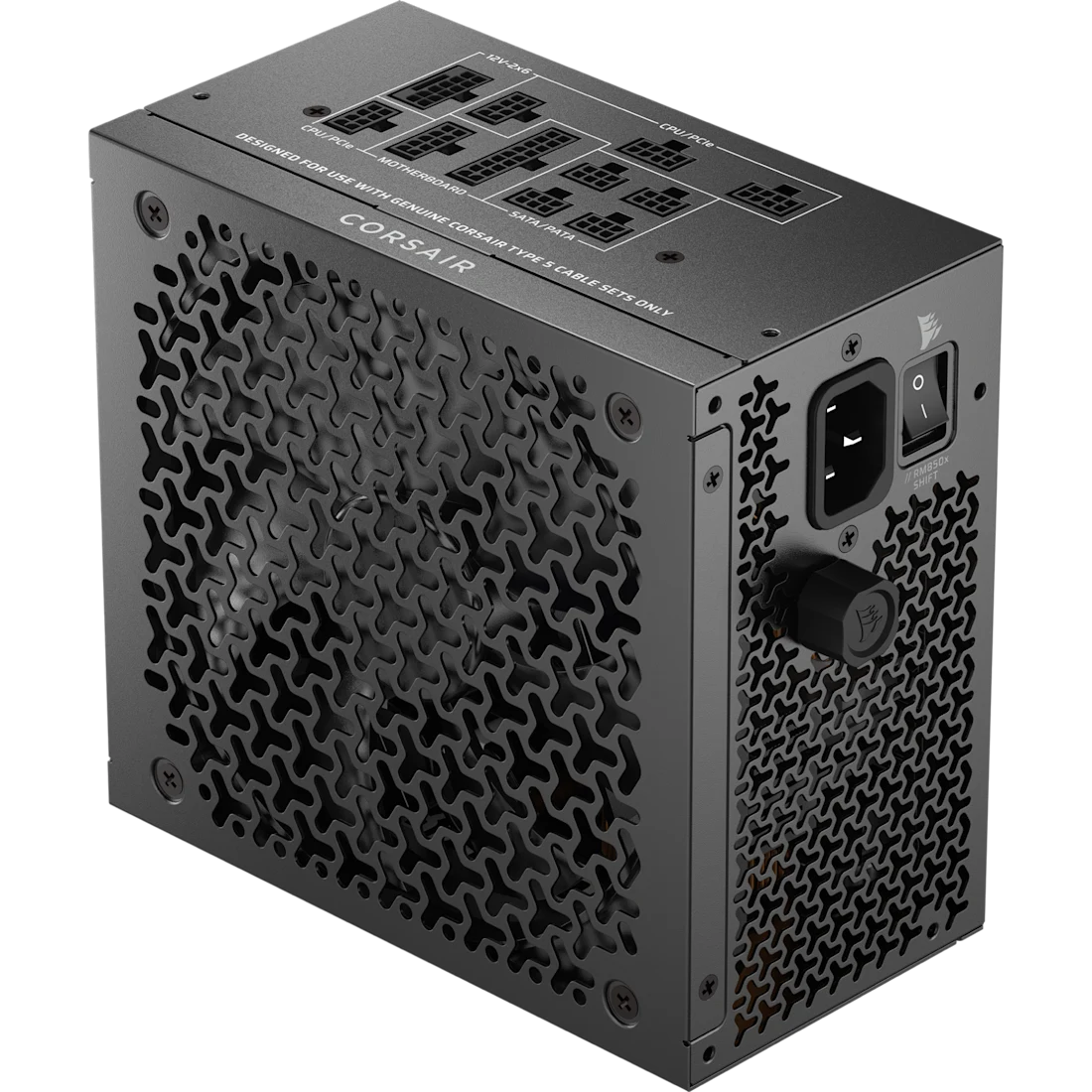
Corsair RM850x SHIFT ATX 3.1 850W PSU
For builds using newer 16-pin GPU power, a native ATX 3.1 PSU avoids adapter clutter and keeps cable routing simpler. Builders should still confirm case clearance, especially with side-mounted modular connectors.
As an Amazon Associate I earn from qualifying purchases.
AMD lists a 450W minimum PSU recommendation for the Radeon AI PRO R9600D. That figure should be read as a platform recommendation, not as a suggestion that the card itself consumes anywhere near that amount.
Retail Availability Is Still the Practical Question
PowerColor’s listing confirms the design details, but pricing and retail timing remain unclear. For buyers, that matters because the Radeon AI PRO R9600D will likely be judged against several different alternatives: higher-end Radeon AI PRO cards, used workstation GPUs, NVIDIA professional cards, and consumer GPUs with large VRAM pools.
The strongest case for the R9600D is its combination of 32GB VRAM, passive single-slot packaging, and a 150W board power target. That is a useful mix for local inference, compact workstations, and multi-card experimentation where memory capacity per slot matters.
The weaker case is just as obvious. One display output narrows its appeal, passive cooling raises system design requirements, and real-world value cannot be judged until pricing and channel availability are known.
Cooler Master’s GPU Shield Moves Into Retail PSUs
The 12V-2×6 connector discussion is also why Cooler Master’s MWE Gold V4 update is worth watching. The company’s GPU Shield feature is now appearing on retail power supplies in China, starting with MWE Gold V4 models that support monitoring through the PSU-side 12V-2×6 connector.
The 850W version has appeared for preorder in China at 659 RMB, or roughly $97, with ATX 3.1 support, a 10-year warranty, and GPU Shield current management. A 1000W model has also been listed, and Cooler Master is preparing a dedicated GPU Shield 16-pin cable.
GPU Shield is designed to detect abnormal current behavior on the 12V pins of the 16-pin connector. It is part of a broader industry response to 12VHPWR and 12V-2×6 connector concerns, where vendors have tried different methods including current monitoring, temperature sensing, warning systems, and power cutoff behavior.
GPU Shield LED States
Cooler Master’s implementation uses an LED near the PSU’s 12V-2×6 header rather than a software dashboard. The behavior shown so far is based on per-pin current.
| Per-pin current | Status | LED behavior | Action |
|---|---|---|---|
| Below 9.3A | Normal operation | Green | No intervention |
| Above 9.3A | Abnormal operation | Flashing red | Warning state |
| Above 15A | GPU Shield engaged | Solid red | GPU power cutoff |
The limitation is visibility. A warning LED on the PSU side may be difficult to see once the system is assembled, especially in a closed case or a desk-mounted tower. A system-level alert or audible warning would be more useful for many users, since a sudden blackout under GPU load is not very informative if the only clue is hidden beside the power connector.
Cooler Master is not the only company working on this kind of protection. MSI, Cybenetics, Seasonic, and Corsair have all shown or discussed connector safety ideas with different approaches, including current imbalance checks, thermal monitoring, warning indicators, and shutdown protection. The common theme is simple: 16-pin GPU power is here to stay, so vendors are trying to make failure modes easier to detect before they become expensive.
For buyers building around cards like the Radeon AI PRO R9600D, this matters even when the GPU is not especially power hungry. The connector standard is shared across a wide range of cards, and careful cable routing, full insertion, and sensible PSU selection still matter more than the wattage number printed beside the GPU.