

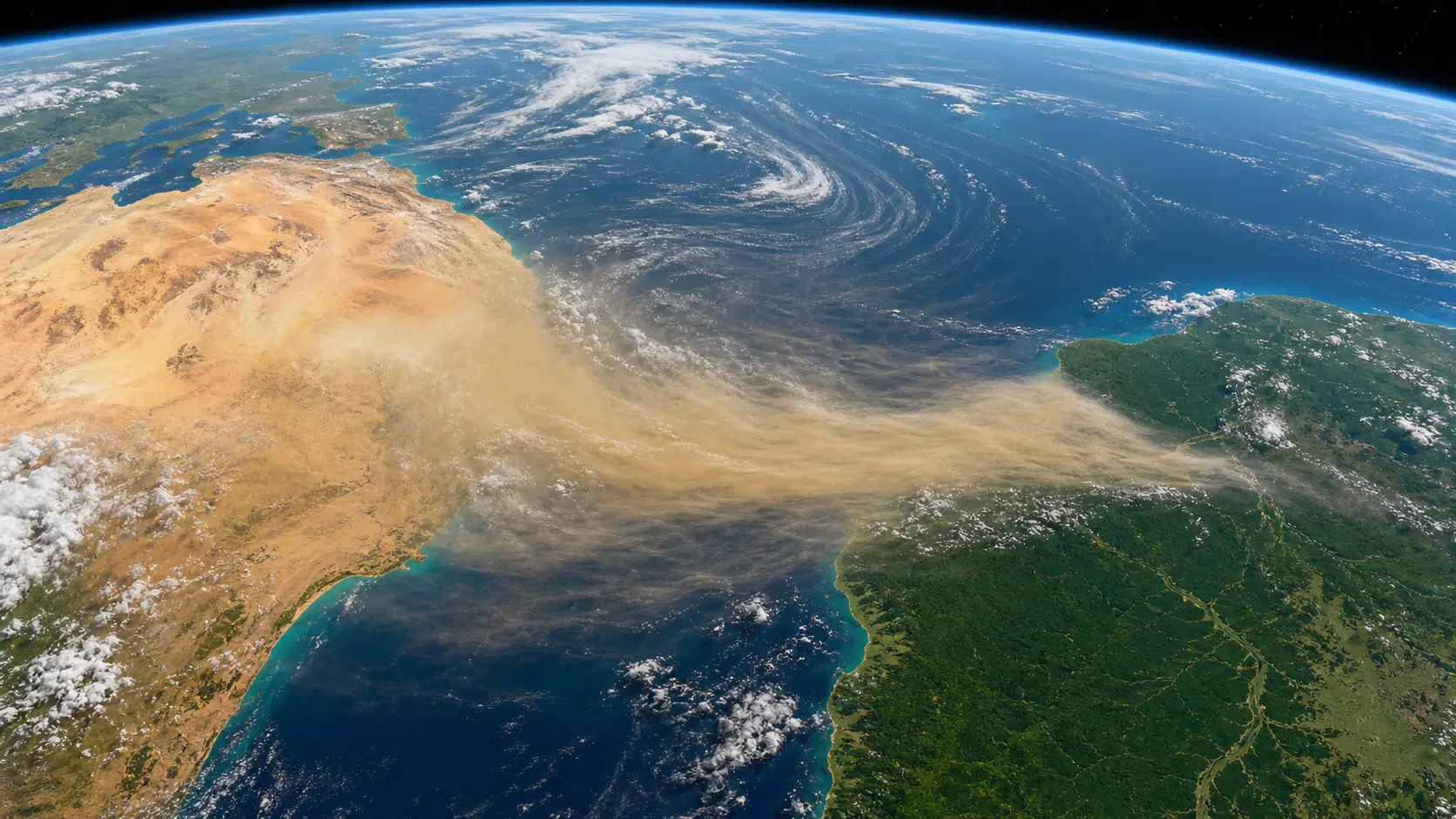

Every year, vast amounts of dust rise from the Sahara, cross the Atlantic Ocean, and settle over South America. A portion of that dust lands in the Amazon Basin, where it delivers phosphorus, a nutrient the rainforest steadily loses through heavy rainfall and runoff.
That connection is not a metaphor. It is a measured planetary exchange: material eroded from one of the driest regions on Earth helps maintain the nutrient budget of one of the wettest and most productive forests.
For readers trying to understand climate risk, rainforest resilience, carbon storage, or the hidden dependencies inside Earth systems, this is the part worth paying attention to. The Amazon is not an isolated green machine. Its long-term productivity depends partly on a supply chain that starts thousands of miles away in North African dust sources.
The Short Verdict
The Sahara-to-Amazon dust connection is real, well measured at the basin scale, and scientifically important. The exact source regions inside North Africa remain debated, but the broader finding is not: Saharan dust carries phosphorus across the Atlantic, and the estimated annual phosphorus input is roughly comparable to what the Amazon loses through water-driven runoff.
That makes the story useful for anyone evaluating claims about rainforest stability. It also makes it easy to overstate. The dust does not single-handedly “create” the Amazon, and researchers are still refining which desert regions contribute most to the material that actually reaches the basin. The best reading is more specific: Saharan dust appears to be an important external nutrient subsidy for a rainforest growing on old, heavily weathered, phosphorus-poor soils.

Earth System Science: A Very Short Introduction
Tim Lenton’s compact introduction is a good fit for readers who want the broader science behind linked systems such as dust transport, rainforest nutrients, climate feedbacks, and planetary regulation.
As an Amazon Associate I earn from qualifying purchases.
What The Satellite Measurements Show
The most widely cited quantitative estimate comes from satellite work using CALIPSO, a satellite system capable of measuring the vertical structure of aerosol layers in the atmosphere. That matters because trans-Atlantic dust transport is not just a flat plume drifting across a map. Dust is lifted, layered, thinned, rained out, and carried at different altitudes before some of it reaches South America.
Across the 2007 to 2013 measurement period, researchers estimated that roughly 182 million tons of Saharan dust leave the western edge of North Africa each year. Most of that material does not land in the Amazon. A large share falls into the Atlantic. Some continues toward the Caribbean. A significant portion, estimated at about 27.7 million tons per year, settles over the Amazon Basin.
Inside that dust is an estimated 22,000 tons of phosphorus per year. That is the number that changes the story from an atmospheric curiosity into an ecological one.
| Measured flow | Approximate annual amount | Why it matters |
|---|---|---|
| Saharan dust leaving western Africa | 182 million tons | Shows the scale of material lifted and exported by winds |
| Dust remaining over the Atlantic path near South America | 132 million tons | Shows how much material survives much of the crossing |
| Dust deposited over the Amazon Basin | 27.7 million tons | Represents the dust input reaching the rainforest region |
| Phosphorus delivered to the Amazon | About 22,000 tons | Roughly offsets estimated phosphorus losses from runoff |
| Dust continuing toward the Caribbean | About 24 million tons | Shows the plume does not stop at the Amazon |
These figures should be read as estimates, not as a fixed annual invoice from the desert to the forest. Dust transport varies from year to year. Conditions in and around the Sahel, the semi-arid zone along the southern edge of the Sahara, influence how much dust is lifted and how efficiently it moves west. The seven-year satellite record is a useful measurement window, but it should not be treated as proof that the same amount will arrive every year indefinitely.
Why Phosphorus Is The Important Detail
The Amazon is famous for biological abundance, but much of that abundance sits on old soils that have been weathered for very long periods. Heavy rainfall helps drive the system, but it also washes nutrients away. Phosphorus is especially important because it supports plant growth, photosynthesis, and the formation of biological molecules plants need to keep functioning.
A common mistake is to imagine the rainforest as self-contained: leaves fall, decompose, return nutrients to the soil, and the system keeps feeding itself. That internal recycling is real, but it does not eliminate losses. Rainfall and flooding remove phosphorus from the system over time. Without some external replacement, the balance would shift.
Saharan dust helps fill that gap. The phosphorus carried inside the dust is small compared with the total mass of mineral material crossing the ocean, but it is ecologically meaningful. Much of the transported material is mineral dust, including fine particles from desert surfaces and ancient sediments. The precise nutritional value of every component should not be overstated, but the phosphorus fraction is the part most directly tied to Amazon productivity.
The Source Question Is Still Being Worked Out
For years, the best-known explanation pointed to the Bodélé Depression in northern Chad. That region is an ancient lake bed associated with the former Mega-Lake Chad, which existed during a wetter period in North Africa thousands of years ago. As that lake system disappeared, it left behind deposits rich in biological sediment, including fossilized remains from aquatic life. Winds can lift fine material from the depression and carry it into the atmosphere.
The Bodélé framing became popular because it was vivid and specific: one dusty basin in Africa helping feed a rainforest across the ocean. It was also supported by early research identifying the Bodélé as a major dust source. For public storytelling, it had everything: a vanished lake, a modern desert, a living rainforest, and a clean planetary connection.
More recent work has complicated that picture. A later analysis argued that although the Bodélé emits large amounts of dust, much of that material may be removed from the atmosphere before it completes the Atlantic crossing, particularly through rainfall along the transport path. That research pointed instead toward western North African source regions, including El Djouf, as more important contributors to the dust that actually reaches the Amazon.
That does not make the older story worthless. It makes it incomplete. The better current reading is that the Sahara-to-Amazon connection is established, while the ranking of specific source regions remains unsettled. Bodélé may still matter. Western Saharan and Sahelian sources may matter more than earlier public summaries suggested. The field is still refining the map.
What This Means For Climate And Conservation Decisions
This is where the finding becomes practical rather than merely surprising. The Amazon’s future is often discussed through deforestation, fire, carbon storage, rainfall recycling, and biodiversity loss. Those are the right topics. But the dust connection adds another layer: the rainforest also depends on atmospheric transport from a distant desert system.
That matters for people comparing climate claims, evaluating conservation priorities, or deciding which environmental risks deserve attention. A forest can be damaged locally by logging and fire while also being influenced remotely by changing winds, rainfall, and dust emissions. A policy debate that treats ecosystems as isolated units misses part of the machinery.

Kestrel 5500 Weather Meter
A handheld weather meter is useful for readers who want to connect climate and atmospheric concepts with local observations of wind, humidity, temperature, and pressure. It will not measure Saharan dust directly, but it can make the weather variables behind transport and deposition easier to study.
As an Amazon Associate I earn from qualifying purchases.
For buyers of climate research tools, educational materials, environmental data products, or serious science books, this is also a useful filter. The best resources do not describe the Amazon only as a self-contained wilderness. They explain it as part of a larger Earth system, tied to ocean circulation, atmospheric chemistry, rainfall patterns, and mineral transport.
Useful Decision Criteria
- Look for sources that distinguish basin-scale dust transport from claims about one specific desert location.
- Prefer materials that explain phosphorus separately from general dust, sand, or mineral aerosol.
- Be cautious with claims that present one ancient lake bed as the settled, exclusive source of Amazon fertilization.
- Give more weight to explanations that acknowledge year-to-year variation and uncertainty under future climate conditions.
The Bigger Lesson
The most important part of the story is not that the Sahara “saves” the Amazon. That wording is too simple. The more accurate lesson is that major ecosystems can depend on slow, distant, fragile exchanges that are easy to miss until satellites and atmospheric models make them visible.
A desert can fertilize a rainforest. A vanished lake can leave sediments that enter modern climate systems. Rainfall over one region can remove dust before it reaches another. Winds can turn geology into biology across an ocean.
That is the useful version of the Sahara-Amazon story: not a neat fact to repeat, but a reminder that environmental stability is often built from long chains of dependence. Some links are local and visible. Others are airborne, seasonal, and thousands of miles away.
The dust crossing the Atlantic each year is one of those hidden links. It does not make the Amazon invulnerable. It makes the rainforest’s dependence on the wider planet harder to ignore.