

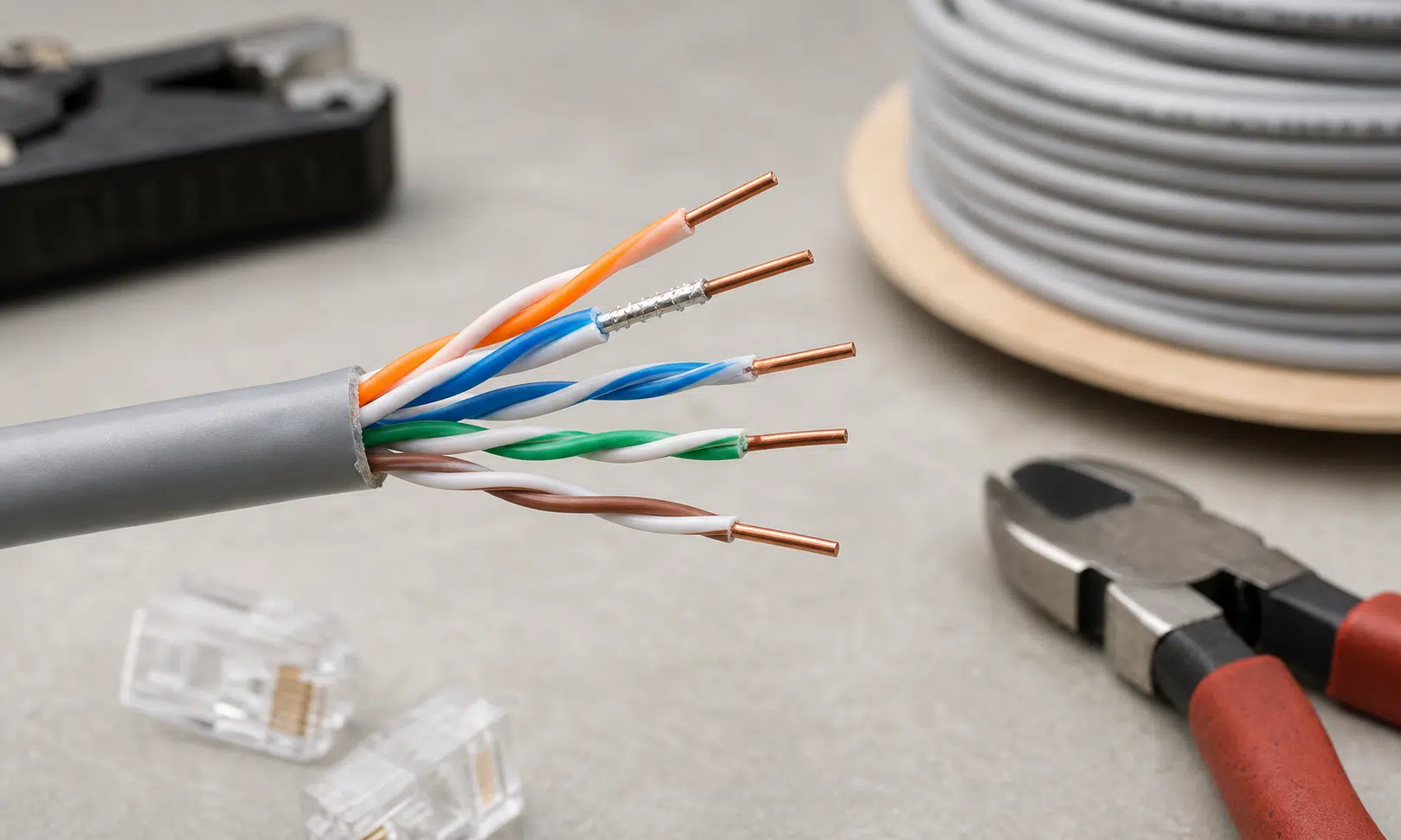

A cheap box of Cat6 Ethernet cable can look like an easy win when you are wiring a house, adding cameras, or cleaning up a home network. The listing may have thousands of reviews, the jacket may say Cat6, and the price may be much lower than the other bulk rolls sitting beside it.
The detail that matters is often buried in three letters: CCA.
CCA means copper-clad aluminum. It is not the same thing as solid copper Ethernet cable, even when it is advertised alongside Cat6 products. For a short patch cable sitting behind a desk, that may not matter much. For a long run, a Power over Ethernet device, or anything you plan to close up inside a wall, it can matter a lot.
This is not a reason to panic about every inexpensive Ethernet cable. It is a reason to slow down before buying bulk cable, read the markings carefully, and avoid treating copper-clad aluminum as interchangeable with proper solid copper cabling.
What CCA Ethernet cable actually is
Copper-clad aluminum cable uses an aluminum conductor with a thin copper layer around the outside. From the outside, it can look like ordinary Ethernet cable. Even after you strip the jacket, the conductor may look copper-colored until you scrape into it.
That construction is why CCA cable can be confusing. It is still a real network cable in the everyday sense. It may pass data over shorter distances, and many people have used it without noticing a problem. But it should not be treated as equivalent to solid copper Category cable simply because a listing or cable jacket uses the Cat6 name.
The practical difference is not cosmetic. CCA cable uses aluminum for most of the conductor, and aluminum behaves differently from copper. It is less conductive for the same size conductor, can be more fragile at terminations, and can create more trouble in demanding installs. Those differences are easiest to ignore on a short cable and hardest to ignore on long permanent runs.
That is the buyer trap: the cable may be cheap enough to look like a bargain, but the savings are small compared with the hassle of pulling bad cable back out of a wall or troubleshooting a device that behaves inconsistently.

Solid Copper Cat6 Bulk Ethernet Cable
For permanent Ethernet runs, choose bulk cable that clearly states solid or pure bare copper conductors and has the jacket rating needed for the space. A CMR-rated Cat6 pull box is a practical fit for many riser-style home wiring projects when local code allows it.
As an Amazon Associate I earn from qualifying purchases.
Why it matters for Cat6 claims
The safest way to think about CCA is simple: if you need real Cat6 performance and compliance, buy cable clearly labeled as solid copper or bare copper, not CCA.
Category-rated cabling is expected to meet more than a speed claim on a product page. It needs to satisfy electrical and construction requirements across the rated distance and use case. A copper-clad aluminum cable may be sold with Cat6 language, but that does not make it a good substitute for properly rated solid copper Cat6 cable.
For casual use, the difference may not show up immediately. A short cable from a router to a TV, game console, or desktop might negotiate at the speed you expect. That does not mean the same cable is a good choice for a 100-foot run, a crowded bundle, a ceiling-mounted access point, or a security camera powered through the cable.
The risk grows when you ask more from the cable:
- Longer cable runs leave less room for signal loss and marginal terminations.
- Multi-gigabit networking is less forgiving than basic 1Gbps use.
- PoE adds power delivery, heat, and voltage drop concerns.
- Permanent in-wall runs bring code, listing, and inspection questions.
In other words, CCA is not just a question of whether the cable works when you first plug it in. The better question is whether it is the right material for the job you are asking it to do.
Keep CCA away from PoE runs
Power over Ethernet is where the case against CCA becomes much stronger. PoE is not only sending data. It is also sending power to devices such as cameras, access points, VoIP phones, sensors, and doorbells.
With CCA cable, the added resistance can become a practical problem. More resistance means more voltage drop before power reaches the device, and it can also mean more heat in the cable. The symptom may not be dramatic. A device may fail to power up, reboot under load, drop offline at night when infrared LEDs turn on, or behave like the network is flaky when the real issue is the cable.
That is especially relevant for longer runs and higher-power PoE devices. A short indoor patch cable connected to a low-power device is not the same scenario as a long cable feeding an outdoor camera or ceiling access point.
If you are buying cable for PoE, the rule should be strict: choose solid copper cable from a seller that states the conductor material clearly. Do not rely on a vague Cat6 label, and do not assume a low price is harmless.
Be careful with in-wall installation
CCA cable also raises a separate issue for permanent installation. Cable that goes inside walls, between floors, through ceilings, or through air-handling spaces may need specific ratings and markings. Local electrical rules vary, and requirements can depend on whether the cable is used in a riser, plenum, or ordinary low-voltage space.
The important point for a homeowner or small-office buyer is not to treat unlisted CCA cable as ordinary in-wall cable. If the cable does not clearly show the right listing and jacket rating for the space, do not bury it in the building.
Look for markings that match the job. For example, in-wall cable is commonly sold with ratings such as CM, CMR, or CMP depending on the installation environment. The exact requirement is a local-code question, but the buying principle is consistent: permanent cable should be properly listed, properly marked, and made for the place it will be installed.
This is also where the cost argument falls apart. Saving a small amount on a bulk roll is not worth creating uncertainty about an installation that may be difficult to inspect, replace, or explain later.
How to tell whether an Ethernet cable is CCA
You can often spot CCA before it ever reaches your cart. The signs are not complicated, but they do require reading past the headline and review count.
Check the listing and jacket text
Start with the product description. Honest listings may say CCA, copper-clad aluminum, or aluminum conductor somewhere in the specifications. That disclosure is useful, but it also means the cable should not be treated as solid copper.
For solid copper cable, look for wording such as bare copper or solid copper. Also look for clear jacket markings and recognized listing information when the cable is meant for permanent installation.
Be cautious with listings that use Cat6 heavily but never state the conductor material. If the seller will not say whether the cable is solid copper, assume you need to verify before using it for anything important.
Use price as a warning sign
Copper has a real material cost, so a bulk roll that is dramatically cheaper than comparable solid copper cable deserves extra scrutiny. A low price does not prove the cable is CCA, but it is a reason to read every specification line carefully.
Weight can be another clue. Aluminum is lighter than copper, so a large box of CCA cable may feel noticeably lighter than a comparable box of solid copper cable. That is not a precise test, but it can reinforce other warning signs.
Scrape a conductor if you already own it
If you already have the cable, the simplest physical check is to strip one conductor and scrape the surface with a blade. Solid copper should remain copper-colored through the conductor. CCA will reveal a silver-colored core once the thin copper layer is scraped away.
Do this on a scrap end, not on a finished cable you plan to use. If you find a silver core, label the box clearly so it does not accidentally become your future in-wall or PoE cable.
Where CCA may still be acceptable
CCA is not automatically useless. For a short, visible patch cable carrying ordinary data, it may work well enough. If the cable is not inside a wall, not powering anything, and not being asked to run near the edge of the Cat6 specification, the real-world downside may be limited.
That is a narrow use case, though. The more permanent or demanding the installation becomes, the less sense CCA makes.
A reasonable split looks like this:
| Use case | CCA cable? | Better choice |
|---|---|---|
| Short patch cable for basic data | May be acceptable if expectations are modest | Solid copper if the price difference is small |
| Long home network run | Avoid | Solid copper Cat6 or Cat6A |
| PoE camera or access point | Avoid | Solid copper cable with the right rating |
| In-wall installation | Avoid unless properly rated and accepted locally | Properly listed in-wall solid copper cable |
| Multi-gigabit networking | Avoid for serious runs | Solid copper cable matched to the speed and distance |
What to buy instead
For permanent wiring, buy once and buy boring. Look for solid copper bulk cable from a reputable seller, with jacket markings that match the installation. If you are wiring a home today, Cat6 is still a sensible baseline for many installs, while Cat6A may be worth considering when the run length, future 10Gbps plans, or local conditions justify the added cost and stiffness.
Do not overfocus on flashy marketing. Gold-colored plugs, inflated speed claims, and aggressive product titles are less important than conductor material, cable rating, termination quality, and whether the cable is appropriate for the space.
For patch cables, the decision can be less strict, but it is still worth checking the description. If a solid copper patch cable is only a few dollars more, it is usually the cleaner choice.
The bottom line
CCA Ethernet cable can be easy to buy by accident because it often sits beside real Cat6 cable in search results and may use similar language. The problem is not that every CCA cable will fail immediately. The problem is that it is the wrong material for the jobs where cable quality matters most.
Use solid copper cable for long runs, PoE devices, multi-gigabit links, and anything that disappears into a wall or ceiling. If a listing says CCA, treat that as a warning label, not a minor technical detail. If a listing does not clearly state the conductor material, keep looking.