

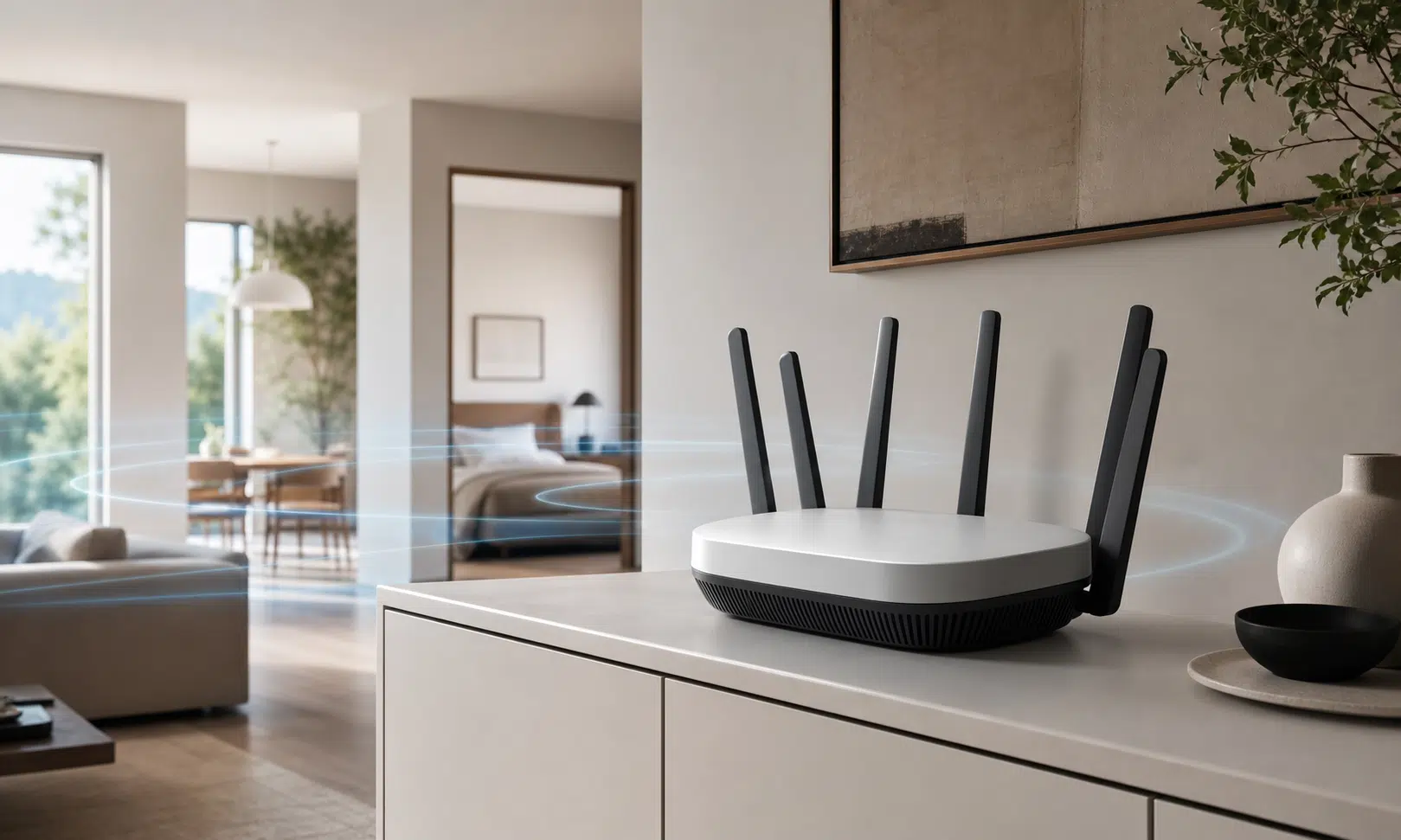

TP-Link has announced Archer 8, its first Wi-Fi 8 router platform, with a planned October 2026 launch. The timing still leaves plenty of room for final specifications, market availability, and real-world performance to change, but the direction is already clear: TP-Link wants Wi-Fi 8 to be judged less by headline speed numbers and more by whether a network stays steady when a home is full of connected devices.
That matters because the most annoying home Wi-Fi problems are rarely about theoretical maximum speed. They are usually about the bedroom that gets weaker signal, the video call that stutters when someone starts streaming, or the mesh system that hesitates as a phone moves from one room to another. Archer 8 is being positioned around those everyday problems rather than a simple faster-is-better pitch.
What TP-Link Is Claiming
Archer 8 is built around the emerging IEEE 802.11bn specification, commonly referred to as Wi-Fi 8. The standard is still in progress, so early Wi-Fi 8 products should be treated as pre-standard hardware until the wider ecosystem settles.
TP-Link says the platform is designed to improve reliability, latency, interference handling, and multi-device performance. The company points to several technical areas behind that push, including antenna architecture, RF optimisation, thermal design, and AI-assisted network management.
For buyers, the useful takeaway is not that Archer 8 will automatically make every home network faster. It is that TP-Link is aiming at the moments where modern routers often feel inconsistent: crowded device lists, multi-floor layouts, interference from nearby networks, and demanding use cases such as gaming, streaming, and video calls.

TP-Link Archer BE550 Wi-Fi 7 Router
If you need a router before Archer 8 arrives, the TP-Link Archer BE550 is a current Wi-Fi 7 option with tri-band support, 2.5GbE ports, and EasyMesh compatibility. It makes the most sense for homes that want a standalone router now rather than waiting for early Wi-Fi 8 hardware.
As an Amazon Associate I earn from qualifying purchases.
Early Performance Claims
TP-Link has shared internal lab figures comparing early Wi-Fi 8 implementations with Wi-Fi 7 under simulated home conditions. These are company-provided numbers, not independent review results, so they should be read as early indicators rather than proof of final product performance.
| Area tested | TP-Link’s reported result | Buyer relevance |
|---|---|---|
| Enhanced modulation and coding | Up to 33% higher throughput | Could help maintain steadier speeds at range |
| Unequal modulation handling | Up to 24% higher throughput | Could improve performance when signal quality varies |
| Multi-access-point interference | Up to 15% improvement | Relevant to mesh systems and busy wireless environments |
| Multi-floor single-device coverage | Up to 30% signal-performance improvement | Potentially useful in larger or taller homes |
| Multi-device environments | 10-20% improvement | Useful where phones, laptops, TVs, consoles, and smart-home gear compete at once |
| Receive sensitivity on 5 GHz and 6 GHz | 1-3 dB improvement | May help strengthen coverage in harder-to-reach rooms |
Those numbers are promising, but they need independent testing across real homes, different client devices, and mixed Wi-Fi generations before they should drive a purchase decision.
Design And Product Roadmap
TP-Link is also putting more emphasis on the physical design of Archer 8 than many router launches do. The company describes a minimalist chassis with micro ridge texturing, precision contours, and a soft front-facing status light. In practical terms, it sounds like a router intended to sit visibly in a living room rather than be hidden behind furniture.
Archer 8 is also the first part of a wider Wi-Fi 8 lineup. TP-Link says Deco 8 mesh systems are planned for Q1 2027, followed by a Roam 8 travel router, range extenders, and adapters in Q2 2027. Regional availability and final specifications are expected closer to launch.
Early Verdict: Who Should Watch Archer 8?
Archer 8 is worth watching if your current router struggles with coverage consistency, crowded device use, or mesh stability. It may be especially relevant for larger homes, multi-floor layouts, and households where streaming, gaming, work calls, and smart-home devices all run at once.
It is not a product most people should plan to buy on announcement alone. Wi-Fi 7 routers are already available, client-device support for Wi-Fi 8 will take time, and TP-Link’s strongest performance claims currently come from internal testing. The sensible move is to treat Archer 8 as an early sign of where premium home networking is going, then wait for final pricing, specifications, compatibility details, and independent reviews before upgrading.

TP-Link Deco BE63 Wi-Fi 7 Mesh System
For homes where weak rooms and device congestion are the main problem, the TP-Link Deco BE63 offers a Wi-Fi 7 mesh setup with tri-band networking and 2.5GbE wired backhaul options. It is a practical current-generation alternative while Wi-Fi 8 products remain pre-launch.
As an Amazon Associate I earn from qualifying purchases.