

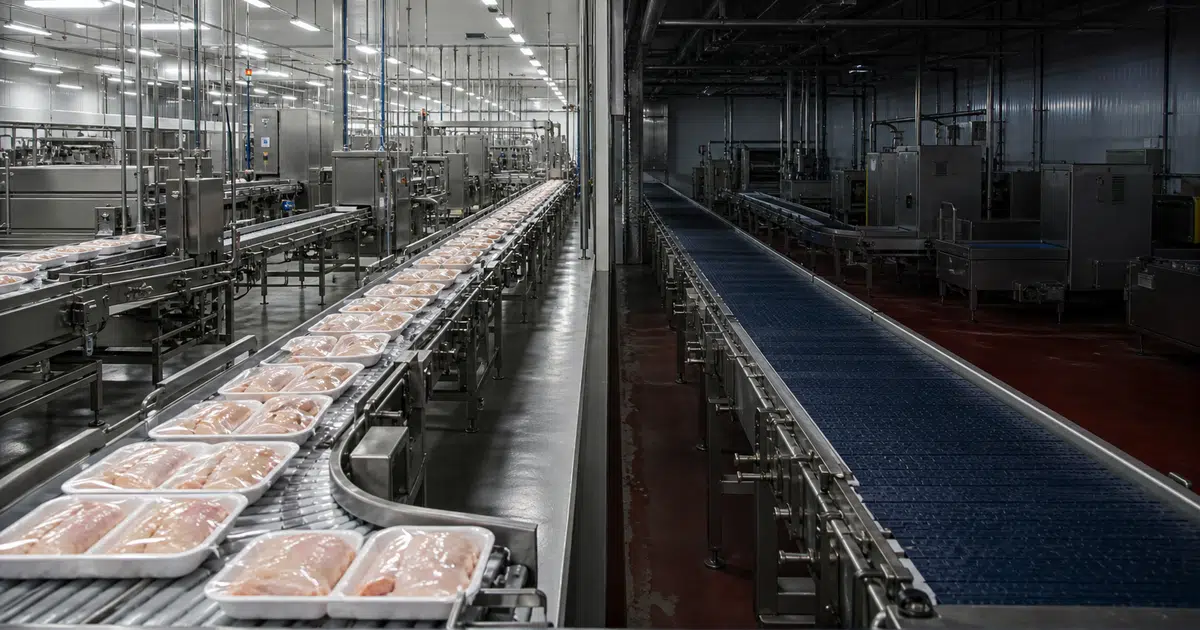

Tyson Foods’ protein portfolio is sending two very different signals. In its most recently reported quarter, the beef unit posted an adjusted operating loss of $138 million. Chicken generated $488 million in adjusted operating income, up from $448 million a year earlier.
That split shows both the value and the limits of diversification. Chicken is providing Tyson with a substantial earnings cushion, but its improvement has not been large enough to erase the damage in beef.
Higher beef prices are not translating into better margins
Consumers are paying considerably more at the meat counter. Ground beef prices increased 12.4% from a year earlier, while steak prices rose 11.4%. Those increases demonstrate that beef inflation has reached shoppers, but they do not mean processors are capturing the additional money as profit.
Tyson’s $138 million adjusted operating loss is the clearest measure of that disconnect. The company is selling into a market with higher retail prices while its beef operation remains in the red. For investors, that makes the difference between consumer prices and processor margins especially important.
Changes to cattle flows from Mexico could eventually affect availability, but a firm timeline for resuming imports has not been publicly confirmed. Without a reliable schedule, any potential benefit remains too uncertain to treat as a near-term answer for processors.
The broader constraint is structural. Meatpackers depend heavily on domestic livestock markets, and their economics move with cattle availability, animal costs, feed expenses, processing volumes, and the prices customers will accept. A processor cannot quickly manufacture additional cattle supply when those conditions move against it.
Chicken producers prepared for a bigger consumer shift
Poultry producers expanded flock sizes in anticipation that high beef prices would push more consumers toward cheaper protein. They also adopted breeds designed to grow more efficiently. Cobb-Vantress, which is owned by Tyson, introduced one such breed designed to grow faster while consuming less feed.
The expected substitution did not happen at the scale producers anticipated. Beef demand remained resilient despite higher prices, leaving chicken companies with more production capacity than the consumer shift required. Favorable raising conditions also allowed more birds to complete the grow-out cycle.
That combination creates a familiar commodity problem: when production expands faster than demand, wholesale pricing comes under pressure. Companies with heavy exposure to bulk chicken can therefore experience very different results from businesses that sell more branded or prepared products, although the precise protection provided by those channels varies.
Tyson’s chicken results show that the pressure is not uniform across the industry. The segment’s adjusted operating margin increased to 11.2% from 10.6%, while operating income gained $40 million from the prior-year period. Chicken has delivered seven consecutive quarters of growth for the company.
Pilgrim’s Pride has also been developing its branded presence. Its Just Bare label expanded from 1% to 13% of the chicken market over three years. That growth indicates meaningful consumer traction, though the figure alone does not establish how much insulation the wider company has from wholesale price movements.
Diversification only works when the stronger business is strong enough
Tyson’s chicken improvement is significant, but the arithmetic remains unforgiving. The segment produced $40 million more adjusted operating income than it did a year earlier, while beef recorded a $138 million quarterly loss. Even a healthy chicken operation can struggle to compensate for losses of that size elsewhere in the portfolio.
For investors, the results make segment-level performance more useful than a simple reading of grocery prices or total demand. Higher shelf prices can coexist with weaker processing earnings when the cost and availability of livestock move differently from retail pricing.
The contrast is a sharp example of food supply-chain economics: selling multiple proteins reduces dependence on a single market, but it does not eliminate commodity exposure. Tyson’s chicken business is providing real support. Its beef operation remains large enough, however, to determine whether that support translates into stronger company-wide results.