

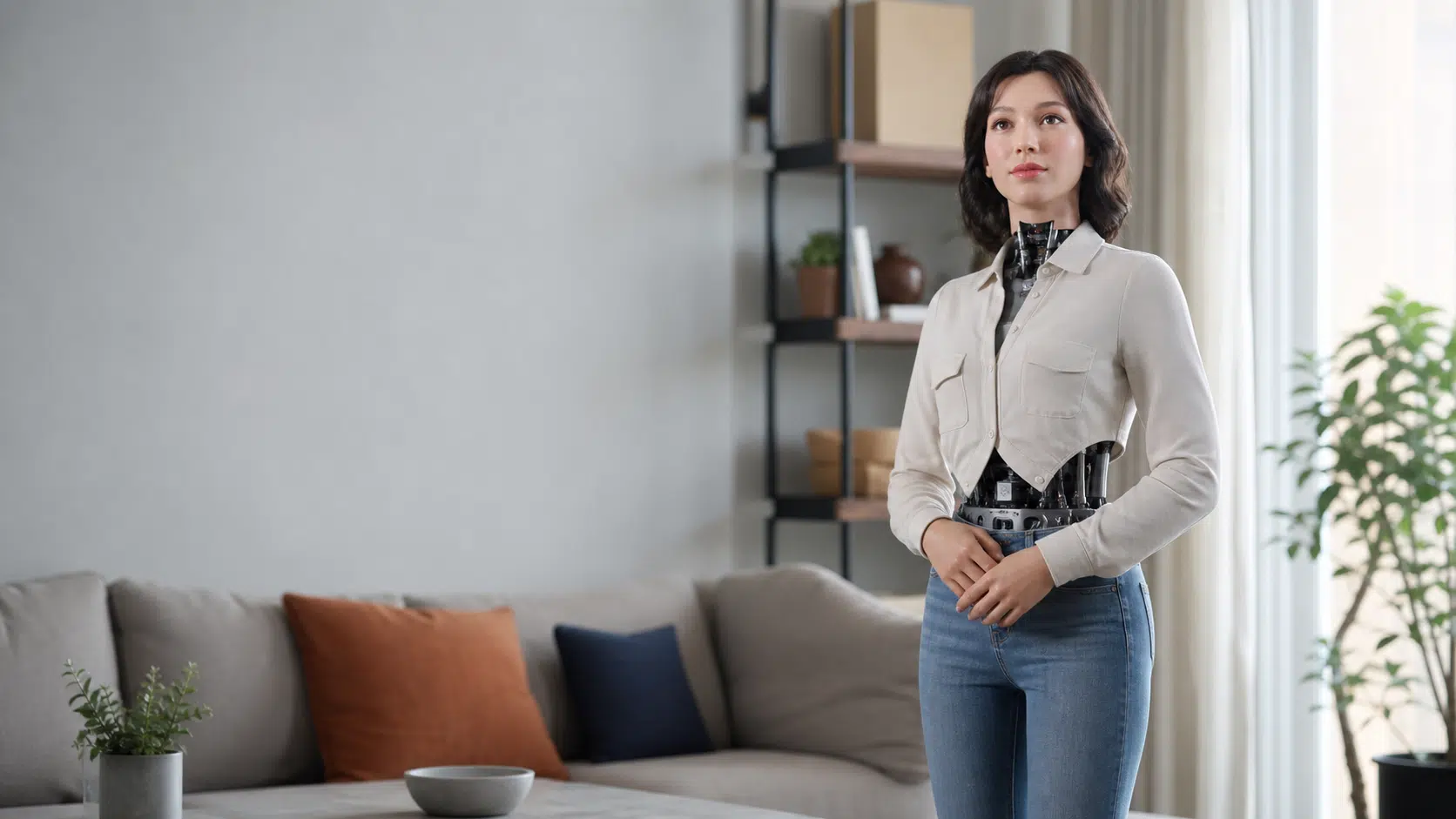

UBTECH is positioning its U1 humanoid robot line as a move toward consumer companion robots, but many of the most eye-catching details should be read as company-reported claims rather than independently verified facts.
The Chinese robotics company says it has created UWORLD, a consumer-focused brand, and placed the U1 series under that label. The pitch is clear: take experience from full-size humanoid robotics and apply it to a home robot built less for labor and more for social presence.
That does not mean the U1 should be understood as a general-purpose household helper. Based on the company’s own description, the robot is presented mainly as a lifelike companion that can converse, respond to emotional cues, and move in limited indoor settings. Claims about pricing, demand, launch timing, industrial customer history, technical specifications, privacy protections, and business momentum have not been independently verified and should be treated with caution.
For readers trying to understand what this product category actually means, the useful question is not whether the robot looks futuristic. It is what the company says the U1 can do, what it appears unable to do, and which details still need confirmation before anyone treats it as a real consumer-ready option.
What UBTECH Says It Is Building
UBTECH describes the U1 series as a line of humanoid robot companions offered through its UWORLD consumer brand. The company’s public framing places the robots in the home rather than in factories, warehouses, or controlled industrial settings.
That distinction matters. Industrial humanoids are usually judged by whether they can repeat tasks, move parts, handle tools, or work safely around people in structured environments. A companion robot is judged differently. It has to communicate naturally enough to feel useful, respond without becoming intrusive, and operate safely in spaces designed for people rather than machines.
According to the company’s description, the U1 line is not being presented primarily as a physical labor robot. It is described as a social and emotional companion, with onboard AI used for conversation and mood-aware responses. UBTECH says the system can consider facial expression, voice tone, and speech patterns when estimating a user’s emotional state. That claim has not been independently verified, so it should be understood as part of the company’s stated product vision rather than proven performance.
The broader idea is familiar in consumer robotics: a machine that does not simply execute commands, but tries to maintain an ongoing relationship with its owner. The U1 appears to sit in that category. It is closer to a conversational presence than to a robot vacuum, delivery robot, or factory automation system.
Reported Design and Physical Details
UBTECH is said to be offering male and female versions of the U1, although that detail has not been independently verified. The reported height figures are 183 centimeters, or about 6 feet, for the male model and 168 centimeters, or about 5 feet 6 inches, for the female model. Those measurements should be treated as reported specifications rather than confirmed measurements.
The robots are described as having lifelike silicone skin, realistic hair, expressive facial features, and 88 degrees of freedom across the body. If accurate, that would suggest a design focused heavily on humanlike motion and appearance, including coordinated movement through the arms, legs, hands, neck, chest, and torso.
Still, appearance is not the same as capability. A humanoid robot can look convincing in promotional footage while still being limited in practical use. Company videos reportedly show the robots in staged, cinematic settings with close-up emphasis on skin texture, hair, facial expression, and reflective eyes. Those videos have not been independently verified as demonstrations of everyday performance.
For anyone assessing this kind of robot, the visual design should be separated from the operating reality. Important questions include:
- Can the robot move reliably in an ordinary home without supervision?
- How well does it handle background noise, interruptions, and multiple speakers?
- Does it recognize emotional cues accurately, or only respond to simple signals?
- What happens when the environment is cluttered, dimly lit, or unfamiliar?
- How often does it need charging, maintenance, cleaning, or calibration?
The source material does not answer those questions in detail. That means the U1 is better understood, for now, as a proposed or company-described companion platform rather than a fully evaluated home robot.
What the U1 Is Supposed to Do
The main promised use case is companionship. UBTECH says the robots can hold conversations, recognize moods, and adjust responses to the user. When a person appears stressed or unhappy, the robot is described as being able to offer supportive dialogue or steer the interaction in a more positive direction.
Those are substantial claims. Emotional recognition in consumer technology can be difficult to validate because it depends on context, culture, lighting, speech patterns, privacy settings, and the accuracy of the underlying model. A robot may detect that a person sounds quiet or looks tense, but that is not the same as truly understanding how the person feels.
A careful reading is that UBTECH is describing the U1 as a conversational companion with emotion-aware features. It should not be assumed that the robot can reliably interpret complex emotional states or provide meaningful mental health support. The source does not provide independent testing, clinical validation, or third-party performance data.
The company also says owners can customize the robot’s appearance and personality traits over time. That could make the product feel more personal, but the exact depth of customization is not clear from the source material. It is not known whether this means simple preset personalities, adjustable conversation style, physical customization, software profiles, or a broader personalization system.
What It Apparently Does Not Do
One of the most important details is the limitation on household work. UBTECH is not presenting the U1 as a robot that can clean the house, cook meals, carry heavy objects, or perform broad domestic chores.
The company’s own description suggests more modest movement abilities. The robots are said to be able to sit, stand, walk on flat indoor surfaces, and engage in conversation. Claims about these movement capabilities have not been independently verified, but even as described, the scope is narrow.
The U1 is also not said to be built for stairs, uneven surfaces, or challenging home layouts. That matters because real homes are not controlled robotics labs. They contain rugs, pets, thresholds, dropped objects, cords, furniture changes, reflections, and people moving unpredictably.
The platform is also described as closed in another practical sense: users reportedly cannot freely program new behaviors or functions. If accurate, that would make the U1 less like a developer robotics platform and more like a managed consumer product. That may reduce risk for ordinary users, but it also limits experimentation and advanced customization.
Here is the practical split based on the source material:
| Area | Company-described direction | Important caveat |
|---|---|---|
| Primary role | Social and emotional companionship | Not independently tested in the source |
| Movement | Sit, stand, and walk on flat indoor surfaces | Not described as suitable for stairs or uneven terrain |
| Household tasks | Not the main focus | No supported claim that it performs chores |
| Customization | Appearance and personality traits are said to be adjustable | Depth of customization is unclear |
| Programming | Reportedly limited for users | Not positioned as an open robotics platform |
Privacy and Personal Data Claims
UBTECH says personal memories and conversation data are stored locally with encryption. That is an important claim because companion robots may collect unusually sensitive information: spoken conversations, routines, emotional patterns, faces, names, preferences, and details about the home.
However, the privacy claim has not been independently verified. Without more detail, readers should not assume they know how data is stored, what is encrypted, whether cloud processing is involved, how long records are retained, or how deletion works.
For a product in this category, the privacy questions are not minor. A home companion robot is not just another connected device on a shelf. It may move through private rooms, listen for speech, recognize people, and build long-term interaction history.
Before treating a robot like this as safe for home use, the key privacy details would need to be clear:
- Whether voice, video, or biometric data ever leaves the device
- What information is stored locally and for how long
- Whether users can review, export, or delete stored memories
- How encryption keys are managed
- Whether third parties can access user data
- How the robot behaves when offline
The source does not provide enough verified detail to answer those questions. The safest wording is that UBTECH claims local encrypted storage, but independent confirmation would be needed before relying on that as a privacy guarantee.
Reported Pricing, Pre-Orders, and Launch Timing
The U1 robots are reported to cost around $30,000, but that figure has not been independently verified. At that price, the product would sit far outside ordinary consumer electronics and closer to a luxury technology purchase, research platform, or early-adopter showcase device.
The source also reports that pre-orders opened on JD.com on June 2 with a 3,000 yuan deposit, roughly equivalent to about $450, and that the company recorded more than 2,100 reservations within the first week. Those details should be treated as unverified company-reported or media-reported figures, not confirmed sales data.
A delivery timeline is also unclear. The source mentions expected deliveries beginning in mid-September and a public launch event scheduled for June 30, but a firm timeline has not been publicly confirmed in the provided material.
That uncertainty is important because robotics products often change between announcement, demonstration, pre-order, and actual delivery. Hardware revisions, safety testing, supply constraints, software readiness, and regulatory requirements can all affect timing.
For now, the safest interpretation is that UBTECH is signaling serious consumer interest in the U1 line, while the actual price, delivery schedule, availability, and customer experience still need confirmation.
How UBTECH Connects This to Its Industrial Robotics Work
UBTECH has spent years developing full-size humanoid robots for industrial use, according to the source material, and manufacturers including NIO and FAW-Volkswagen are named as users. The source also lists Airbus, Texas Instruments, ZEEKR, Dongfeng Liuzhou Motor, and FAW-Volkswagen among companies said to have received advanced humanoid systems. Those customer and deployment claims have not been independently verified here.
The company’s argument appears to be that technologies developed for factories and warehouses can support a move into consumer robotics. In principle, that makes sense. Industrial humanoid work can involve balance, perception, motion control, safety systems, task planning, and human-machine interaction. Those areas are also relevant to home robots.
But the home is not simply an easier version of the factory. A factory can be mapped, standardized, supervised, and optimized around automation. A home is personal, irregular, and much harder to control. A robot that performs well in a structured industrial setting may still struggle in a living room, hallway, kitchen, or bedroom.
The source also says UBTECH and Siemens partnered in March 2025 to accelerate humanoid robot production, with a target of 10,000 units in annual manufacturing capacity by 2026. That partnership and target have not been independently verified in this rewrite, so they should be understood as reported claims.
Business Momentum Claims Need Context
The source says UBTECH reported 821 million yuan in 2025 revenue from full-size embodied intelligent humanoid robot products and solutions, more than 22 times the previous year. It also says the segment accounted for 41.1 percent of total company revenue, up from 2.7 percent a year earlier, with cumulative deliveries reaching 1,079 units.
Those numbers are presented as company-reported or media-reported figures and have not been independently verified here. They may indicate that UBTECH sees humanoid robotics as a fast-growing part of its business, but readers should not treat them as audited or confirmed based only on the supplied source text.
Even if the figures are accurate, industrial revenue growth does not automatically prove consumer demand for lifelike humanoid companions. The two markets have different buyers, budgets, support expectations, safety concerns, and definitions of usefulness.
For businesses, a robot can be justified if it improves throughput, reduces labor strain, or supports automation goals. For households, the value question is more personal: does the robot make daily life better enough to justify its cost, complexity, and privacy tradeoffs?
What to Watch Before Taking the U1 Seriously as a Home Robot
The U1 concept is notable because it shows how quickly humanoid robotics companies are trying to move beyond factory demonstrations and into consumer-facing products. But the source material leaves too many open questions to treat the robot as a proven home companion.
The most useful way to evaluate the U1 is to look for independent evidence on ordinary performance rather than polished demonstrations. That includes long-form testing in real homes, clear privacy documentation, confirmed pricing, confirmed delivery dates, repair and support terms, and unedited demonstrations of movement and conversation.
Readers should also watch whether UBTECH explains the limits of the system plainly. A companion robot does not need to do everything to be useful, but it does need honest boundaries. If it cannot climb stairs, perform chores, handle cluttered floors, or accept user-created behaviors, those limits should be clear before anyone places a deposit or treats it as a practical household assistant.
Based on the available material, the U1 is best understood as an ambitious companion robot concept from a company trying to extend humanoid robotics into the home. It may signal where consumer robotics is heading, but the strongest claims around capability, demand, privacy, delivery timing, and business scale still need independent confirmation.