


Ouster’s new Rev8 sensor family is built around a simple but important idea: a LiDAR point cloud should not have to be color-blind.
Traditional LiDAR is excellent at measuring geometry. It sends out laser pulses, times their return and builds a 3D map of the world around a vehicle, robot, drone or mapping rig. But that map is usually based on distance and reflectivity, not full visual color. If a system needs to know whether it is looking at a stop sign, a brake light, lane paint, vegetation or a marked work zone, color normally comes from a separate camera and a software pipeline that attempts to align the camera image with the LiDAR data.
Rev8 changes that architecture, at least in Ouster’s version of the technology. The company says the new OS sensor family produces native color LiDAR data, meaning each 3D point can carry color information from the moment it is captured rather than being painted afterward by a camera-calibration process. For engineers building perception stacks, the pitch is not just prettier point clouds. It is tighter alignment between shape, depth and color.
That matters because calibration between sensors can become a source of error. A camera and a LiDAR unit do not see from exactly the same place, at exactly the same time, with exactly the same optical behavior. Software can compensate, but high-speed vehicles, mobile robots and crowded industrial spaces leave less room for imperfect alignment. Rev8 is aimed at customers that want some of that complexity pushed down into the sensor itself.
What Native Color LiDAR Means
In a conventional setup, LiDAR supplies the structure and a camera supplies the image. The perception system then has to decide which camera pixels correspond to which LiDAR points. That can work well, and many deployed autonomy systems already use some form of sensor fusion, but it adds calibration, synchronization and processing work.
Ouster describes Rev8 differently. Its native color approach fuses color and geometry through the sensor hardware, so the output can include RGB-D data: red, green and blue color values attached to depth points. The result is a point cloud that can show both the shape of an object and its visible color without relying on a separate camera to colorize it afterward.
The company frames this as useful for several practical tasks:
- Reading or classifying signs where color and shape both matter.
- Recognizing brake lights and signal lights in traffic scenes.
- Creating colorized 3D maps for surveying, inspection and digital twins.
- Helping robots distinguish objects that may have similar geometry but different visual meaning.
Those are application claims from the company, and real-world performance will depend on integration, software, lighting, object distance and deployment conditions. Still, the underlying direction is clear: Ouster wants LiDAR to carry more semantic information before the data ever reaches the AI model.
The L4 Chip Behind Rev8
Rev8 is powered by Ouster’s new L4 Ouster Silicon, including L4 and L4 Max variants. Ouster says the chip architecture embeds Fujifilm color science and supports hardware-enabled high dynamic range color capture.
The company lists several headline figures for the L4 architecture: 42.9 GMACs of processing power, detection of up to 20 trillion photons per second, a 40 kHz measurement rate and picosecond timing precision. Those numbers are not especially useful to most buyers in isolation, but they point to the design goal: more processing and more sensing work happening on the device rather than in a separate perception box.
The color specification is also notable. Ouster says Rev8 supports 48-bit color depth and 116 dB of dynamic range, with native color performance across lighting conditions from 1 lux to 2,000,000 lux. In plain terms, the company is claiming the sensor can preserve color data across very dim and very bright scenes, although field results will matter more than lab-style numbers for customers operating outdoors, underground or in mixed-light industrial sites.
OS1 Max Leads the New Lineup
The flagship Rev8 model is the OS1 Max, a long-range sensor designed for demanding autonomy and mapping use cases. Ouster positions it for autonomous vehicles, trucks and buses, off-highway equipment, industrial robotics, traffic monitoring, security and 3D mapping vehicles.
The OS1 Max is a 256-channel sensor in its highest-resolution configuration. Ouster’s datasheet lists 200 m range on a 10% reflectivity target and a 500 m maximum representable range. The company also says the sensor offers a 360-degree horizontal field of view and a vertical field of view just under 44 degrees, while marketing materials round that class as a 45-degree field-of-view sensor.
| OS1 Max specification | Ouster-listed figure |
|---|---|
| Sensor family | Rev8 OS |
| Maximum vertical resolution | 256 channels |
| Range on 10% target | 200 m |
| Maximum representable range | 500 m |
| Horizontal field of view | 360 degrees |
| Vertical field of view | 43.9 degrees, marketed as 45 degrees |
| Maximum points per second | Up to 10.4 million |
| Color output | Native RGB-D point cloud |
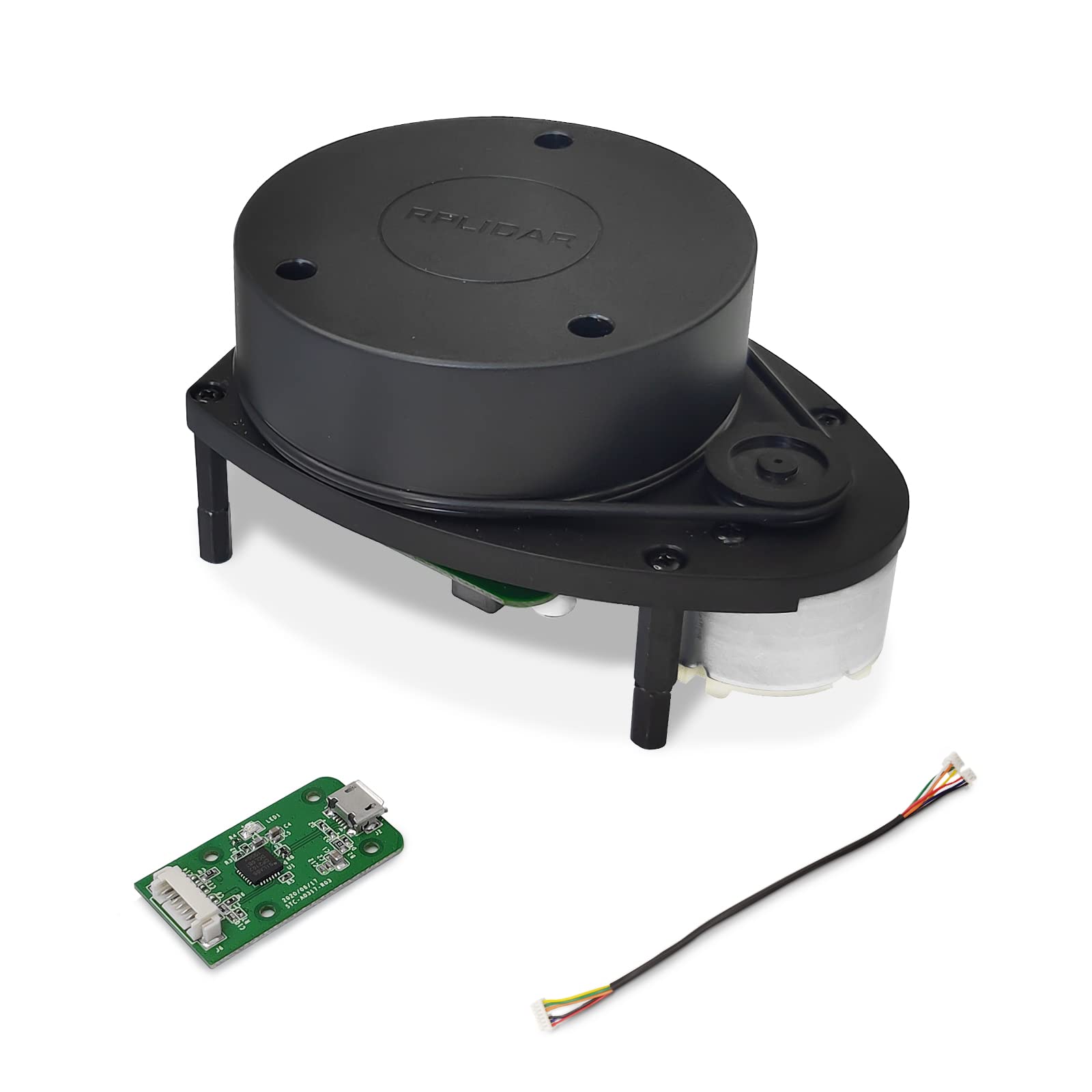
Slamtec RPLIDAR A1M8 2D LiDAR Sensor
For lab-scale robotics work, a compact 2D LiDAR such as the Slamtec RPLIDAR A1M8 can help teams experiment with obstacle detection, scan data, and basic mapping before moving to higher-end perception hardware. It is not a native color or long-range automotive LiDAR, so it fits best as a development and education sensor.
As an Amazon Associate I earn from qualifying purchases.
For a buyer, the important comparison is not only range. It is whether the sensor can reduce the number of components, calibration procedures and failure points in a production system. A single native color LiDAR will not eliminate the need for cameras in every design, and Ouster is careful to aim Rev8 at sensing and perception rather than consumer photography. But for robots or vehicles that already depend on LiDAR, adding color at the point level could simplify parts of the pipeline.
Why Color Could Matter for Physical AI
Ouster repeatedly ties Rev8 to “Physical AI,” the industry term now being used for AI systems that perceive and act in the physical world. That includes warehouse robots, autonomous trucks, delivery machines, inspection drones, mining vehicles, traffic systems and security deployments.
For those systems, depth alone is rarely enough. A robot may need to identify a pallet label, painted safety boundary, traffic cone, worker vest, signal light or sign. A vehicle may need to separate a dark object from a shadowed road surface. A mapping platform may want a 3D model that is useful to humans without a separate colorization pass.
Color does not automatically solve those problems, and it can introduce its own questions around lighting, weather, surface materials and perception-model training. But if color and geometry arrive already aligned, developers may spend less effort correcting timing and viewpoint differences between multiple sensors. That is the strongest buyer-facing argument for Rev8: not that it replaces every camera, but that it could make fused perception cleaner in the cases where LiDAR is already central.
Competition Is Already Moving
Ouster is not the only LiDAR company pushing color into the sensor conversation. Hesai has been promoting its ETX platform as a full-color or 6D LiDAR system powered by its Picasso SPAD-SoC. Hesai’s own materials describe ETX as capturing multiple dimensions of data, including spatial coordinates, reflectivity, velocity and color, although direct performance comparisons between the two platforms should be treated cautiously until buyers can evaluate both in comparable deployments.
The distinction is still useful. Ouster is emphasizing native color point clouds across its Rev8 OS family, with the OS1 Max as the long-range flagship. Hesai is positioning ETX as an automotive-grade, ultra-long-range platform for L3 autonomy. Both are signs that LiDAR vendors are trying to move beyond basic range measurement toward richer perception data.
For customers, that means the buying question is expanding. Range, resolution, price and durability still matter, but color handling, software compatibility, data bandwidth, safety targets and integration cost are becoming part of the same decision.
Part of a Bigger Ouster Shift
Rev8 also fits into Ouster’s broader move from standalone LiDAR hardware toward a fuller sensing and perception platform. In February 2026, Ouster closed its acquisition of StereoLabs, a computer vision and perception company, for about $35 million in cash plus 1.8 million shares, with a portion of those shares scheduled for release over four years.
That deal matters because it shows Ouster is not treating cameras and LiDAR as separate product islands. StereoLabs brought stereo cameras, perception software and AI model work into the company. Rev8 then adds native color LiDAR on the hardware side. Put together, the strategy is to offer customers more of the perception stack rather than only a sensor box.
That could be attractive for companies moving from prototype fleets to commercial deployments. A lab team can tolerate manual calibration, custom wiring and one-off software glue. A production fleet needs repeatability, diagnostics, long-term supply and stable interfaces. Ouster says Rev8 is designed with automotive-grade reliability, cybersecurity and functional-safety targets in mind, which is the language commercial buyers expect to hear before committing to hardware that may live in the field for years.
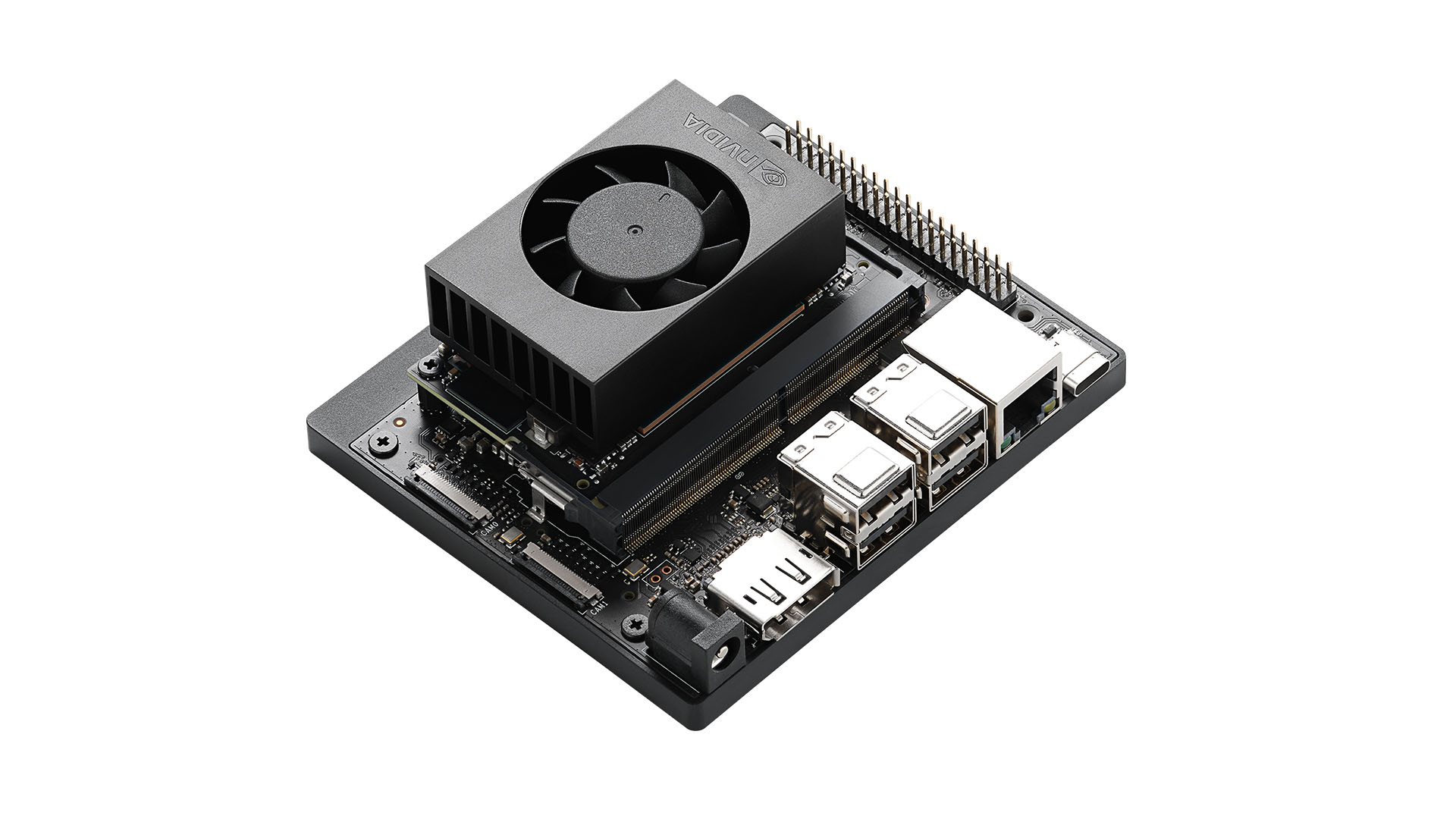
NVIDIA Jetson Orin Nano Super Developer Kit
An edge AI developer kit gives robotics teams a local platform for testing perception models, camera streams, and sensor-processing pipelines. The Jetson Orin Nano Super Developer Kit is best suited for prototyping and evaluation work rather than replacing production automotive compute hardware.
As an Amazon Associate I earn from qualifying purchases.
Availability and the Open Questions
Ouster says Rev8 sensors are available to order, with initial shipments expected to begin in the current quarter. Public pricing has not been listed, which is typical for this category. These are business-to-business sensors sold into robotics, automotive, mapping and infrastructure programs, where volume, configuration and support requirements can shape the final quote.
Early customer names mentioned around the Rev8 launch include Google, Volvo Autonomous Solutions, Skydio, PlusAI and Seegrid, along with other robotics, automotive and infrastructure companies. That does not tell buyers how quickly the technology will move into production, but it does suggest Ouster is targeting serious commercial evaluation rather than a purely experimental release.
The practical questions now are the ones procurement and engineering teams will ask first: how the native color data performs in rain, dust, glare and low light; how easy it is to integrate with existing perception software; how much data bandwidth the richer point cloud requires; and whether the sensor can reduce total system cost enough to justify adoption.
For now, Rev8 is best understood as a meaningful step in LiDAR’s evolution. It does not make autonomy simple, and it does not remove every reason to use cameras. But by attaching color directly to 3D points, Ouster is pushing LiDAR toward a richer role in machine perception – one where robots and vehicles do not just measure the world, but see more of what the world means.