

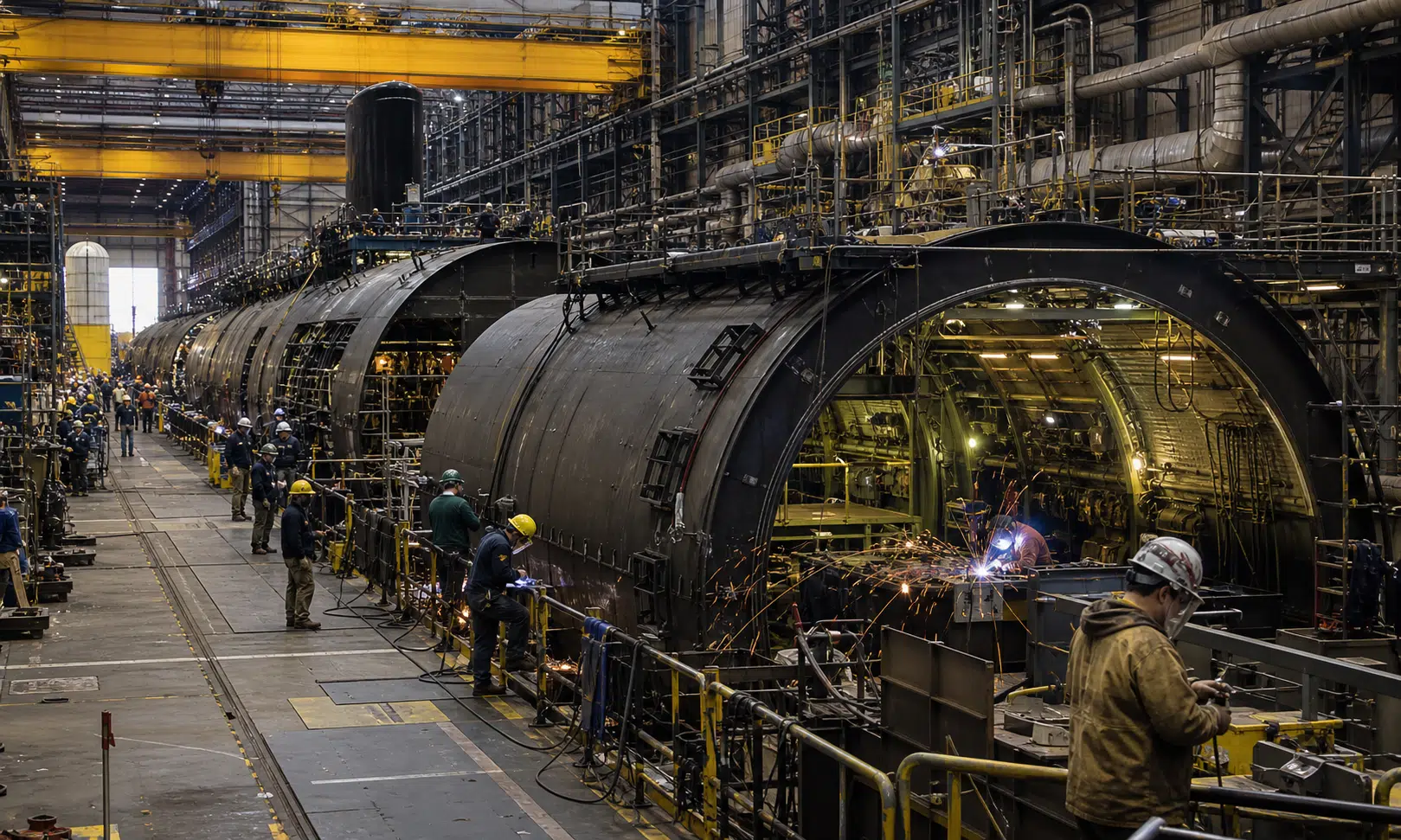

The US Navy’s submarine plans depend on more than steel, shipyard space, and defense contracts. They also depend on keeping enough skilled workers in physically demanding trades long enough to build some of the most complex vessels in the military.
That is proving difficult, according to the workforce picture described by the Navy’s Submarine Industrial Base Program Office. The challenge is especially sharp among younger, entry-level employees, who are reportedly leaving shipyard jobs for work in nearby industries that can offer similar skills, less strain, or more predictable conditions.
The issue matters because submarine construction is already under pressure. Navy officials have described a need to expand the industrial base for submarine production, particularly as yards work toward building Columbia-class ballistic-missile submarines and Virginia-class attack submarines while also supporting other shipbuilding demands. Some specific production and hiring targets have been reported, but those figures should be read as part of a broader planning discussion rather than as independently confirmed guarantees.
Why Retention Is Becoming A Shipbuilding Problem
Shipbuilding depends on trades that take time to learn. Welders, pipefitters, electricians, machinists, fabricators, and other workers do not become fully productive overnight, especially in a defense environment where quality standards, security rules, documentation, and safety procedures add complexity.
That makes early attrition costly. When a new worker leaves during the first year, a yard does not just lose a name on a staffing chart. It loses recruiting time, onboarding time, training capacity, and the chance to build a deeper bench for future work.
According to the Navy office’s account, some major yards have seen attrition remain a concern despite efforts to improve hiring and pay. Reported rates vary by yard and trade, and the available figures have not been independently verified here. Still, the pattern described by officials is clear enough: some of the hardest jobs to fill are also among the hardest jobs to keep filled.
The reasons are not hard to understand. Many shipyard jobs are physically demanding. Workers may spend long hours on their feet, handle heavy equipment, work in tight spaces, follow strict schedules, and meet exacting production standards. For younger employees comparing options, those conditions can make adjacent jobs in manufacturing, construction, data centers, or other industrial settings more attractive.
Those alternatives may use similar hands-on skills while offering different schedules, locations, workplace cultures, or growth paths. For a new worker still deciding whether shipbuilding is a long-term career, that tradeoff can be decisive.
The Hardest Roles To Fill
The Navy office identified several skilled trades as especially difficult to recruit for, including welding, machining, electrical work, and fabrication. Those roles require specific training, and in submarine construction they often require additional experience before workers can operate at the level yards need.
Location can add another layer of difficulty. Shipyards in expensive labor markets, or near commercial industries competing for the same workers, may have a harder time attracting and keeping people. Areas such as San Diego and Pearl Harbor were cited in the source material as examples where cost of living and outside competition can complicate recruiting, though local conditions can vary.
The workforce challenge also runs in the other direction. While younger workers may be leaving early, older workers are nearing retirement. Navy workforce officials have said a significant share of the maritime workforce is over 55, though the exact percentage cited in the source has not been independently verified here.
That matters because shipbuilding relies heavily on institutional knowledge. Experienced workers know how to solve production problems, train newer employees, interpret requirements, and spot mistakes before they become expensive. When too many senior workers leave at once, yards can lose practical knowledge that is difficult to replace with classroom training alone.
A simplified view of the challenge looks like this:
| Workforce pressure | Why it matters |
|---|---|
| Younger workers leaving early | Shipyards lose training investments before workers become fully experienced. |
| Physically demanding trades | Jobs can be harder to retain when nearby industries offer less demanding conditions. |
| Competition from other sectors | Manufacturing, construction, and data centers may draw from the same labor pool. |
| Retiring senior workers | Yards risk losing practical knowledge built over decades. |
The Navy’s Workforce Push
The Navy has been trying to address the labor problem through regional training and hiring efforts. The Submarine Industrial Base Program Office has described six regional Talent Pipeline Programs that, according to its account, have placed thousands of workers into maritime careers since 2021. The exact placement total reported by the office has not been independently verified here, but the programs show the direction of the effort: build a more deliberate route from training into shipyard and supplier jobs.
Those efforts are not limited to the largest shipbuilders. Smaller and mid-sized suppliers are also part of the submarine industrial base, and they need workers who can produce components, materials, and services that feed into the larger yards. A labor shortage at a supplier can still slow the wider system.
In New England, Navy officials have pointed to partnerships involving the Southeastern New England Defense Industry Alliance, state officials, industry groups, workforce organizations, suppliers, and major shipbuilders. The stated goal is to align training more closely with actual hiring needs so workers are not trained for jobs that do not exist, and employers are not left searching for skills that local programs are not producing.
The source material also cited worker training agreements and placements tied to SENEDIA, along with partnerships across many regional suppliers. Those figures are best treated as program-reported numbers rather than independently verified totals.
Virginia has been another focus. The Accelerated Training in Defense Manufacturing program has been described as a way to shorten the time needed to prepare workers for defense manufacturing trades. A Maritime Training Center opened in January 2025, according to the source material, with a stated capacity to graduate workers across multiple trades. The opening date and capacity claim have not been independently verified here, but the broader point is consistent with the Navy’s stated need for faster training pipelines.
Why Training Alone May Not Be Enough
Training more workers helps, but it does not fully solve a retention problem. If shipyards bring in new employees faster but continue losing them early, the industrial base stays under strain.
That is why the issue is not only about recruitment. It is also about whether shipyard careers can compete with other skilled trade paths once workers experience the daily reality of the job. Pay matters, but so do schedules, commute times, supervisors, safety culture, advancement opportunities, and whether workers can see a long-term future in the trade.
For younger employees, especially those with portable technical skills, the first year can be a sorting period. If the job feels too rigid or too physically punishing compared with other options, they may leave before shipbuilding becomes a career identity.
The Navy’s longer-term approach appears to include partnerships with colleges, technical schools, and K-12 programs. That can make maritime careers more visible before students enter the workforce. But visibility is only one piece. The jobs still have to be appealing enough to keep people once they arrive.
A Larger Industrial Base Problem
The submarine workforce issue sits inside a larger shipbuilding problem. Navy leaders and defense officials have warned for years that the United States has less shipbuilding capacity than it needs for its ambitions. Expanding that capacity is difficult because it requires steady demand, trained labor, supplier investment, facilities, and time.
Recent policy attention has put shipbuilding higher on the national defense agenda. The Trump administration has made the issue a stated priority, according to the source material, while officials and outside experts have argued that rebuilding capacity after decades of decline will not have a quick fix.
That is the practical problem behind the discussion of young workers leaving shipyards. Submarine construction is not just a budget line or a production target. It is a labor system. If younger workers do not stay, older workers retire, and suppliers struggle to hire, the Navy’s plans become harder to execute.
The next phase of the workforce push will likely depend on whether shipbuilding can offer a convincing answer to a simple question: why should a young skilled worker choose the shipyard over another demanding but possibly more flexible job?
Until that answer is clear, retention may remain one of the most important constraints on America’s submarine-building plans.