

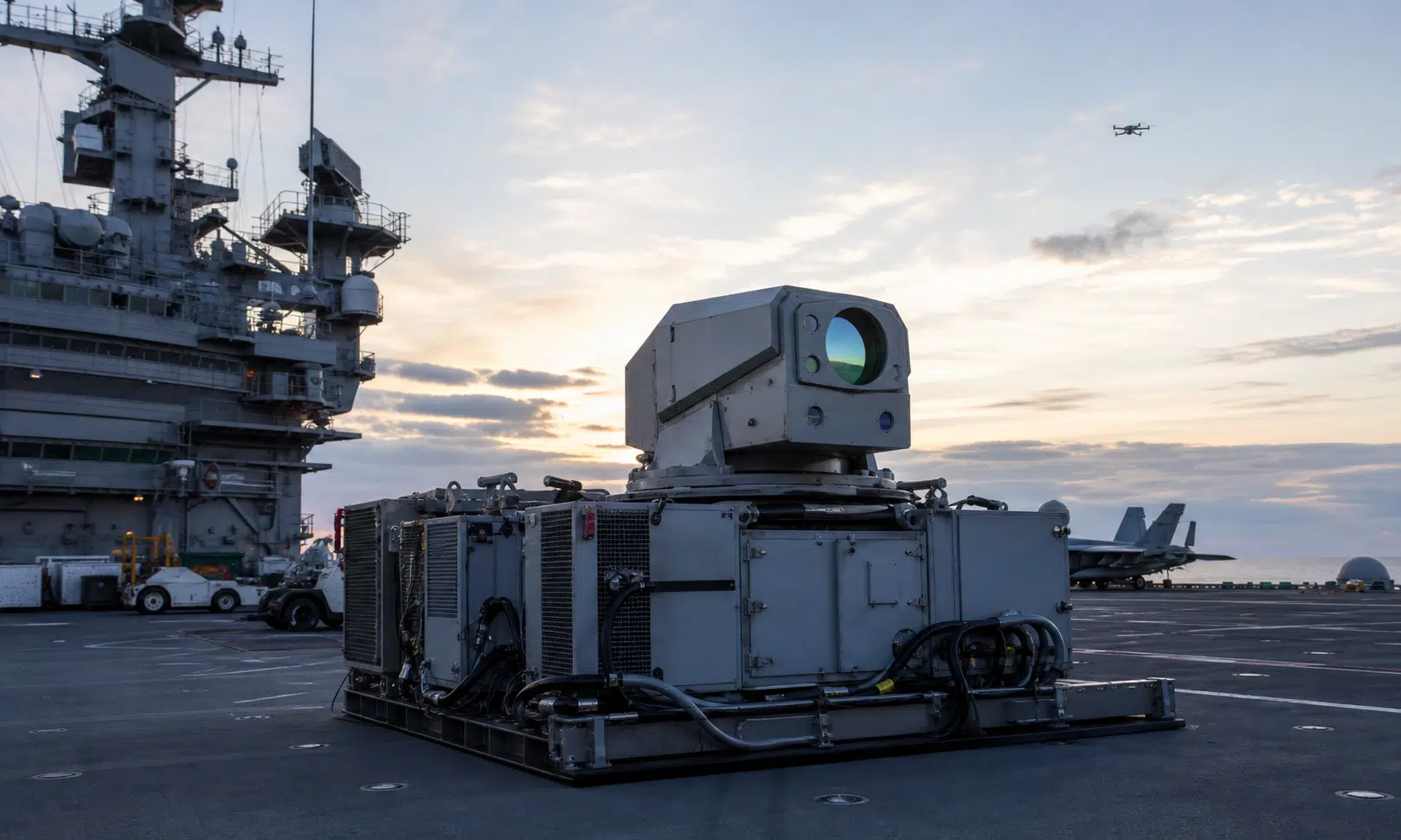

AeroVironment’s LOCUST laser weapon has moved from land-based counter-drone work to a U.S. Navy aircraft carrier, giving the service a closer look at how a roll-on, roll-off directed-energy system might protect ships without permanent modification.
The test took place aboard USS George H.W. Bush, the Nimitz-class carrier designated CVN-77, during a live-fire event in October 2025. AeroVironment said the palletized LOCUST Laser Weapon System detected, tracked, engaged and neutralized multiple aerial drone targets during the demonstration.
That matters because carrier decks are busy, constrained spaces. A weapon that can be brought aboard for a specific defensive mission, run from ship power or its own battery bank, then removed when flight operations resume, gives planners a different option from permanently installed ship lasers.
A Laser Weapon Built to Move
LOCUST is not being presented as a traditional shipboard weapon bolted into the hull. It is a Palletized High Energy Laser system, often shortened to P-HEL, packaged so it can be moved by forklift and placed where the mission allows.
That is the main practical distinction. Earlier naval laser programs often centered on ship integration: structural work, power routing, cooling, combat-system interfaces and long installation timelines. LOCUST is aimed at a different problem. It gives commanders a counter-drone tool that can be deployed temporarily on a ship, at a fixed site or on a vehicle.
The system has already been associated with land-based mobile platforms, including vehicle-mounted Army counter-UAS work. The carrier trial was meant to show that the same basic laser weapon could operate in a harsher maritime setting, where salt air, deck motion, humidity and vibration all make precision targeting harder.
AeroVironment describes the LOCUST family as a high-energy laser system for countering unmanned aircraft threats. Current public descriptions of newer LOCUST variants include scalable laser output in the 20-kW to 35-kW-plus range, depending on configuration.
For defense buyers and planners, the headline is not just the laser power. The more important question is whether the system can be moved, set up, operated and removed without creating a long integration burden for the host platform.

Directed Energy Weapons: Physics of High Energy Lasers
Readers evaluating claims about palletized laser systems may benefit from a deeper reference on high-energy laser physics, beam behavior, and field constraints. This book is best suited to technical readers, engineers, and analysts rather than casual military-news readers.
As an Amazon Associate I earn from qualifying purchases.
Why the Carrier Test Matters
Ships are difficult places for lasers. A beam weapon needs a stable line of sight and precise target tracking. At sea, both the weapon and the target are moving, atmospheric conditions can change quickly, and the system has to avoid interfering with friendly aircraft or ship operations.
In the USS George H.W. Bush demonstration, LOCUST was tested against multiple drone targets. AeroVironment said the system completed the full engagement chain: detection, tracking and neutralization.
That engagement chain is important. A laser weapon is not useful just because it can produce power. It also needs sensors, beam control, targeting software, stabilization and operator workflows that can keep pace with small, fast aerial threats.
The demonstration also suggests a specific use case for carriers. When a carrier is in port, operating in restricted waters or otherwise unable to conduct normal flight operations, it may still face drone threats. A temporary laser defense layer could be placed on deck for that period, then removed when the ship needs the deck back for aviation.
That does not make LOCUST a complete replacement for missiles, guns or electronic warfare. Small drones can vary widely in size, speed, construction and attack profile. Weather, visibility and target materials can also affect laser performance. But a successful shipboard live-fire test gives the Navy another data point as it evaluates directed-energy systems for layered defense.
The Buyer-Aware Case for Palletized Directed Energy
For military customers, palletization changes the procurement conversation. A permanent ship installation can be powerful, but it also ties the weapon to a specific platform and requires shipyard planning. A palletized system can be assigned where the threat and mission justify it.
That flexibility is especially relevant as low-cost drones keep forcing expensive defensive responses. Interceptor missiles can cost far more than the drones they destroy. Lasers promise a lower cost per shot once the system is fielded, powered and maintained, though they still carry real acquisition, training, sustainment and integration costs.
A practical evaluation of a system like LOCUST would likely focus on several points:
- How quickly the system can be placed, powered and made ready for use.
- How reliably it tracks small drones in maritime weather and ship motion.
- How much power and cooling support it needs in different operating modes.
- How easily sailors or soldiers can be trained to run the engagement workflow.
- How well it integrates with existing sensors, command systems and safety procedures.
- How often the system needs maintenance after exposure to salt, humidity and vibration.
AeroVironment has emphasized that LOCUST can operate from ship power or recharge its battery bank, reducing the need for a separate ammunition supply. That is one of the central attractions of directed energy: the magazine is limited less by physical rounds and more by power, thermal capacity, target conditions and system availability.

Unmanned Aircraft Systems in the Cyber Domain
A counter-drone laser story makes more sense when readers understand how unmanned aircraft are used, linked, disrupted, and defended against. This reference fits the procurement checklist section because it broadens the threat and systems context around C-UAS planning.
As an Amazon Associate I earn from qualifying purchases.
What the Test Does Not Prove Yet
The carrier trial is significant, but it should not be read as proof that laser weapons are ready to replace conventional ship defenses across the fleet.
Public information about the demonstration does not provide the full target set, engagement ranges, weather conditions, drone types or operational constraints. Those details matter. A laser that performs well against known test drones in controlled conditions may still face harder problems against coordinated attacks, mixed threats, poor visibility or targets designed to reduce laser effectiveness.
There is also the question of fleet integration. A roll-on system reduces ship modification requirements, but it still has to fit into command authority, airspace safety rules, emissions procedures, deck handling, power management and watchstanding routines. Those are not minor details on a carrier.
The stronger takeaway is narrower and more useful: LOCUST appears to have shown that a palletized laser weapon can operate from a maneuvering aircraft carrier and successfully engage multiple drone targets in a live-fire event. That is a meaningful step for mobile directed-energy defense.
Where LOCUST Fits in the Drone Defense Problem
Drone defense is becoming a layered problem. No single tool covers every threat. Radar, electro-optical sensors, electronic warfare, guns, missiles and directed-energy systems all solve different parts of the puzzle.
LOCUST is aimed at the part of the problem where precision, fast engagement and low per-shot cost are valuable. It is especially relevant against smaller unmanned aircraft where using a high-end missile may be tactically effective but economically painful.
For the Navy, the appeal is clear enough. A carrier or other high-value ship could gain a temporary defensive layer without going through the same level of structural work required by a built-in weapon. For the Army and other land users, the same core technology can be mounted on vehicles or used at fixed sites.
The USS George H.W. Bush test does not close the book on naval lasers. It opens a more practical chapter: systems that can be moved, tested, improved and assigned where the need is greatest. If future trials show consistent performance in tougher conditions, palletized lasers such as LOCUST could become a useful part of the counter-drone kit rather than a technology demonstration waiting for a permanent home.