

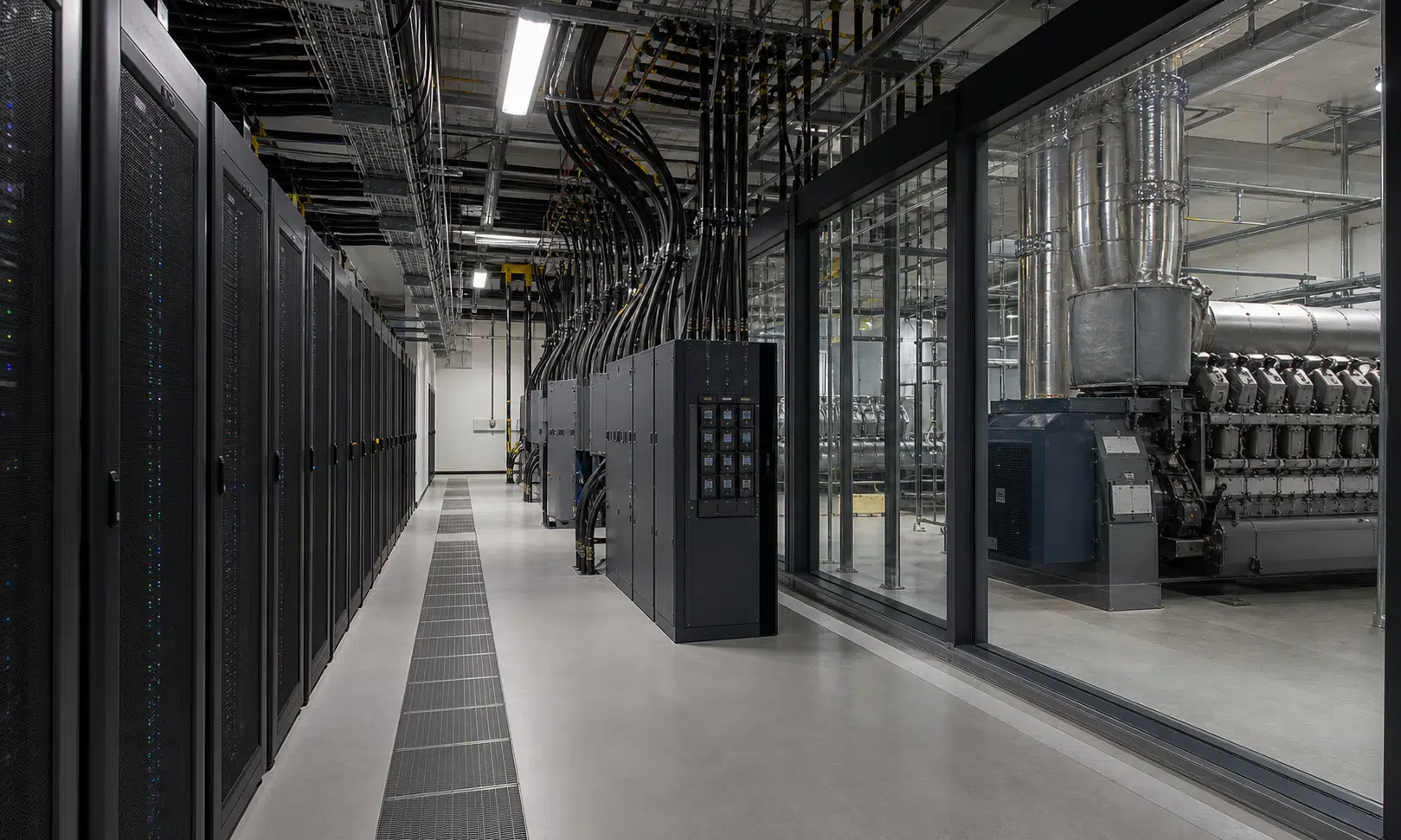

More than 100 proposed UK datacentres are looking at gas connections as a way to generate electricity, a shift that could turn energy supply into one of the hardest questions for companies buying AI infrastructure.
The pressure point is the electricity grid. Developers are facing long waits to connect large projects, while demand from AI, cloud computing and high-density data workloads keeps rising. For some operators, gas is no longer being discussed only as emergency backup. It is being considered as a primary power source, and in some cases potentially on a long-term basis.
That changes the buying decision for enterprises, cloud customers and public-sector teams. A datacentre contract is no longer only about compute availability, price, location and security. It also raises questions about how the facility is powered, whether the supplier can prove its emissions claims, and whether future regulation could affect cost or availability.
What is driving the gas option?
Ofgem officials have pointed to the scale of the queue for grid access. Stuart Okin, director of cyber regulation and AI at Ofgem, said there are about 100GW of datacentre projects waiting to connect to the National Grid. He also acknowledged that not all of those projects are likely to secure grid connections.
For developers, that creates a blunt commercial problem. A datacentre can be designed, financed and marketed, but without a reliable power route it cannot operate at the density needed for modern AI workloads. If the grid connection is delayed by years, operators have to choose between waiting, relocating, scaling back or finding another source of power.
Gas networks are now part of that conversation. Silvia Simon, head of research at Future Energy Networks, which represents UK natural gas suppliers, said the group had received “more than 100” requests for gas connections from datacentre operators over the past two years, a figure that has not been independently verified. She said those requests amounted to more than 15 terawatt hours of energy a year, roughly enough to power London for several months.
Simon also said the requests were not only about resilience. Some developers, she said, were looking at gas for primary supply, which suggests they are struggling to secure electricity network access quickly enough.
The buyer risk is bigger than the headline number
For cloud and AI buyers, the practical issue is not simply whether a datacentre uses gas. The more important question is how that use is structured, disclosed and priced into the contract.
A temporary gas arrangement used during a clearly defined grid-connection delay carries a different risk profile from a facility designed around permanent on-site fossil-fuel generation. The first may be a transitional compromise. The second could become a long-term emissions and reputational exposure for customers using the site.
| Buyer question | Why it matters |
|---|---|
| Is gas backup or primary power? | Backup generation is a different operational and climate risk from continuous supply. |
| How long is the gas plan expected to last? | A short bridge to grid power is easier to assess than an open-ended fossil-fuel dependency. |
| Are emissions included in customer reporting? | AI workloads can affect Scope 3 reporting and public climate commitments. |
| What happens if policy changes? | Planning rules, carbon costs or energy regulation could affect pricing and continuity. |

Data Center Handbook, 2nd Edition
This handbook is a technical reference for teams that need to understand datacentre design, energy use, resilience and operational risk before evaluating suppliers or site-level claims.
As an Amazon Associate I earn from qualifying purchases.
The commercial risk is sharper for companies that have made net-zero commitments or sell into regulated sectors. A supplier may advertise clean-energy goals at corporate level while a particular site depends on gas generation. Buyers need site-level evidence, not only group-level sustainability language.
Climate targets are becoming a planning constraint
The UK has set a target for clean power by 2030, including a goal of reducing unabated gas in electricity supply to below 5%. Julian Leslie, director of strategic planning at the National Energy System Operator, said datacentres powered outside the electricity grid by unabated gas raise a difficult question for that target.
The issue is partly accounting. If a datacentre is not connected to the grid but burns gas on site, the power may sit outside the main electricity-system calculation while still adding emissions. That could make the country’s clean-power progress harder to assess and harder to defend.
Officials have also said the connection process needs reform. Eleanor Warburton, Ofgem’s director for energy system design and development, said AI growth is affecting energy demand through the expansion of datacentres, and that viable projects should be able to connect faster. The government is also considering whether strategic projects, potentially including some AI developments, should receive priority.
That could help some schemes move away from gas. But prioritisation also creates another question: which projects deserve faster access to constrained grid capacity, and on what public-interest basis?
What procurement teams should ask before signing
This is now a due-diligence issue. Buyers evaluating colocation, cloud regions, AI training capacity or managed infrastructure should ask for specific answers before committing workloads to a facility.
- Whether the site uses gas generation today or plans to use it before grid connection.
- Whether gas is intended for backup, peak support or primary supply.
- The expected annual energy demand and the share supplied by fossil fuels.
- The timetable for grid connection, including any dependencies outside the operator’s control.
- How site-level emissions will be reported to customers.
- Whether customer contracts include protection if energy costs, carbon costs or planning conditions change.
Data Centre Essentials
For procurement, legal or finance teams new to datacentre deals, this reference explains the commercial, technical and operational issues that shape site selection and contract review.
As an Amazon Associate I earn from qualifying purchases.
These questions are especially important for AI buyers because compute demand can be unusually power-intensive and concentrated. A model-training project may look attractive on price and availability, but the energy source can affect sustainability reporting, public perception and long-term operating cost.
Verdict: treat power source as a core buying criterion
The emerging gas plans do not mean every UK datacentre project is unsuitable, or that every gas request will turn into a permanent fossil-fuel power plant. Some projects may use gas as a temporary bridge. Others may never be built. The connection queue itself is larger than the capacity likely to come online.
But the direction of travel matters. UK datacentre developers are under pressure to meet AI demand faster than the electricity grid can always support. That makes on-site gas generation a live commercial option, not a theoretical edge case.
For buyers, the safest stance is to treat energy sourcing as part of infrastructure quality. The strongest suppliers will be able to explain how each site is powered, how long any gas use is expected to continue, what emissions customers inherit, and what happens if regulation tightens. Vague sustainability claims are not enough when the facility’s power plan may determine the real cost of the AI capacity being purchased.