

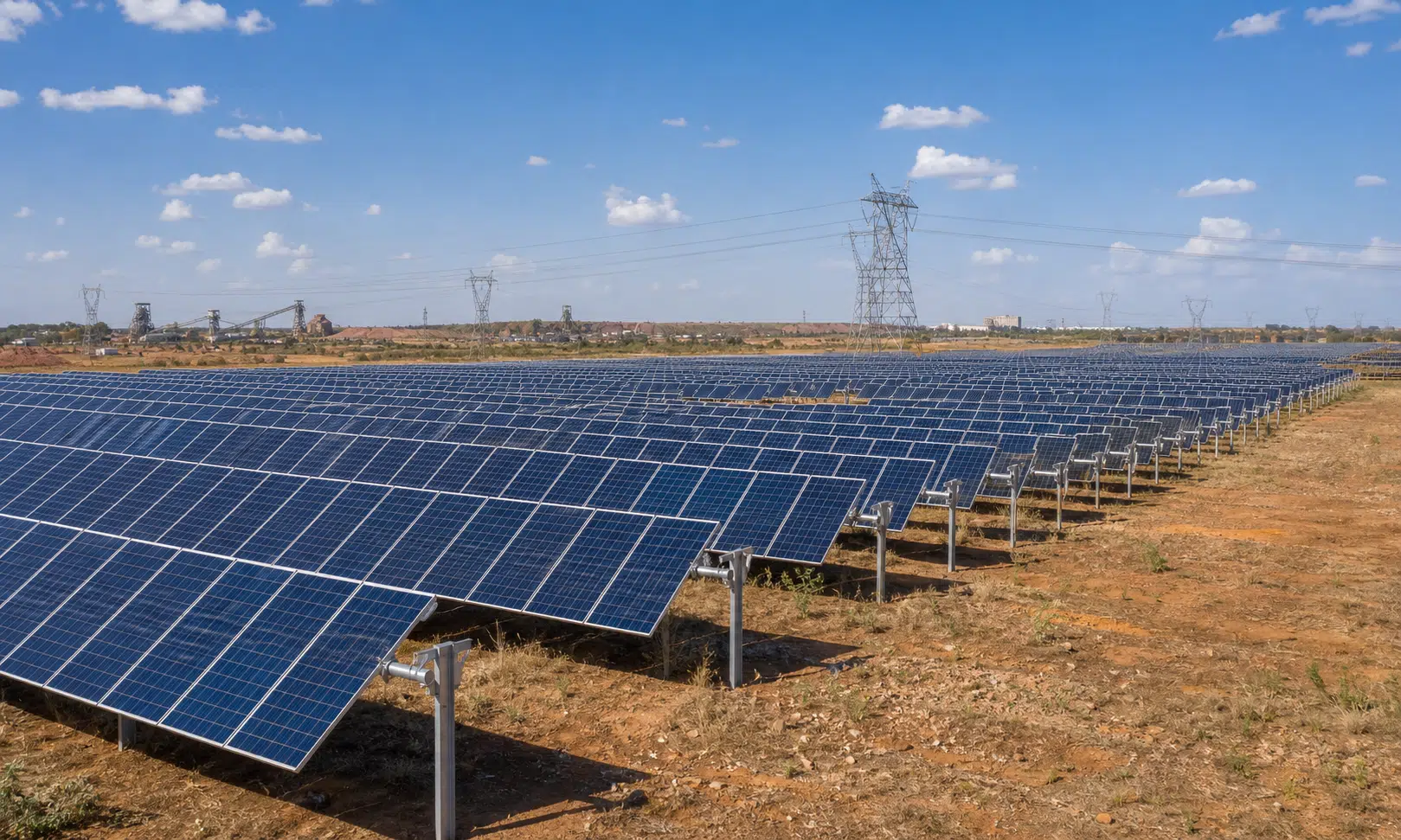

Zambia’s utility-scale solar market has taken another visible step forward, with Copperbelt Energy Corporation announcing the energization of the 136 MW Itimpi II solar plant in Kitwe. The project is being presented as the country’s largest operational solar asset to date, and its timing matters for industrial power users facing supply pressure, especially in the mining-heavy Copperbelt region.
For buyers, lenders, EPCs, storage suppliers, and corporate energy teams, the significance is not only the project size. It is what the plant says about Zambia’s near-term power procurement landscape: larger solar assets are moving from pipeline talk into operating capacity, industrial offtake remains central, and battery storage is becoming a practical next question rather than a distant add-on.
What Has Gone Online
CEC says the Itimpi II solar plant has been energized in Kitwe, northern Zambia. At 136 MW, it materially expands the company’s solar fleet and brings CEC’s reported solar generation capacity to about 230 MW after commissioning.
The project was built on roughly 170 hectares and took 14 months to construct, according to the company’s project details. CEC also reported that construction created 2,568 jobs, with more than 95% held by Zambians, and that more than 100 roles have become permanent.
Those numbers matter for local procurement teams and public-sector stakeholders because they show a project of this size can carry a sizeable domestic employment footprint. For commercial buyers, however, the more immediate question is whether Itimpi II improves the reliability and pricing outlook for large power users that need predictable supply.
CEC Chief Executive Officer Owen Silavwe has positioned the project as a response to Zambia’s power deficit and as a supply asset for industry, particularly mining. That framing is important. Mining operations are energy-intensive, hard to curtail without financial consequences, and often willing to evaluate dedicated supply arrangements when grid reliability is under strain.

Fluke 1738 Advanced Power Logger
A three-phase power logger can help industrial sites document load patterns, voltage events, harmonics, and power quality before negotiating solar-linked supply or backup arrangements. That data is useful when comparing daytime solar output against actual operating demand.
As an Amazon Associate I earn from qualifying purchases.
Buyer Takeaway: This Is About Supply Risk, Not Just Renewable Capacity
For a power buyer, a new solar plant is not automatically a complete answer. Solar output varies by time of day and weather, and industrial load often requires a firmer supply profile. The more useful question is how new solar capacity fits into a broader energy strategy that may include grid power, bilateral supply, backup generation, storage, demand management, or hybrid procurement.
The Itimpi II project is still a meaningful signal because it adds operating renewable capacity in a market where supply shortages have real operational consequences. Buyers evaluating Zambia exposure should watch how CEC and other developers pair solar generation with storage, grid services, and offtake structures.
A practical procurement review should focus on:
- Whether solar output aligns with the buyer’s daytime load profile
- How evening, night, and low-irradiance demand will be covered
- Whether storage is included, planned, or left to the customer
- How curtailment, grid outages, and force majeure are treated in contracts
- Whether the project has a credible operating record, not only announced capacity
How Itimpi II Compares With Other Zambia Solar Projects
The current Zambia solar pipeline includes both operating assets and larger projects still under development. For decision-makers, the difference matters. Operating capacity can affect near-term procurement choices. Announced or early-stage projects are useful for market direction, but they should be treated with more caution until financing, construction, grid connection, and offtake details are clear.
| Project or Program | Reported Size | Status Signal | Why Buyers Should Care |
|---|---|---|---|
| Itimpi II solar plant | 136 MW | CEC has announced energization | Adds near-term utility-scale solar capacity in the Copperbelt region |
| CEC solar portfolio target | More than 500 MW by 2027 | Company target | Could expand options for industrial and commercial energy procurement |
| Globeleq solar-plus-storage project | 250 MW solar plus 150 MW / 600 MWh storage | Work announced as underway | Storage-backed solar could better match firm power needs than solar alone |
| Chipata West site | 100 MW | Reported as under development, though details should be independently checked before relying on it | Part of a wider buildout narrative, but not a substitute for bankable operating capacity |
CEC has said it is working toward more than 500 MW of solar generation capacity by 2027. That target, if delivered, would make the company a more significant renewable power supplier for energy-intensive users. Buyers should still separate targets from contracted supply. A procurement team should ask which assets are already operating, which are under construction, and which depend on approvals, financing, or grid upgrades.

Fluke BT521 Advanced Battery Analyzer
For sites evaluating battery-backed solar, a battery analyzer can support maintenance checks on stationary battery systems and help track resistance, voltage, ripple, and temperature data over time. It is most relevant for technical teams responsible for commissioning or maintaining storage assets.
As an Amazon Associate I earn from qualifying purchases.
Financing And Bankability Questions
CEC has linked the Itimpi II project to its green bond financing program. The company has also discussed battery energy storage as a future use of remaining green bond proceeds, although a firm deployment timeline has not been publicly confirmed.
That distinction is important for buyers and investors. A financed and energized solar asset is one level of certainty. A future storage deployment is another. Storage can improve the commercial value of solar by shifting output, smoothing supply, and supporting peak demand, but the details determine whether it changes the buyer’s risk profile.
For energy buyers considering solar-linked supply in Zambia, the bankability questions should be specific:
- Who owns and operates the generation asset?
- What is the contracted delivery point?
- Is storage included in the tariff, optional, or planned later?
- What happens when solar production is below forecast?
- Are performance guarantees tied to energy delivered, capacity availability, or both?
- How are grid constraints and transmission losses allocated?
These are not legal technicalities. They affect real operating cost, production continuity, and whether a renewable power contract performs like a dependable supply product or simply adds variable daytime generation.
What Storage Suppliers And EPCs Should Watch
The Itimpi II announcement also points to a likely growth area for vendors: battery systems and hybrid plant design. Zambia’s solar resource can support substantial daytime generation, but the country’s industrial demand profile creates a strong case for storage when buyers need better coverage outside peak sunlight hours.
Storage suppliers should watch for projects where the buyer’s need is not merely renewable energy certificates or lower daytime costs, but resilience. Mining, processing, and large commercial facilities may value storage for outage management, ramp control, backup integration, and peak reduction.
EPCs and technical advisers should also expect more scrutiny around system design. In a market shaped by power deficits, buyers will want clear answers on degradation, replacement cycles, warranties, dispatch strategy, and whether a battery is sized for economic shifting, reliability support, or both.
Verdict For Energy Buyers
Itimpi II is a meaningful development for Zambia’s solar sector because it moves another large project into the operational column. For buyers, the commercial value is strongest where daytime solar output can reduce exposure to high-cost or unreliable supply, especially for industrial users with substantial daytime demand.
It is less complete as a standalone answer for buyers that need round-the-clock firmness. Those users should treat solar capacity as one part of a procurement package and press for clarity on storage, backup supply, grid delivery, and contractual performance obligations.
The broader signal is constructive: Zambia’s solar market is moving at larger scale, and storage is becoming central to the next phase. The Africa Solar Industry Association has identified 977.2 MW of operational solar in Zambia in its database, though that figure should be treated as a market estimate rather than an independently verified total.
For now, buyers should view Itimpi II as a strong proof point for utility-scale delivery in Zambia, not as a reason to skip due diligence. The best opportunities will likely sit where operating solar capacity, credible storage plans, and industrial offtake needs overlap.