

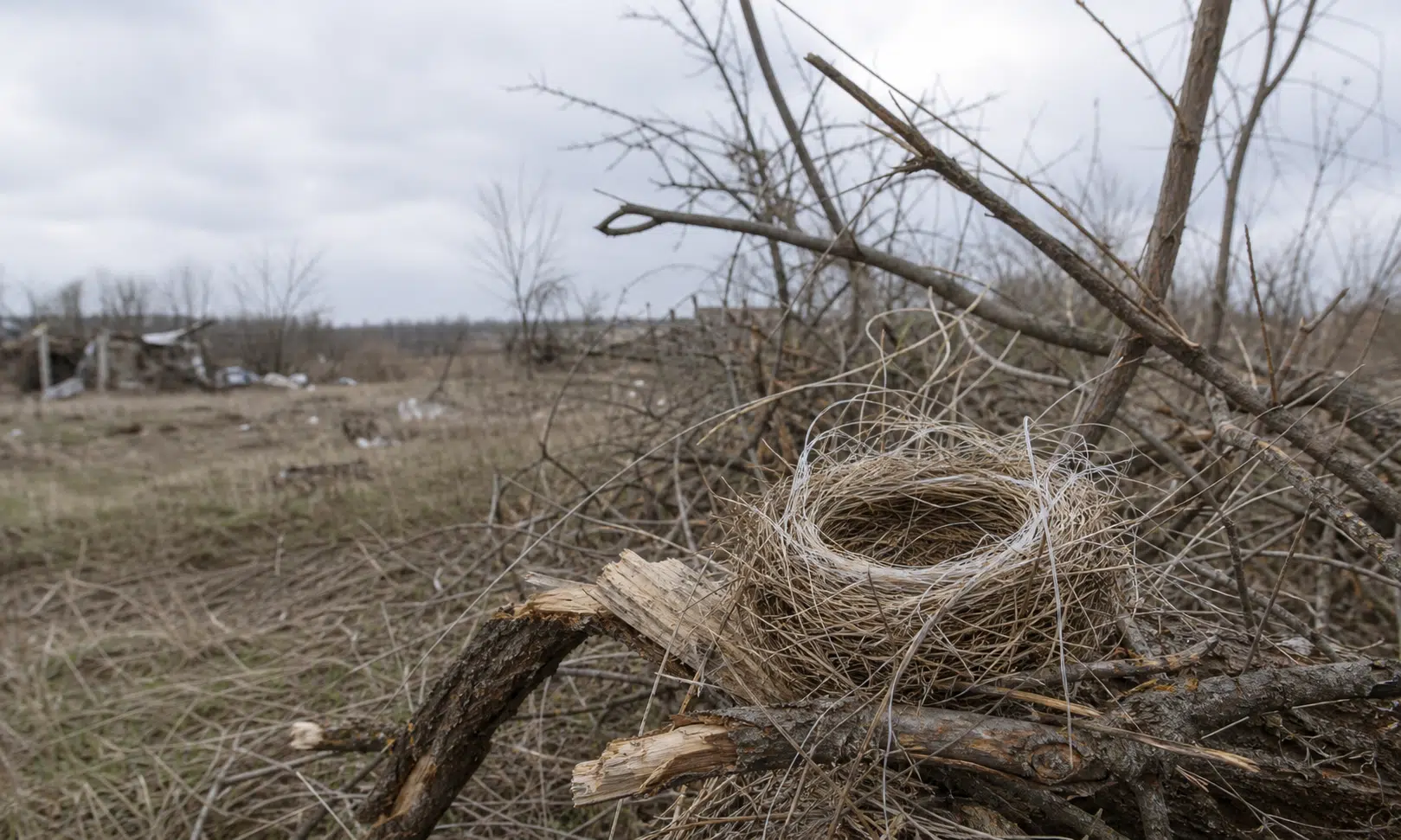

Photos circulating from Ukraine appear to show a small bird nest woven with strands of fiber-optic cable, a bleak detail from a battlefield increasingly associated with tethered drone warfare.
The images were shared on X by Ukrainian civil society figure Olena Tregub, who described the nest as having emerged from a tree knocked down in Donbas after a Russian glide bomb strike. She credited Oleg Malchenko for the photo. That account has not been independently verified, so the safest reading is narrow: the images appear to show a bird nest that includes thin optical fiber, but they do not prove how common the behavior is or exactly where the material was collected.
What the reported nest appears to show
The nest is notable because the material is not typical urban litter such as string, plastic, or wire. It appears to include pale, hairlike fiber-optic cable, the kind associated in recent reporting with first-person-view drones that remain physically connected to their operators by a long spool of optical fiber.
That matters because fiber-tethered drones are used to reduce vulnerability to radio jamming. Unlike conventional radio-controlled drones, they can continue receiving control signals through a physical cable. The tradeoff is obvious in the landscape they leave behind: after a flight, long strands of fiber can remain across fields, roads, tree lines, and damaged structures.
The nest does not turn that debris into a tidy ecological story. At most, it suggests that at least one bird may have used available battlefield material while building a nest. Birds are known to incorporate nearby human-made material when nesting, but the insulation value, safety, and frequency of fiber-optic use in this setting are not established by the reported images.
What can and cannot be concluded
| Claim | Careful reading |
|---|---|
| A nest appears to contain drone fiber-optic cable | The images appear consistent with that description, but the source account has not been independently verified. |
| Birds in Ukraine are widely adapting to drone fiber debris | The source does not support a broad conclusion. This should be treated as an isolated reported example. |
| Fiber debris is a visible byproduct of tethered drones | The article supports this as part of the wider discussion around fiber-tethered FPV drones. |
| The material benefits the birds | That remains speculative and should not be stated as fact. |
Why fiber is appearing on the battlefield
The broader context is the use of fiber-optic FPV drones in the Russia-Ukraine war. These drones trail cable from a spool as they fly, giving operators a control link that is harder to disrupt with electronic warfare. Reports cited in the source describe ranges that have grown over time, including previously reported Ukrainian examples around 42 km and later Russian systems said to reach up to 65 km. Those figures should be treated as reported claims, not independently confirmed measurements here.
The same context also explains why countermeasures have emerged. The source refers to a Ukrainian concept using rotating barbed-wire barriers to catch and tear fiber left behind by passing drones. Whether such defenses scale effectively is not established in the source, but the idea underscores a practical problem: fiber is not only part of the drone system while it is flying. It can remain in the environment afterward.
A small image with a larger signal
If the reported Donbas nest is genuine, it is a small but sharp example of how war debris moves into ordinary natural spaces. The image should not be overstated as proof of a widespread wildlife pattern, and it should not be softened into a feel-good story about animals cleaning up a battlefield.
The more grounded takeaway is simpler: fiber-optic drone warfare may leave behind physical traces that persist beyond the strike itself. In this case, those traces appear to have ended up in a bird nest.