

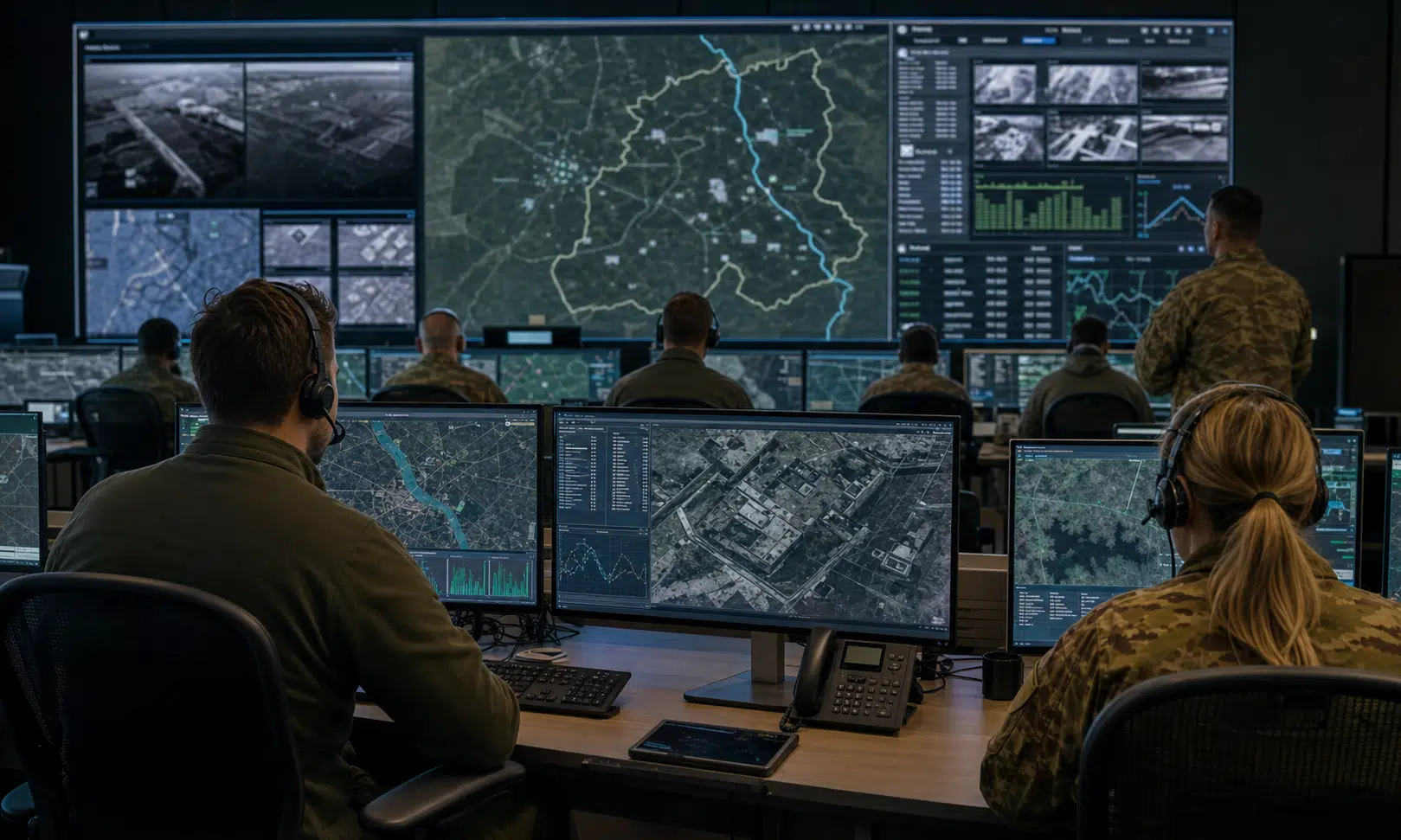

Ukraine’s military AI officials are warning that future wars may be shaped less by the number of soldiers in the field and more by the speed at which armies can collect data, interpret it, and turn it into battlefield decisions.
The warning comes from Danylo Tsvok, head of the Ukrainian defence ministry’s AI research centre, who has described artificial intelligence as a force that could form a new model of warfare. Some of the specific battlefield claims around Ukraine’s use of AI have not been independently verified, but the direction of travel is clear: Kyiv wants faster, more coordinated systems for a war already defined by drones, sensors, and constant surveillance.
For commanders, the practical question is no longer whether AI belongs in military operations. It is how far decision-support systems can go before the human role becomes the slowest part of the process.
What Ukraine says it is trying to build
Ukraine’s stated ambition is to move toward a unified AI-powered military operating system: a connected layer that can process battlefield data, compare options, and recommend actions to human commanders. Tsvok has framed this as a possible “war of operating systems,” where advantage goes to the side that can understand events faster and coordinate weapons, units, and intelligence more effectively.
That does not mean Ukraine has already built a fully automated battlefield brain. A firm timeline has not been publicly confirmed, and many details remain difficult to verify from outside the war zone. The more careful reading is that Ukraine is working toward deeper integration of AI into command systems, rather than claiming that machines are already directing the war independently.
The goal, as described by Tsvok, is to connect data and weapons systems into a coordinated structure that can support decisions from frontline units up to higher command. In theory, such a system could help process information from a front line stretching roughly 1,200 kilometres, but the extent of current deployment has not been independently verified.
That distinction matters. AI in warfare is often discussed as if it means autonomous weapons choosing targets on their own. The more immediate use case is decision support: sorting feeds, flagging patterns, ranking risks, and reducing the time between detection and response.
Why speed is becoming the central comparison
The war in Ukraine has already shown how quickly drones can compress the time between finding a target and striking it. Both Ukrainian and Russian forces use large numbers of unmanned aerial vehicles, though specific daily totals and operational details are hard to verify independently.
The battlefield value is not only the drone itself. It is the chain around it: detection, identification, targeting, approval, and strike execution. Military planners often call that sequence the kill chain. Tsvok’s argument is that AI could shorten it further by helping commanders move from raw data to recommended action more quickly.
For any defense organization evaluating AI-enabled systems, the comparison is therefore less about a single product and more about the operating model behind it.
| Decision area | Traditional pressure point | AI-supported promise | Main risk |
|---|---|---|---|
| Drone operations | Pilots and analysts must handle large volumes of live information | Systems may help identify patterns, targets, or route options faster | Errors can scale quickly if recommendations are trusted too easily |
| Combat planning | Commanders balance incomplete reports under time pressure | AI tools may compare options and surface likely outcomes | Models may miss context that humans understand |
| Air attack analysis | Missile and drone attacks generate complex data after each strike | Automated analysis may help detect changes in tactics | False confidence can lead to poor defensive assumptions |
| Strategic command | Large fronts create delays between observation and response | A shared operating system may coordinate information across levels | Centralized systems become high-value targets |
This is the buyer-relevant lesson for governments, defense contractors, and security teams watching Ukraine: the strongest system may not be the one with the most impressive model in isolation. It may be the one that links sensors, operators, command approval, and weapons in a way that remains usable under attack.
The human-in-the-loop problem
Ukraine says it operates on the principle that humans remain involved in combat decisions. That principle is politically and ethically important, especially when weapons are involved. But Tsvok has also raised the harder operational question: what happens when autonomous or semi-autonomous systems generate recommendations faster than people can review them?
That is where the debate becomes less theoretical. Keeping a human in the loop can reduce the risk of unlawful or mistaken action, but it can also slow the response cycle. Removing humans from decisions may increase speed, but it raises serious accountability, reliability, and escalation concerns.
For organizations comparing military AI systems, that tradeoff is central. A useful evaluation should ask:
- What decisions does the system only recommend, and what can it execute?
- How does a commander see the reason for a recommendation?
- What confidence level, uncertainty, or missing data is shown to the user?
- How quickly can a human override or stop the system?
- What happens when communications are degraded or spoofed?
Those questions are not cosmetic procurement details. They determine whether an AI system supports command judgment or quietly pressures people to accept machine-generated actions because the battlefield is moving too quickly.
Why outside AI companies are watching Ukraine
The war has drawn interest from foreign defense and AI companies because Ukraine offers something rare: a live, high-intensity battlefield where new systems can be tested against real tactics, electronic warfare, and operational stress. Some companies, including Palantir, have been reported as providing systems to Ukraine, though the full scope of such deployments is not publicly clear.
Kyiv has also been linked to battlefield data-sharing efforts intended to help allied countries and technology partners train or test software. Claims about the exact structure and use of those datasets should be treated cautiously unless confirmed by the parties involved.
Still, the commercial signal is significant. Defense AI is not only about better algorithms. Buyers will compare vendors on integration, data access, explainability, security, deployment speed, and whether the system can survive messy conditions rather than polished demonstrations.
Russia is part of the same race
Ukraine’s concern is not limited to its own modernization. Ukrainian officials have also warned that Russia is developing or applying AI capabilities, including in the planning of drone and missile attacks. Specific claims about Russian planning tools are difficult to verify independently, but the concern fits the wider pattern of both sides seeking faster targeting, analysis, and coordination.
That makes the conflict a test case for a broader military shift. If one side can process surveillance, signals, strike data, and battlefield reports faster than the other, it may gain an advantage even without a decisive numerical edge.
The risk is that this pushes both sides toward shorter decision windows. The faster the systems become, the more pressure commanders face to trust automated recommendations. In future conflicts, the decisive comparison may be not simply who has more drones, but who has the better command architecture around them.
What the warning really means
Ukraine’s warning should not be read as proof that AI is already deciding the war. Many of the strongest claims about battlefield AI remain difficult to verify from public reporting alone. A more grounded conclusion is that Ukraine sees AI as a way to manage the scale, speed, and complexity of modern combat.
That makes the “war of operating systems” idea useful, even if it remains partly aspirational. Armies are no longer competing only through tanks, artillery, aircraft, and troop strength. They are also competing through data pipelines, software integration, sensor networks, and command tools.
For military buyers and policymakers, the immediate decision is not whether to chase the most autonomous system available. It is how to build AI into command structures without losing judgment, accountability, or resilience. The side that moves fastest may gain an edge, but the side that moves fastest without control may create risks of its own.