

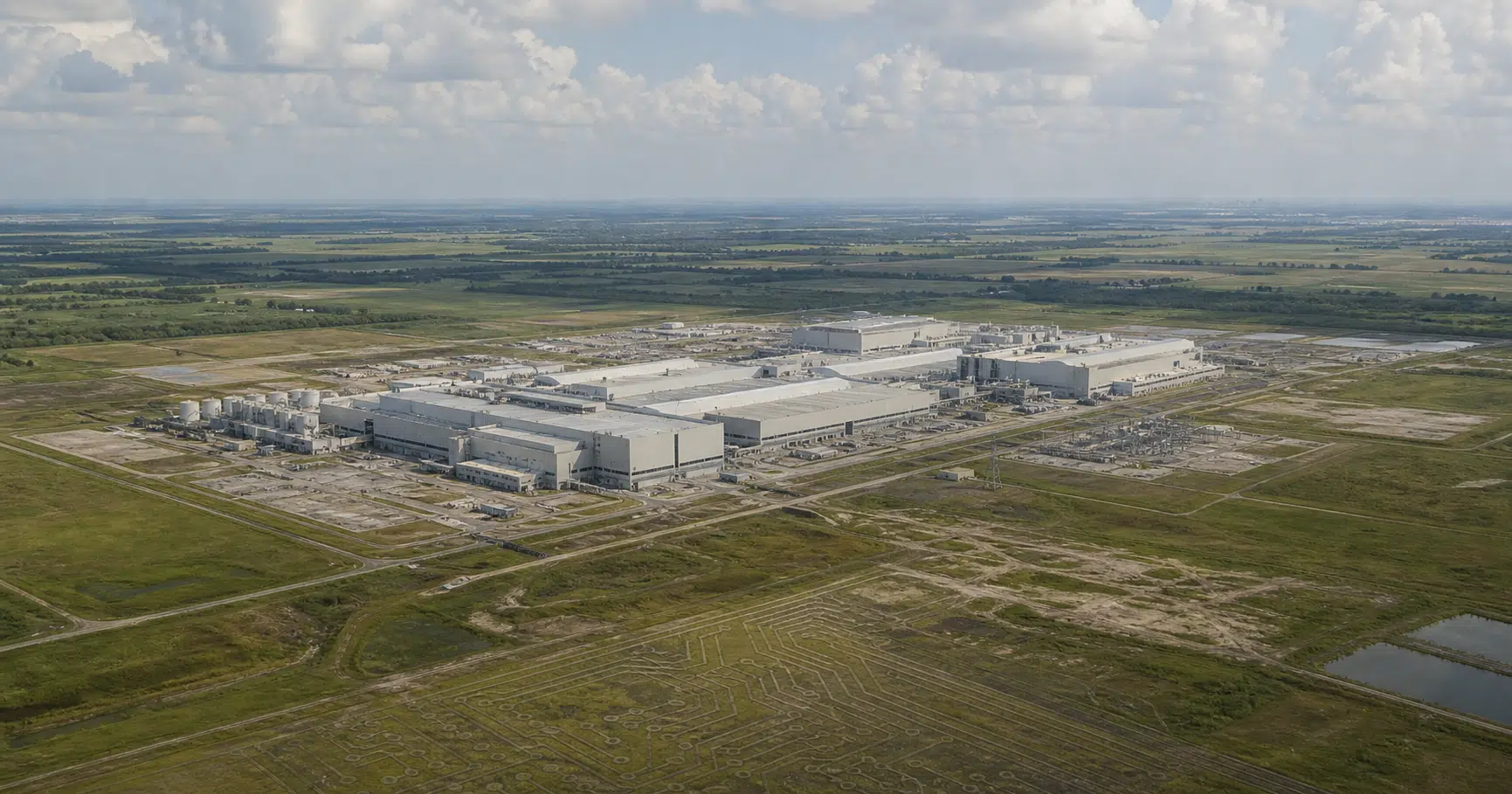

Tesla and SpaceX have selected Grimes County, Texas, for Terafab, a jointly developed semiconductor factory intended to support the companies’ growing demand for computing hardware. The site will be outside Houston, with the two companies proposing an initial investment of $16.8 billion.
Even at that opening price, Terafab would be an unusually ambitious manufacturing project. Tesla and SpaceX are pitching it as a vertically integrated complex capable of producing the specialized computing hardware behind their artificial intelligence, robotics and space programs. The announcement establishes the location and initial investment, but it leaves the factory’s construction schedule and several operational details unresolved.
Terafab is being designed on an enormous scale
SpaceX has described plans for more than 100 million square feet of manufacturing space. That figure has not been independently verified, and no firm timeline has been publicly confirmed. It should therefore be treated as the companies’ proposed scale rather than the footprint of a fully approved and scheduled facility.
The design outlined by SpaceX would place semiconductor manufacturing, packaging and testing at one location. Bringing those stages together could give Tesla and SpaceX tighter control over how chips are designed, produced and incorporated into their hardware, although the companies have not provided enough operational detail to establish how the proposed system would work in practice.
The project is positioned as an advanced semiconductor manufacturing hub rather than a conventional component plant. Its planned size reflects the amount of computing capacity Tesla and SpaceX expect their future products and services to require, but the facility’s eventual production volume remains unclear.
The companies want chips tailored to their own hardware
The strategic case for Terafab rests on the increasingly specialized computing needs inside both companies. Tesla is developing artificial intelligence systems for its Optimus robot and Cybercab program, while SpaceX has discussed computing infrastructure intended for use alongside its satellite operations.
SpaceX has framed the factory as a way to produce logic and memory devices optimized for edge computing and AI inference. Those applications demand hardware that can process large workloads with fewer delays and less dependence on distant data centers. However, the specific chips, production processes and performance targets attached to Terafab have not been publicly confirmed.
The factory would also reduce the distance between chip development and the products that use those chips. In theory, that structure could help engineers revise hardware more quickly, but it remains a proposed benefit rather than a demonstrated capability. Terafab has not started producing components, and the companies have not disclosed when manufacturing could begin.
The initial investment may cover only the first phase
Tesla and SpaceX have placed the initial investment at $16.8 billion, indicating that the project is expected to proceed in phases. A separate figure of as much as $119 billion has appeared in materials associated with a potential multiphase buildout, but that larger estimate has not been independently verified.
The difference between those figures is significant. The $16.8 billion commitment provides the clearest view of the proposed starting point, while the much larger number depends on later construction and expansion decisions that have not been detailed. The companies have not disclosed a complete financing structure, a phase-by-phase budget or firm completion dates.
Questions also remain about participation by outside chipmakers. Intel has been linked to Terafab, but the nature and size of any contribution have not been publicly established. Until responsibilities are defined, it is unclear whether an outside partner would provide manufacturing technology, technical support, equipment or another form of assistance.
Local scrutiny is growing alongside the project
The scale of Terafab has already generated debate in Grimes County. Hundreds of residents attended a county meeting where participants questioned tax breaks connected to the development and raised concerns about transparency. Those issues are likely to remain central as local officials consider the project’s economic promises against its cost to public institutions.
Water use is another prominent question. SpaceX says it intends to draw water from the nearby Gibbons Creek Reservoir instead of relying on local groundwater. That commitment has not been independently confirmed, and the available plans do not specify how much water the factory would require once operating at scale.
The companies have also projected employment benefits for Grimes County and neighboring Brazos County, but the stated job totals and hiring schedule have not been independently verified. Without a construction timeline, it remains difficult to determine when permanent positions might materialize or how employment would be divided between factory operations and temporary building work.
For now, Terafab is best understood as a large initial investment attached to an even larger industrial plan. Tesla and SpaceX have named the location and explained the computing ambitions behind it, but the ultimate footprint, total cost, production capacity and opening date remain unsettled. Those details will determine whether Terafab becomes the vertically integrated chip operation the companies envision or advances as a more limited, phased facility.