

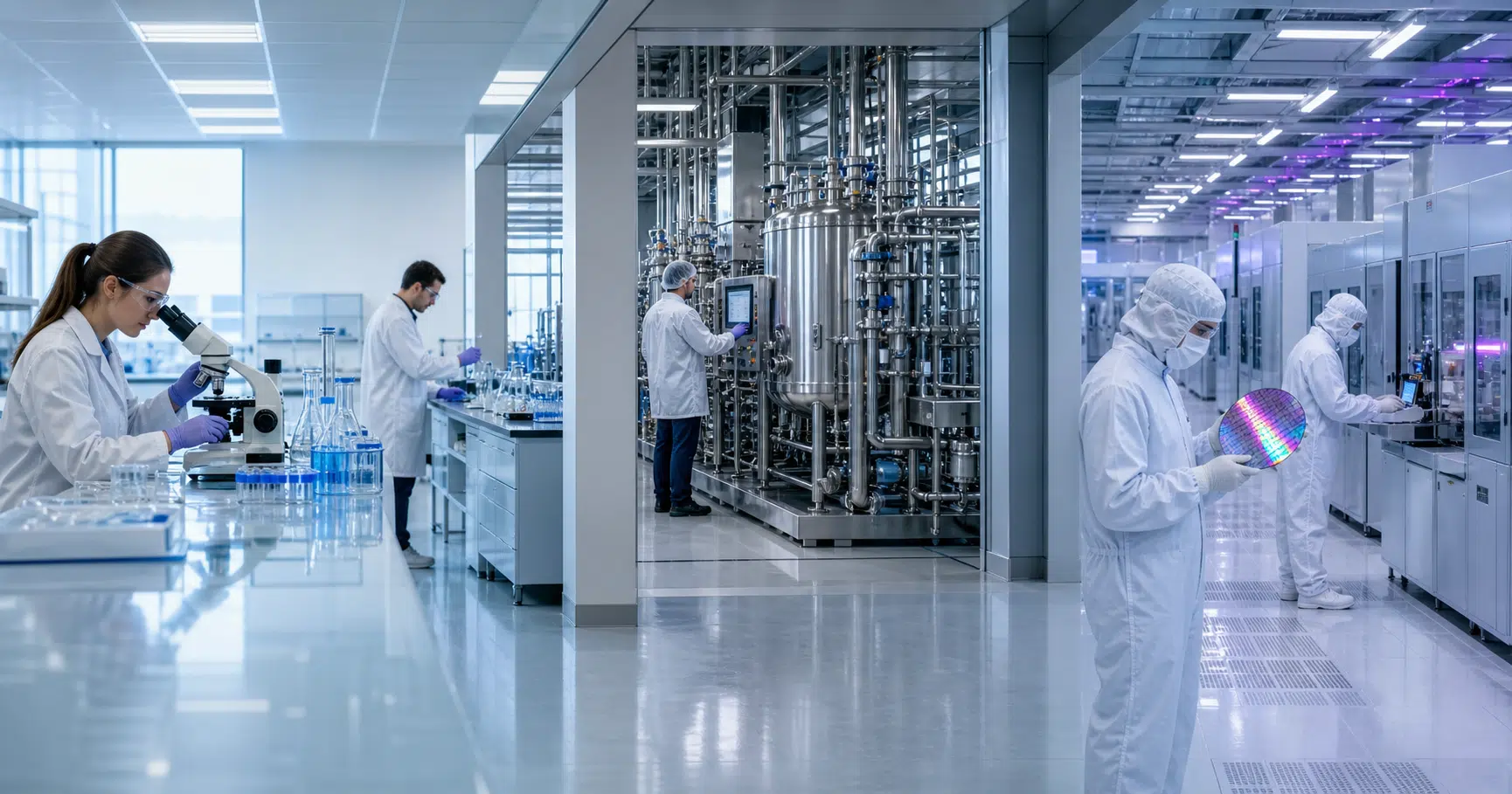

Merck KGaA opened a large facility in Kaohsiung in 2025 to support semiconductor manufacturing, extending a corporate transformation that has taken the Darmstadt-based company well beyond its pharmaceutical roots.
The facility is an especially visible marker of where Merck has been investing. The company remains associated with medicines, but decades of acquisitions have also made it a substantial supplier of laboratory products, biopharmaceutical manufacturing equipment and specialized materials used in electronics production.
That breadth can be difficult to see from the Merck name alone. A drug developer, a university laboratory and a semiconductor manufacturer may encounter different brands, product catalogs and business units, even when those operations sit within the same corporate group.
There is another layer of potential confusion: Merck KGaA and the American pharmaceutical company Merck & Co. are separate corporations. In the United States and Canada, the Darmstadt-based group commonly appears through names including EMD Serono, MilliporeSigma and EMD Electronics. This article concerns Merck KGaA and its associated operations.
The practical story is less about one product than about a portfolio assembled across three demanding markets. Healthcare depends on clinical development and regulatory approval. Life science supplies depend on repeatable laboratory and production workflows. Electronics materials must fit tightly controlled manufacturing processes in which small changes can affect an entire production line.
Merck’s expansion has given it exposure to all three. It has also created a company whose performance cannot be judged only by the success of a medicine or the volume of a single chemical. Research priorities, manufacturing capacity, customer qualification cycles and the integration of acquired businesses all matter.
A portfolio connecting the clinic, laboratory and chip fab
Merck presents its activities through healthcare, life science and electronics operations. Those areas share a scientific foundation, but their customers and commercial rhythms are markedly different.
Healthcare includes prescription medicines and research programs in areas such as oncology, immunology, neurology, fertility, endocrinology and general medicine. Pharmaceutical development can take years, and an unsuccessful clinical program can erase much of the expected value of an experimental treatment.
Life science operates further upstream. It supplies products and services used by researchers, testing laboratories and biopharmaceutical manufacturers. Its catalog encompasses laboratory chemicals, filtration and purification products, analytical tools, process equipment, testing services and contract development and manufacturing work.
Electronics supplies materials, delivery systems and related services used in semiconductor production. It also includes products for coatings, pigments, cosmetics, printing and security applications. The semiconductor portion has become particularly important as chipmakers add capacity and adopt increasingly complex manufacturing processes.
The portfolio gives Merck several ways to participate in science-intensive industries. It can sell a medicine, provide materials used to develop and manufacture medicines, or supply chemicals used to produce the electronics supporting modern laboratory and industrial systems.
That does not make the businesses interchangeable. Pharmaceutical demand can be shaped by patent protection, clinical evidence and reimbursement. Laboratory products depend more heavily on research activity, recurring consumption and manufacturing volumes. Semiconductor materials must be qualified for particular production processes, potentially creating durable customer relationships but also lengthy sales cycles.
For customers, the group’s scale is most relevant when it translates into dependable supply, documentation and technical support. A long product catalog has limited value if a material cannot be delivered consistently or if a manufacturing change creates qualification problems. Merck’s acquisitions have therefore been about more than adding products: they have expanded manufacturing assets, process knowledge and relationships with regulated or technically demanding customers.
From a Darmstadt pharmacy to an industrial group
Merck describes its roots as reaching back to 1668, when Friedrich Jacob Merck took ownership of the Engel-Apotheke, or Angel Pharmacy, in Darmstadt. The company used that lineage as the basis for its 350th-anniversary celebration in 2018.
Its account of the early business emphasizes the transition from pharmacy work to chemical production. Emanuel Merck took over the pharmacy in the 19th century and worked with alkaloids in its laboratory. Merck dates the production of pharmaceutical and chemical substances at larger scale to 1827, an important step in the development of the operation that eventually became an industrial manufacturer.
The company’s historical association with morphine and cocaine reflects an era in which pharmaceutical science, commercial chemistry and medical practice were developing under standards very different from those applied to modern drugs. Merck later expanded into additional chemicals and finished medicines, creating a broader factory operation around the original pharmacy business.
An American branch of the enterprise emerged in the late 19th century. The business that became Merck & Co. was separated from its German predecessor during the First World War and developed as an independent American company. The resulting naming overlap has persisted even though the two corporations have distinct ownership, strategies and product portfolios.
Merck’s history also includes its conduct under Nazi rule. During the Second World War, the Darmstadt plant manufactured products considered important to the war economy, including narcotics, vitamins, biocides and other chemicals.
Merck’s account places 265 forced laborers at the Darmstadt plant, most of them women from Russia and Poland. Several hundred additional foreign workers from France and Belgium were employed during the war. An air raid on December 12, 1944, destroyed nearly 70 percent of the plant and killed 55 employees.
The company resumed the production of medicines, pesticides, preservatives, laboratory reagents and fine chemicals after the war. Germany’s postwar economic expansion produced years of strong sales growth, while Merck developed and sold products including corticosteroid preparations, cold remedies and hormone treatments.
The postwar company also broadened through acquisitions. Merck Ltd. acquired BDH Chemicals from the Glaxo Group in 1973, adding a business with a long presence in laboratory and industrial chemicals.
Merck dates its Frankfurt stock-market listing and adoption of the Merck KGaA legal form to 1995. The structure preserved a role for the family-linked holding organization while bringing publicly traded shares into the capital structure. Exact ownership figures and leadership titles can change, so they are better treated as filing-specific information than permanent features of the company profile.
The shift into a publicly traded structure did not immediately produce the portfolio recognizable in later years. Much of that was built through a series of large transactions beginning in the 2000s.
The acquisition campaign that reshaped Merck
Merck’s modern form owes a great deal to mergers and acquisitions. The company used deals to expand in biotechnology, laboratory supplies and electronic materials, while divesting operations that no longer matched its priorities.
In March 2006, Merck made a takeover bid for Schering AG, a major producer of oral contraceptives. Bayer subsequently submitted a supported offer, and Merck withdrew from the contest. The episode showed its appetite for a much larger pharmaceutical position, even though that particular transaction did not proceed.
Later that year, Merck announced a $13.2 billion bid for Swiss biotechnology company Serono. The transaction included the purchase of the Bertarelli family’s controlling stake, followed by an offer for the remaining shares.
Serono added a substantial biologics business and research organization. The combined operation began working as Merck Serono in 2007, giving the German group a stronger position in specialized pharmaceuticals and a larger research budget.
Merck established the Merck Foundation in 2008. The philanthropic organization has run programs connected with health, education and scientific capacity, particularly in regions where access to medical training and specialist care can be limited.
The next transformative deal came in 2010, when Merck acquired Millipore Corporation for €5.3 billion, or about $7.2 billion at the stated transaction value. Millipore supplied filtration, purification and other technologies used by laboratories and biopharmaceutical manufacturers.
That acquisition helped establish life science as a major commercial platform rather than a supporting chemicals operation. It also expanded Merck’s position in the United States and increased its exposure to recurring laboratory and production demand.
In 2013, Merck agreed to buy AZ Electronic Materials for roughly $2.6 billion in cash. AZ supplied specialty chemicals used in electronics manufacturing, giving Merck a larger role in an industry where materials have to meet exacting performance and purity requirements.
The company also encountered the other side of research-driven growth. In 2014, Merck stopped development work on drug candidates associated with Oxygen Biotherapeutics. One program struggled with patient recruitment, while the cancer immunotherapy tecemotide failed to meet the stated survival endpoint in a Phase I/II study involving Stage III non-small cell lung cancer.
Clinical setbacks can be particularly consequential for pharmaceutical companies because development spending is concentrated on products that may never reach the market. Merck’s broader portfolio does not remove that risk, but it reduces the extent to which the entire group depends on a small number of clinical programs.
Later in 2014, Merck announced its $17 billion acquisition of Sigma-Aldrich. The transaction, completed in 2015, combined one of the best-known laboratory chemical catalogs with the life science operation assembled around Millipore.
Sigma-Aldrich brought chemicals, reagents, analytical products and established relationships across academic research, biotechnology, pharmaceuticals and quality-control laboratories. The strategic logic was not merely product volume. The acquisition gave Merck more opportunities to supply customers from early research through regulated manufacturing.
Merck and Pfizer also reached an immuno-oncology agreement in 2014. Pfizer paid an initial fee of $850 million under a deal that shared development and commercialization rights for an experimental immunotherapy. Such partnerships can distribute research costs and combine the clinical or commercial capabilities of two companies, though they do not guarantee that a candidate will succeed.
In 2015, Merck returned rights to the rare-disease drug Kuvan to BioMarin Pharmaceutical. The move accompanied a sharper research focus on areas including cancer, immunology and neurology.
The transaction pace continued at a smaller scale. In 2017, Merck completed the purchase of food-safety testing company BioControl Systems. It also acquired Natrix Separations, which developed membrane-based products for bioprocessing.
Those deals fit the life science strategy more directly than a conventional pharmaceutical acquisition. Food testing and bioprocess separation involve specialized workflows in which consumables, validation and technical performance can matter as much as the initial equipment purchase.
Merck’s expansion in electronic materials accelerated in 2019. The company acquired Versum Materials in a transaction representing about $5.8 billion in equity value. Versum supplied materials and delivery equipment used by semiconductor manufacturers.
Merck also acquired Intermolecular, a California company focused on advanced materials, for approximately $62 million in equity value. Intermolecular added capabilities for testing material combinations in application environments, potentially shortening the cycle between formulation work and customer evaluation.
The Versum and Intermolecular transactions significantly enlarged Merck’s electronics portfolio. The integrated organization launched in June 2020, combining materials, equipment and development capabilities under a broader operating structure.
In 2020, Merck agreed to sell Allergopharma to Dermapharm for an undisclosed amount. The transaction covered operations in Europe and parts of Asia, including China and India. It was another example of portfolio pruning alongside the larger expansion into life science and electronics.
In 2021, MilliporeSigma announced the acquisition of AmpTec. The deal was designed to add capabilities relevant to messenger RNA manufacturing, treatment development and diagnostics. Demand for mRNA-related tools had become strategically important for suppliers serving vaccine and therapeutic developers.
Merck’s North American healthcare operation, EMD Serono, also agreed to acquire Chord Therapeutics in 2021. The Swiss company’s lead program involved cladribine for generalized myasthenia gravis and neuromyelitis optica spectrum disorder.
The acquisition history also identifies Erbi Biosystems, acquired in 2022, and Mirus Bio, acquired in 2024, as additions to the life science portfolio. Those purchases continued the pattern of adding specialized technologies around bioprocessing and biological research.
The result is not a single, linear expansion. Merck has alternated between large platform deals, targeted technology purchases, research alliances and divestments. Serono strengthened biotechnology and specialized medicines. Millipore and Sigma-Aldrich built life science scale. AZ Electronic Materials, Versum and Intermolecular pushed the group deeper into semiconductor production.
A condensed transaction timeline
| Year | Transaction or decision | Strategic area |
|---|---|---|
| 2006 | Bid for Schering withdrawn after Bayer’s supported offer | Healthcare |
| 2006 | Agreement to acquire Serono for $13.2 billion | Biotechnology and healthcare |
| 2010 | Millipore acquired for €5.3 billion | Life science |
| 2013 | AZ Electronic Materials acquired for about $2.6 billion | Electronics materials |
| 2014 | Sigma-Aldrich acquisition announced for $17 billion | Laboratory and life science products |
| 2017 | BioControl Systems and Natrix Separations acquired | Testing and bioprocessing |
| 2019 | Versum Materials acquired at about $5.8 billion in equity value | Semiconductor materials |
| 2019 | Intermolecular acquired at about $62 million in equity value | Advanced materials development |
| 2020 | Allergopharma divestment announced | Portfolio simplification |
| 2021 | AmpTec and Chord Therapeutics acquisitions announced | Life science and healthcare |
| 2022 | Erbi Biosystems added | Bioprocessing |
| 2024 | Mirus Bio added | Biological research tools |
The consumer-health exit
Not every Merck business remained part of the long-term plan. In 2017, the company began considering options for its consumer-health division, including a full sale, a partial sale or a strategic partnership.
The process attracted reported interest from strategic buyers and private-equity-backed groups. Early estimates placed the business at between €1.8 billion and €2.7 billion, although later bidding expectations rose considerably.
Nestlé and the private-equity owners of Stada were associated with possible bids. Perrigo was also linked to an offer around €4 billion, while Mylan entered advanced discussions at a reported value of €3.5 billion to €4 billion.
Procter & Gamble ultimately agreed to purchase the division for €3.4 billion in 2018. The sale transferred a portfolio of consumer products to a company built around mass-market brands and allowed Merck to concentrate resources on prescription medicines, life science and specialty materials.
The strategic distinction matters. Consumer health depends heavily on retail distribution, brand marketing and high-volume categories. Merck’s retained businesses lean more heavily on scientific development, regulated production and business-to-business relationships.
The sale therefore did more than raise cash. It made the company’s direction clearer: fewer everyday consumer products and more emphasis on technologies sold into clinical, laboratory and industrial systems.
Healthcare remains a high-risk, research-led business
Merck’s healthcare operation sits closest to the company’s pharmaceutical identity. Its work has included oncology, neurology, immunology, fertility, endocrinology and general medicine, with research spending directed toward areas where biological understanding can be translated into prescription treatments.
The company’s history in pharmaceuticals reaches back to the production of alkaloids and other chemical substances. Merck later participated in the manufacture and marketing of morphine and cocaine during the 19th century, before modern drug-control systems and clinical standards existed.
In the 20th century, the portfolio expanded into vitamins. Vigantol was introduced in 1927 and Cebion followed in 1934. Postwar products included the corticosteroid preparation Fortecortin, the cold remedy Nasivin and the hormone product Gestafortin.
For 2018, Merck reported investing more than €1.6 billion in pharmaceutical research and development. Its research network employed more than 2,500 people across major hubs in Europe, the United States and Asia.
Erbitux, or cetuximab, became one of the notable marketed oncology products in the portfolio. Merck held marketing rights outside North America, while Bristol Myers Squibb marketed the treatment in North America. The drug was originally discovered by ImClone Systems.
Merck’s healthcare business also included products used in diabetes, thyroid disease and cardiovascular care. Examples named within the portfolio included metformin, bisoprolol, levothyroxine and digitoxin. These established medicines operate differently from experimental cancer drugs: their clinical roles may be well understood, but competition, pricing and regional market structures can shape their commercial value.
The research strategy has relied in part on external partnerships. Merck worked with Quintiles on clinical development support across its pipeline, reflecting the pharmaceutical industry’s reliance on contract research organizations to coordinate trials, sites, data and regulatory processes.
In 2019, Merck and GSK announced a partnership to develop and commercialize bintrafusp alfa, also known during development as M7824. The companies presented it as an immunotherapy candidate for difficult-to-treat cancers. The agreement established development ambitions rather than proof of clinical success, an important distinction whenever an experimental drug is discussed.
Merck also entered a partnership with Chinese cosmetics company Pechoin in 2020 to develop skincare products described as combining technology with herbal ingredients. That collaboration sat at the boundary between scientific formulation and consumer-facing personal care.
The healthcare business illustrates why Merck’s diversification matters. A laboratory-supply product can generate repeat demand without passing through a multistage clinical trial, while an electronics material can become embedded in a customer’s manufacturing process. Pharmaceuticals offer the possibility of substantial returns, but they also carry binary development outcomes and regulatory risk.
This balance does not eliminate volatility. A failed trial, delayed enrollment or change in research priorities can still produce write-offs and lost time. Partnerships can spread costs, and established medicines can support revenue, but neither substitutes for convincing clinical evidence.
For patients and healthcare providers, corporate scale is secondary to safety, efficacy, availability and appropriate use. For investors and business customers, the healthcare operation is best understood as one component of Merck’s wider scientific portfolio, not the only engine of the group.
Life science turns research workflows into recurring business
Merck’s life science operation took shape after the 2010 acquisition of Millipore and expanded dramatically with Sigma-Aldrich in 2015. It serves customers across biotechnology, pharmaceuticals, diagnostics, food safety, environmental testing and academic research.
The business is less visible to the general public than a branded medicine, but its products can appear throughout the development and production chain. A laboratory may buy reagents to run an experiment, purification products to prepare samples, analytical standards for quality control and equipment for producing biological material.
A biopharmaceutical manufacturer may use filtration systems, single-use processing components, chemicals, testing services and contract manufacturing capabilities. The value is not only in the individual item. Compatibility, documentation, continuity of supply and the ability to reproduce a process are crucial in regulated environments.
Merck has presented the portfolio as containing roughly 300,000 products across its life science activities. Because catalogs and organizational structures change, that figure is best understood as a scale indicator tied to a particular period rather than a permanent count.
The portfolio has operated through three broad groupings: Science and Lab Solutions, Process Solutions and Life Science Services.
Science and Lab Solutions serves laboratories and quality-control organizations. Its products include chemicals, reagents, analytical tools, water-purification systems and other supplies used in research and testing.
Process Solutions focuses on biopharmaceutical manufacturing. It includes products used in upstream and downstream processing, filtration, purification and single-use workflows. Single-use systems can reduce cleaning requirements and make it easier to change production campaigns, although customers still have to evaluate compatibility, supply security and process validation.
Life Science Services includes contract development and manufacturing work as well as contract testing. These services allow drug developers to outsource portions of process development, production or quality assessment when building the same capability internally would require additional facilities and specialist staff.
The business brings together several recognized brands, including Sigma-Aldrich, Millipore, SAFC, Supelco, Milli-Q and BioReliance. Each arrived with its own product history and customer recognition, making brand integration more complex than simply applying one corporate logo.
Sigma-Aldrich remains closely associated with research chemicals and laboratory reagents. Millipore is strongly linked to filtration and purification. Milli-Q is associated with laboratory water systems, while BioReliance operates in testing services. SAFC and other brands extend into materials and services used in biopharmaceutical production.
This portfolio structure can support recurring demand because many laboratory and manufacturing products are consumed during use. However, recurring does not mean automatic. Researchers can change protocols, manufacturers can qualify alternative suppliers and customers can consolidate purchasing. Product availability and technical support remain important competitive factors.
The acquisitions of AmpTec, Erbi Biosystems and Mirus Bio extended the operation into additional biological production and research technologies. AmpTec added capabilities associated with RNA. Erbi Biosystems contributed bioprocessing technology, while Mirus Bio expanded tools used in biological research.
These additions reflect a larger shift within drug development. Biologics, cell-based research and RNA technologies require specialized materials and manufacturing techniques that differ from conventional small-molecule chemistry. Suppliers able to support those workflows can participate across multiple customer programs without carrying the entire clinical risk of any one medicine.
Merck’s life science business has also sponsored scientific awards, including the Alfred R. Bader Award for Student Innovation. The program recognizes graduate-level work in chemistry, often involving synthetic organic chemistry.
For research organizations, Merck’s scale can simplify procurement when multiple products are available through one supplier. That convenience must still be weighed against practical considerations such as lead times, lot consistency, technical documentation and the risk of depending too heavily on a single vendor.
For Merck, the strategic appeal is clear. The business can sell into discovery laboratories, quality-control operations and commercial manufacturing, creating customer relationships that may extend across much of a product’s development cycle.
Electronics puts Merck inside semiconductor production
Merck renamed its Performance Materials division as Electronics in 2021, a change that made the strategic priority more explicit. Semiconductor Solutions became the largest unit within that operation.
The business supplies materials, delivery systems and services for semiconductor manufacturing. Its products are used across major stages of wafer processing, including doping, lithography, patterning, deposition, planarization, etching and cleaning.
Those stages require different chemical and material properties. Lithography transfers circuit patterns. Deposition adds thin layers of material. Etching removes selected material, while planarization creates a sufficiently flat surface for subsequent layers. Cleaning steps remove contaminants that could damage yield or reliability.
A supplier participating across those processes gains more than a broad catalog. It develops knowledge of how materials interact with particular equipment, process conditions and device architectures. That knowledge can become commercially valuable as chip structures grow more complex.
The 2013 acquisition of AZ Electronic Materials was an early major step in this direction. AZ brought specialty chemicals used in electronics manufacturing, strengthening Merck’s position in photolithography and related applications.
Versum Materials added a much larger set of semiconductor materials and delivery capabilities in 2019. Intermolecular contributed methods for evaluating combinations of advanced materials in application environments.
That testing capability is strategically useful because a promising chemical formulation still has to perform inside a real manufacturing process. Faster experimentation can reduce the time needed to reject unsuitable combinations and focus development work on candidates with better performance.
The combined electronics organization began operating in June 2020. Its portfolio positioned Merck as a supplier across multiple wafer-processing steps rather than a company tied to one narrow class of specialty chemicals.
In December 2021, Merck, operating as EMD Electronics in North America, announced plans to invest $1 billion in a United States operations initiative with Palantir Technologies. The project was intended to address parts of the semiconductor industry’s supply-chain challenge, with planned activity in Pennsylvania, Texas, California and Arizona.
The announcement connected materials expansion with data and supply-chain coordination. Semiconductor production depends on networks of specialized suppliers, and disruptions in one material category can affect factories far downstream. Better visibility may help companies identify constraints, but software cannot replace physical manufacturing capacity or eliminate qualification requirements.
The large Kaohsiung facility opened in 2025 extended the physical side of that strategy. Kaohsiung is an important location for the electronics supply chain, and the facility was built to support semiconductor-industry customers.
The investment also illustrates why geographic proximity can matter in electronic materials. Customers may need technical collaboration, reliable delivery and rapid responses to manufacturing issues. Locating capacity near major production clusters can reduce some logistical friction, although it also concentrates investment in regions exposed to industry cycles and geopolitical risk.
Electronics demand can be volatile. Chip shortages encourage capacity expansion, while inventory corrections can quickly reduce orders. Suppliers must plan for long qualification periods even when customer spending changes faster than new materials can be introduced.
Merck’s position is therefore different from that of a chip designer or foundry. It does not need to create the finished processor to benefit from increasing process complexity. Instead, it supplies some of the materials and systems required to manufacture devices at scale.
That can be attractive when each new generation of chips requires tighter tolerances and additional processing steps. It also raises the cost of failure: contamination, inconsistent material or an unreliable delivery system can interrupt extremely expensive manufacturing operations.
Surface materials extend beyond chips
The Electronics operation is not limited to semiconductors. Merck began working on effect pigments in 1957, and those activities later formed part of the Surface Solutions business.
Surface Solutions has served automotive coatings, cosmetics and industrial applications. Its materials can create visual effects, add functional properties or support security features intended to make products more difficult to counterfeit.
Xirallic is one example from the pigment portfolio. The brand is associated with alumina-based effect pigments used to produce distinctive finishes, including in automotive coatings.
The wider operation has included pigments and functional materials for lacquers, printing, plastics, food and pharmaceutical applications. It has also supplied active substances and pigments used in cosmetics.
This is a different market from semiconductor fabrication, but the underlying commercial theme is similar. Customers are buying controlled material properties rather than a generic commodity. Color, reflectivity, stability, purity and compatibility with a production process can determine whether a formulation is suitable.
Why the Merck name changes across markets
Merck’s naming is unusually complicated because the Darmstadt group and Merck & Co. share historical roots but operate independently. Readers searching for a product, corporate office or investor document can therefore land on information for the wrong company.
In the United States and Canada, the Darmstadt group commonly uses EMD at the corporate and business level. Its healthcare operation appears as EMD Serono, the life science business as MilliporeSigma and the electronics operation as EMD Electronics.
Elsewhere, the group generally emphasizes the Merck name. The American pharmaceutical company uses MSD in many markets outside the United States and Canada, adding another variation that customers and readers may encounter.
Merck introduced a new visual identity in 2015, applying a more distinctive design across subsidiaries and business brands. The rebrand was intended to separate its presentation more clearly from that of the American company while giving healthcare, life science and materials operations a more consistent appearance.
The naming dispute also reached the courts. In 2016, the High Court in the United Kingdom ruled that MSD had breached an agreement concerning use of the Merck name. The court also found that use of Merck branding on global websites could be directed toward UK users and infringe the Darmstadt company’s UK trademark rights.
MSD responded with litigation in the United States. The competing cases demonstrated that a corporate website does not remain neatly confined to the country in which it is managed. A global page can create trademark consequences in markets where users can access it and where branding is protected differently.
For customers, the practical safeguard is to verify the full legal or business name attached to a product. Merck KGaA, EMD Serono, MilliporeSigma and EMD Electronics belong to the Darmstadt-centered group discussed here. Merck & Co. and MSD identify the separate American pharmaceutical business.
This distinction matters in procurement and support requests as much as it does in news coverage. A laboratory reagent, prescription medicine and investor filing may each use different branding, and sending an inquiry to the wrong Merck can delay a straightforward task.
Historical and geopolitical controversies remain part of the picture
Merck’s scale and longevity bring a record that includes serious controversies. Its use of forced labor during the Second World War is part of the company’s history, not a peripheral detail. The Darmstadt site’s production for the Nazi war economy and employment of forced laborers place its industrial development within the broader system of coercion used by German companies during that period.
Another controversy involved Generics UK, a former British subsidiary. The company paid a £12 million out-of-court settlement to the UK Department of Health and Social Care over alleged participation in price and supply fixing.
The broader allegations concerned whether pharmaceutical companies exploited concentrated market conditions and restricted the supply of commonly prescribed medicines. The National Health Service pursued claims involving several drugs, while the Serious Fraud Office conducted a parallel investigation focused on products including warfarin and penicillin-based antibiotics.
Investigators raided homes and offices connected with six companies in 2002, including Generics UK, Ranbaxy, Norton Healthcare, Goldshield and Regent-GM. The settlement did not turn every allegation in the wider investigation into a proven claim, so the distinction between an allegation, an investigation and an adjudicated finding remains important.
Merck has also faced criticism for maintaining business operations in Russia following the invasion of Ukraine. The company has cited its responsibility to continue supplying essential medicines, while activists and corporate-responsibility groups have argued that continued operations sustain commercial ties with the country.
The dispute presents a difficult tension for healthcare companies. A broad corporate withdrawal can increase economic pressure, but interrupting supplies of essential medicines may harm patients who have little control over government policy.
That tension does not resolve every question about which products, investments or taxes are necessary to sustain medical access. It does explain why an essential-medicines argument requires more detailed evaluation than a simple statement that a company remained or withdrew.
For customers and investors assessing Merck, these controversies belong alongside financial and technical considerations. Corporate history, supply commitments, sanctions exposure and conduct in regulated markets can affect reputation and operating risk even when they sit outside a product specification.
Research awards and venture investment broaden the pipeline
Merck has supported external science through awards, university relationships and venture investment. These activities can give the company contact with emerging research before it develops into a mature commercial market.
The Emanuel Merck Lectureship Award was established with Technische Universität Darmstadt in 1992. It recognizes contributions to chemical and pharmaceutical research and reflects Merck’s long-standing relationship with the university in its home city.
The Heinrich Emanuel Merck Award began in 1988 with a focus on novel methods in analytical chemistry. In 2025, its scope was broadened to include innovation in computational sciences, acknowledging the growing role of computation in research, measurement and materials development.
During its 350th-anniversary year in 2018, Merck announced the Future Insight Prize. The program was structured around a €1 million annual research grant over 35 years, with the aim of encouraging work on major scientific and societal problems.
M Ventures serves as Merck’s venture-capital operation. In 2021, the funds available for investment were increased by €600 million to support biotechnology and technology investments.
Venture investing gives a corporate group another route into emerging fields. It can back a specialized company before a full acquisition makes sense, observe how a technology develops and build relationships with founders or researchers.
It also carries familiar risks. Early-stage biotechnology and materials companies may need years of development before their products generate substantial revenue. Some will fail technically, struggle to raise additional capital or discover that a promising laboratory result does not translate into a scalable product.
For Merck, the value of venture investment is strongest when it connects with expertise already present in healthcare, life science or electronics. A corporate investor can offer technical knowledge, manufacturing experience and access to customers, while the startup can pursue a narrower idea without being absorbed immediately into a large operating structure.
Merck’s central challenge is making breadth work
Merck KGaA has assembled an unusual combination of businesses. It develops medicines, supplies tools used to discover and manufacture biological products, and produces materials used in semiconductor fabrication and specialized surface applications.
The portfolio offers diversification, but it also demands disciplined execution across industries with different regulations, investment cycles and customer expectations. A clinical-development organization cannot be managed exactly like a laboratory catalog, and neither operates like a semiconductor-materials supplier.
The acquisitions of Serono, Millipore, Sigma-Aldrich, AZ Electronic Materials and Versum were large enough to redefine the group. Smaller purchases then added particular capabilities around testing, filtration, RNA, bioprocessing and advanced-material evaluation.
The strategic case depends on integration. Merck must retain the technical depth and customer recognition of acquired businesses while coordinating manufacturing, digital systems, quality processes and capital spending across the group.
Its 2025 expansion in Kaohsiung shows that electronics remains central to that effort. The company is investing not only in research but also in the physical capacity and regional presence required to support chip manufacturers.
At the same time, healthcare still carries the scientific ambition and clinical risk associated with the Merck name, while life science provides exposure to the research and production infrastructure surrounding modern biotechnology.
That combination makes Merck less straightforward than a pure pharmaceutical company or a conventional chemical supplier. It is better understood as a collection of science-intensive platforms tied together by materials expertise, regulated production and long customer development cycles.
The opportunity is to participate in several industries whose technical requirements continue to rise. The risk is that scale and variety become organizational complexity rather than a durable advantage. Merck’s next phase will depend on whether the company can keep turning its acquisitions, facilities and research programs into products that work reliably inside the clinic, the laboratory and the chip fab.