

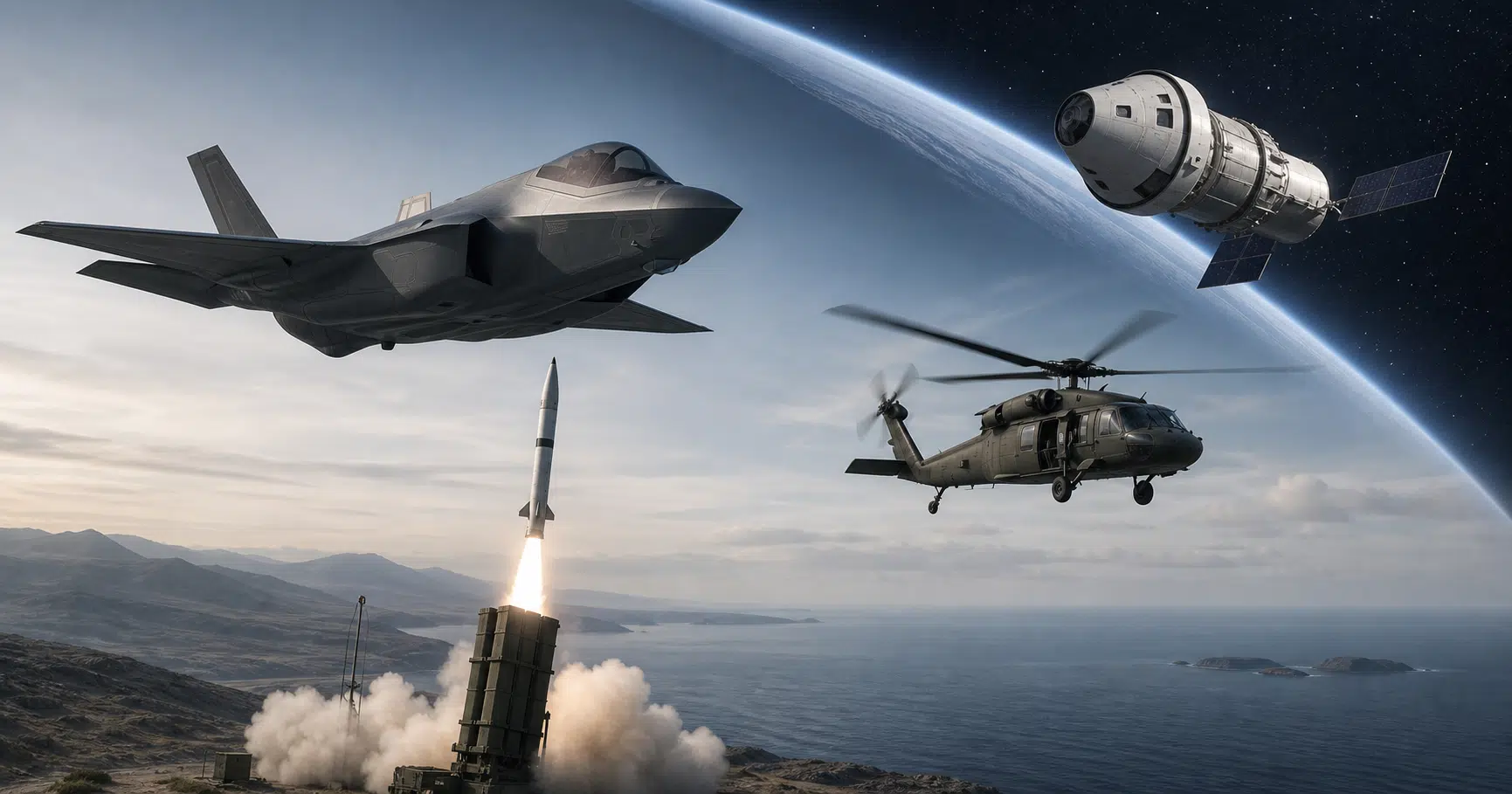

Lockheed Martin is best understood as a portfolio of long-duration government programs rather than a conventional manufacturer selling discrete products into an open market. Its aircraft, missiles, helicopters, combat systems, satellites, and spacecraft may be highly visible, but the commercial engine behind them is a dense web of development contracts, production lots, sustainment agreements, classified work, international government sales, and multiyear procurement decisions.
That distinction matters for anyone evaluating the company. A government buyer is not simply comparing the sticker price of an aircraft or interceptor. It is evaluating mission requirements, integration work, training, maintenance, software, supply availability, security restrictions, delivery schedules, and the cost of operating a system for decades. Suppliers and program partners face demanding quality controls and long qualification cycles. Investors must weigh a large backlog and persistent demand against customer concentration, program execution risk, political scrutiny, and the limited visibility that comes with classified work.
Lockheed Martin describes itself as a global defense technology company. Its portfolio is organized into four business areas: Aeronautics, Missiles and Fire Control, Rotary and Mission Systems, and Space. The F-35 remains its largest individual program, while products such as the C-130J, F-16, PAC-3 interceptor, THAAD, Black Hawk, Aegis, GPS III, Trident II, and Orion spread the company across air, land, sea, missile defense, and space missions.
The practical offer is breadth. A customer can work with the same prime contractor across aircraft, sensors, command systems, missile defense, training, sustainment, and space infrastructure. The constraint is that these are rarely fast or uncomplicated purchases. Programs can span decades, involve hundreds of suppliers, depend on annual government appropriations, and require close coordination among military services, regulators, international partners, and the prime contractor.
The short version
Lockheed Martin reported approximately $75 billion in sales for 2025. Its year-end backlog reached about $194 billion, representing contracted work that had not yet been recognized as revenue. Aeronautics was the largest business area, with roughly $30.3 billion in 2025 sales. Rotary and Mission Systems generated approximately $17.3 billion, Missiles and Fire Control about $14.5 billion, and Space roughly $13 billion.
The customer mix explains both the appeal and the central risk. In 2025, 63% of sales came from the US defense department, while international customers accounted for 28%. The remaining 9% combined other US government and commercial customers. The F-35 alone generated 27% of consolidated sales.
For a procurement team, Lockheed Martin is most relevant when the requirement involves complex military or space systems, close integration with an existing US or allied architecture, and a long support life. It is less comparable to a commercial technology vendor offering a short deployment cycle, transparent unit pricing, and easy substitution between suppliers.
For investors, the company offers exposure to large defense programs, a substantial backlog, international security spending, and replacement demand for munitions and aging platforms. The tradeoff is material dependence on government priorities and a small number of very large programs. Cost overruns or revised assumptions on one difficult contract can affect an otherwise stable quarter.
| Decision factor | What Lockheed Martin offers | Main constraint |
|---|---|---|
| Portfolio breadth | Aircraft, missiles, helicopters, naval systems, sensors, command systems, satellites, and spacecraft | Different programs sit inside separate contracting, security, and regulatory structures |
| Program scale | Experience managing large, long-duration government programs | Scale can increase schedule, supplier, software, and cost-estimation risk |
| Installed base | Long-term sustainment and upgrade opportunities around widely deployed systems | Customers may face switching costs and dependence on approved parts, data, and support channels |
| Government alignment | Deep familiarity with US and allied procurement processes | Revenue depends heavily on budgets, appropriations, export approvals, and political decisions |
| Financial visibility | Large backlog and multiyear program demand | Backlog is not guaranteed profit, and classified programs can limit outside visibility |
There is no retail offer, promotional price, or consumer discount to evaluate. The buyer decision is whether Lockheed Martin’s program experience, installed base, and integration capacity outweigh the cost, complexity, concentration, and execution risks attached to becoming part of one of its ecosystems.
What Lockheed Martin actually sells
Calling Lockheed Martin an aircraft manufacturer captures only one part of the business. Its programs combine physical platforms with sensors, software, communications, training, logistics, upgrades, spare parts, testing, and long-term sustainment. A finished aircraft or missile may be the visible output, but much of the contractual relationship surrounds the system before and after delivery.
This produces several overlapping lines of business:
- Development work turns military or civil requirements into a design, prototype, test campaign, and production plan.
- Production contracts cover complete platforms, missiles, interceptors, sensors, spacecraft, or major subsystems.
- Sustainment work supports deployed equipment through maintenance, parts, repairs, software updates, training, and engineering changes.
- Integration contracts connect radars, weapons, communications, command systems, and data from multiple vendors.
- Classified programs support capabilities whose technical details and sometimes even mission descriptions remain restricted.
- International sales may be handled through the US government or directly with an approved foreign government customer.
These categories can overlap inside one program. An aircraft contract may include production, support equipment, training, spares, and sustainment. A missile-defense purchase can require interceptors, launch equipment, radar connections, command software, testing, and integration into a wider defensive network. A spacecraft project can include design, manufacturing, mission software, ground systems, launch preparation, and operational support.
That makes headline contract values difficult to compare. A larger award may cover a longer period, more units, support services, or options that are not guaranteed to be exercised. A smaller award could be an early development phase that leads to much larger production work. Buyers need to distinguish funded work from options, development from recurring production, and the price of delivered equipment from the cost of operating it.
Lockheed Martin also works through joint ventures and extensive supplier networks. United Launch Alliance, its launch venture with Boeing, is a prominent example. Other arrangements connect the company with partners in missile programs, sensors, maintenance, and international manufacturing. The prime contractor remains responsible for coordinating many of these moving parts even when important components come from outside companies.
The commercial advantage is that Lockheed Martin can combine mature platforms with integration and support. The risk is that responsibility can be distributed across government offices, the prime contractor, engine or subsystem suppliers, software teams, international partners, and local maintenance organizations. A delay in one part of the chain can affect delivery or readiness somewhere else.
How the four business areas divide the portfolio
The four-segment structure is the clearest way to understand Lockheed Martin without getting lost in a list of individual products. Each segment has a different mix of customers, contract types, technical risks, and production cycles.
| Business area | 2025 sales | Representative programs and capabilities | Primary decision issue |
|---|---|---|---|
| Aeronautics | About $30.3 billion | F-35, F-16, C-130J, advanced development, and aircraft sustainment | Large-program concentration, production cadence, software, upgrades, and fleet support |
| Missiles and Fire Control | About $14.5 billion | PAC-3, THAAD, JASSM, LRASM, Javelin, Precision Strike Missile, sensors, and targeting systems | Production capacity, supplier readiness, demand visibility, and qualification requirements |
| Rotary and Mission Systems | About $17.3 billion | Sikorsky helicopters, Aegis, radars, undersea systems, command and control, training, and logistics | Integration across platforms, upgrade paths, mission software, and sustainment |
| Space | About $13 billion | GPS III, missile-warning spacecraft, Trident II support, missile defense, hypersonic programs, Orion, and civil satellites | Technical complexity, launch and mission dependencies, classified work, and long development cycles |
The figures are useful as a scale check, but they do not tell buyers which segment will own every piece of a proposed solution. A missile-defense architecture, for example, can touch interceptors from Missiles and Fire Control, radars and command systems from Rotary and Mission Systems, and space-based warning capabilities from Space. Cross-segment integration can be a selling point, but it also makes responsibility and interface definitions important contract topics.
Aeronautics: the F-35 sets the scale
Aeronautics is Lockheed Martin’s largest business area and the home of its best-known aircraft programs. Its portfolio includes the F-35 Lightning II, F-16 Fighting Falcon, C-130J Super Hercules, aircraft sustainment, and advanced development work associated with Skunk Works.
The F-35 dominates the economics. It accounted for 27% of total company sales in 2025, making it much larger than any other individual program in the portfolio. That share includes more than the assembly of new aircraft. The program also creates work around sustainment, training, upgrades, logistics, and support for a multinational fleet.
For buyers, the F-35’s size offers benefits that a small fleet cannot easily match. A broad operator base can support shared training, common upgrades, a larger supplier ecosystem, and interoperability among partner nations. At the same time, the scale makes changes difficult. Software, hardware, maintenance procedures, mission data, security restrictions, and modernization plans must be coordinated across many stakeholders.
Production quantity is only one part of the readiness equation. An aircraft can be delivered while separate work continues on software, support equipment, spare parts, depot capacity, and later capability updates. Procurement teams therefore need to evaluate the complete support plan rather than treating delivery as the end of the purchase.
The F-16 occupies a different position. It is an older design with a large global history, but new-build aircraft and modernization work continue to serve approved international customers. The commercial case can differ from the F-35 because customer requirements, infrastructure, security approvals, mission expectations, and acquisition budgets are not identical.
The C-130J serves tactical airlift and related missions. Its value proposition rests on a long-running aircraft family, multiple mission configurations, and an installed international base. Buyers still need to examine the exact configuration, support package, training requirement, and delivery plan. An aircraft family name does not make every fleet technically interchangeable.
Skunk Works covers advanced development and classified or highly sensitive aircraft work. These programs can carry unusual technical and financial risk because they may involve unproven designs, demanding performance targets, restricted disclosure, and cost estimates formed before the full engineering challenge is visible. Successful development work can create strategically important franchises, but a problem on one large contract can generate a substantial charge.
Aeronautics buyers should focus on five questions:
- What portion of the contract is development, production, modification, or sustainment?
- Which software and hardware capabilities are included at delivery, and which depend on later upgrades?
- What training, spares, support equipment, and infrastructure must be purchased separately?
- Which suppliers control critical components, and what happens if their schedules slip?
- How are cost increases, engineering changes, and delayed customer decisions allocated between the parties?
The segment’s strength is its combination of advanced design work, large-scale production, and fleet support. Its main commercial weakness is concentration. When one program represents more than a quarter of company sales, production decisions, modernization delays, sustainment performance, or customer negotiations around that program can affect the whole corporation.
Missiles and Fire Control: demand meets manufacturing reality
Missiles and Fire Control covers air and missile defense, tactical and strike weapons, precision fires, sensors, targeting systems, and related sustainment. Representative products include PAC-3 interceptors, THAAD, Javelin, JASSM, LRASM, Precision Strike Missile, Hellfire-related systems, Sniper targeting pods, and Apache fire-control equipment.
This business has become particularly important as governments examine munitions inventories, air-defense coverage, and the production rates needed for prolonged demand. A contract award does not instantly create output. Missile production depends on specialized materials, electronics, propulsion components, energetic materials, test equipment, approved suppliers, secure facilities, and trained workers. Some components have long lead times, while suppliers may need their own capital investments before final assembly can increase.
PAC-3 is associated with the Patriot air-defense architecture, but the interceptor is only one part of a wider system. Buyers must understand which organization supplies the radar, launcher, command system, communications, and integration work for a particular configuration. Compatibility also depends on approved software and system baselines, not simply on whether two components carry the Patriot name.
THAAD addresses a different part of layered missile defense. A procurement decision can involve interceptors, launchers, radar, fire control, training, site preparation, and integration with other warning and command systems. Buyers evaluating layered defense should define the threat set and required coverage before comparing individual interceptors. No single product substitutes for an architecture designed around detection, tracking, decision time, engagement range, and the number of available shots.
JASSM and LRASM sit in the strike portfolio, while Javelin and Hellfire-related products serve different tactical missions. Precision Strike Missile is tied to long-range ground-launched fires. These products should not be compared as variations of the same purchase. Each has its own launch platforms, targeting needs, integration approvals, production constraints, and support arrangements.
Missile demand can appear easier to forecast than aircraft demand because weapons are consumed, tested, retired, or stockpiled. That does not eliminate uncertainty. Government orders can arrive in irregular batches, export approvals can affect international schedules, and production investments may be justified by anticipated multiyear demand that has not yet become a fully funded contract.
Lockheed Martin said in May 2026 that it had broken ground on an 87,000-square-foot production center in Troy, Alabama, to support THAAD interceptors and potential future work associated with the Next Generation Interceptor. The company placed the project inside a manufacturing investment program of more than $9 billion through 2030. That is a meaningful capacity signal, but a new building is not the same as qualified production output. Equipment installation, supplier flow, employee training, testing, and customer acceptance still determine when capacity becomes usable.
A buyer assessing this segment should request clarity on:
- The annual delivery profile rather than only the total contract quantity
- Which components remain supply-constrained
- The assumptions behind any planned production-rate increase
- Whether pricing changes at different order quantities
- Which test, training, launcher, and integration costs sit outside the interceptor price
- How shelf life, recertification, storage, and future software baselines will be handled
- Whether international deliveries depend on separate US government approvals
The segment fits customers with established defense requirements and the institutional capacity to manage secure, regulated, multiyear acquisition programs. It is not a plug-and-play catalog purchase. Even a mature missile can require platform integration, testing, training, and modifications to the customer’s command structure.
Rotary and Mission Systems: the integration-heavy segment
Rotary and Mission Systems combines Sikorsky helicopters with naval combat systems, radars, missile-defense command software, undersea systems, electronic warfare, training, simulation, logistics, and command-and-control capabilities. The portfolio is broader than the segment name suggests.
Sikorsky gives Lockheed Martin a substantial position in military rotorcraft. The portfolio includes Black Hawk variants, the CH-53K heavy-lift helicopter, Seahawk maritime helicopters, combat-rescue aircraft, and the VH-92 presidential helicopter program. These are separate programs with different users, missions, configurations, and support structures.
The acquisition of Sikorsky in 2015 expanded Lockheed Martin beyond its fixed-wing aircraft and systems businesses. It also introduced the economics of helicopter production and sustainment, where aircraft availability depends on parts, maintenance, upgrades, depot capacity, and fleet age. International helicopter contracts can add configuration and certification requirements that differ from the US fleet.
Aegis is one of the most important non-aircraft franchises in the segment. It combines radar inputs, weapons control, command functions, and software into a combat-system architecture used across naval and missile-defense missions. The commercial value comes from integration and continued upgrades. The constraint is that system baselines, ship configurations, radar types, weapon compatibility, and national security requirements can vary across customers.
Mission systems work tends to create less visible but highly consequential dependencies. A radar, command node, training system, or undersea sensor may not attract the attention given to a fighter aircraft, yet it can determine whether a wider force can detect, share, and act on information. Integration failures may appear as software, interface, timing, cybersecurity, or data-quality problems rather than obvious hardware defects.
The segment also supports training and logistics. These services are central to the delivered capability because complex platforms cannot be used safely or effectively without trained operators, maintainers, simulators, technical publications, and support systems. Buyers should treat training capacity as part of the acquisition schedule. Delivering equipment before crews and maintainers are ready can create an expensive gap between ownership and operational use.
RMS is a logical fit when the requirement involves one or more of the following:
- Integration of sensors, weapons, and command systems
- Military helicopter production or long-term fleet support
- Naval combat-system modernization
- Radar and missile-warning capabilities
- Undersea warfare systems
- Simulation, training, and logistics for complex platforms
- Electronic warfare or secure mission software
The buyer tradeoff is integration dependence. A customer may gain a coordinated solution from a prime contractor that knows the interfaces, but it must also understand data rights, software access, upgrade control, cybersecurity responsibilities, and the cost of changing a component later. Open interfaces can reduce dependence only when the contract defines them precisely and the customer receives the rights, documentation, and test environment needed to use them.
RMS also illustrates why fixed-price work is not automatically low risk. A contract can have a fixed selling price while the contractor remains exposed to changes in estimated labor, supplier cost, engineering effort, or schedule. If a technically difficult program requires more work than expected, the contractor may recognize a loss even though the customer does not agree to pay more.
Space: national security, exploration, and strategic systems
Lockheed Martin Space covers national-security spacecraft, missile-warning systems, navigation satellites, strategic missiles, missile-defense development, hypersonic programs, and civil-space work. Its recognizable programs include GPS III, next-generation overhead infrared systems, Trident II support, the Next Generation Interceptor, and NASA’s Orion spacecraft.
Space programs differ from many conventional manufacturing contracts because a failure can be irreversible. A spacecraft must survive launch, operate in a harsh environment, communicate with ground systems, and perform without ordinary access for repair. This places heavy emphasis on design assurance, component traceability, testing, redundancy, and mission-specific software.
National-security work adds classification and restricted disclosure. Customers may have detailed insight into a program while investors and the public receive only limited descriptions. That arrangement is normal for sensitive missions, but it makes independent assessment of technical progress and profitability difficult.
GPS III is part of the US military navigation satellite portfolio. Missile-warning spacecraft support detection and tracking missions. Trident II is associated with sea-based strategic deterrence. These programs exist inside wider government architectures rather than as stand-alone commercial products.
Orion is the crew spacecraft developed for NASA’s Artemis program. Lockheed Martin’s role centers on the crew module and related spacecraft work, while other organizations provide the launch vehicle, ground infrastructure, service-module elements, and mission operations. The program demonstrates both the opportunity and the interface risk of large space projects: no single company controls every dependency.
A space buyer or program partner should examine:
- Who owns each interface among the spacecraft, launch system, payload, ground system, and operations team?
- Which milestones trigger payment and how acceptance is defined?
- How much schedule margin exists before a launch window or dependent mission is affected?
- Which parts rely on limited or sole-source suppliers?
- What testing is performed at component, subsystem, spacecraft, and mission levels?
- How are classified requirements separated from work that international or commercial partners can access?
- What happens if the launch provider, payload, or government-furnished equipment is late?
The segment’s appeal is experience across both national-security and civil-space missions. The drawback is the severity of technical and schedule risk. Space programs often carry long development periods, small production quantities, specialized parts, and little opportunity to correct a failure after launch.
Customer concentration shapes every decision
Lockheed Martin’s relationship with the US government is not a side channel; it is the foundation of the business. In 2025, 63% of company sales came from the US defense department. International customers contributed 28%, and other US government and commercial customers made up the remaining 9%.
That structure provides access to programs with long service lives and high barriers to entry. It also means the company is exposed to decisions made through budgets, authorization bills, appropriations, contract negotiations, export rules, audits, and program reviews. Demand may remain strong while a specific award is delayed by administrative or political processes.
Government concentration has several practical effects:
- Customers can exercise extensive audit, inspection, and cost-review rights.
- Contracts may be terminated, modified, protested, delayed, or restructured.
- Payment depends on compliance with detailed procurement and accounting requirements.
- Some costs may be disallowed even after the company has incurred them.
- International sales can depend on US foreign-policy and export-control decisions.
- Changes in administration or congressional priorities can alter program timing.
- Security requirements restrict personnel, facilities, data, and suppliers.
International sales provide diversification, but they do not fully remove US government exposure. In 2025, approximately 77% of international sales were handled through the Foreign Military Sales process, with the remainder classified as direct commercial sales to international government customers. Under the FMS structure, the US government remains a central party in the transaction.
For an international buyer, that can simplify access to approved US systems and create a government-to-government framework. It can also add lead time and reduce flexibility. Configuration, release of technology, training, delivery, and support may depend on decisions beyond the buyer’s direct negotiation with Lockheed Martin.
Commercial customers are a relatively small part of the consolidated mix. A buyer should therefore avoid evaluating Lockheed Martin as if it had the incentives or operating model of a company dependent on high-volume consumer or enterprise sales. Government mission requirements, not rapid commercial adoption, drive the portfolio.
The F-35 concentration deserves separate treatment
A single program producing 27% of annual sales deserves attention even inside a company with four large segments. The F-35 provides scale, a multinational customer base, production work, sustainment revenue, and a long modernization path. It also creates a concentration that affects earnings, supplier planning, political scrutiny, and capital allocation.
The program is not one contract. It includes recurring production lots, development and modernization work, sustainment, training, support equipment, spare parts, and contracts involving different customers and funding sources. The economics can therefore change even when the program remains strategically important.
For government buyers, the most important distinction is between acquisition and lifecycle cost. The purchase price of the aircraft is only one component. Infrastructure, simulators, training, maintenance, spares, software support, mission planning, weapons integration, and upgrades all contribute to the long-term commitment.
For suppliers, the program’s scale can justify investment in dedicated equipment and facilities. The same specialization can create dependence. If quantities change or a component is redesigned, a supplier may have limited alternative demand for its investment.
For investors, the program creates both durability and sensitivity. A broad installed fleet can support decades of sustainment, but disputes over delivery, software, production economics, or support performance can affect a large share of company results. Political support across customer nations helps, yet it does not remove pressure over price, readiness, and accountability.
The prudent evaluation is not whether the F-35 is important. Its importance is clear from its share of sales and its international footprint. The useful questions are how production, modernization, and sustainment risks are divided; whether near-term execution matches contractual assumptions; and how much diversification the rest of the company provides if one part of the program slows.
Contract type changes who absorbs the risk
Lockheed Martin’s 2025 portfolio was approximately 60% cost-type work and 40% fixed-price work. Those labels describe the broad allocation of financial risk, but neither removes the need for careful contract review.
Under a cost-type arrangement, allowable costs are generally reimbursed within the contract’s terms, often with a fee structure tied to performance. This can be appropriate when technical uncertainty makes a reliable fixed price difficult. The customer retains more cost risk but also receives audit rights and oversight. The contractor must document costs and comply with detailed rules governing what can be charged.
Under a fixed-price arrangement, the contractor agrees to deliver within an established price structure. If the work costs more than estimated, the contractor may absorb the difference. That can create a strong incentive to control cost, but it can also produce losses when early assumptions prove too optimistic.
The label alone is not enough. Buyers should examine:
- Whether the scope is mature enough for a reliable price
- What inflation, labor, and supplier assumptions sit behind the estimate
- How engineering changes are priced
- Whether the customer provides equipment, data, facilities, or test support
- Which milestones and acceptance criteria trigger payment
- How delays caused by another contractor or government office are handled
- Whether options have firm prices or require later negotiation
- What termination rights and liability limits apply
A large backlog also requires interpretation. Lockheed Martin ended 2025 with approximately $193.6 billion in backlog. This indicates substantial contracted demand, but backlog is not cash in the bank and not all backlog has the same margin or schedule. Work can be recognized over several years, and contract modifications or terminations may change the final result.
Backlog quality depends on program funding, contract terms, execution performance, customer priorities, and the contractor’s ability to deliver. A difficult fixed-price program can remain in backlog while generating weak or negative profit. A cost-type development program may produce steadier reimbursement but carry a lower margin or face close customer oversight.
From the 1995 combination to a four-segment prime contractor
Lockheed Martin traces its modern corporate structure to the 1995 combination of Lockheed and Martin Marietta. The two predecessor companies brought together military aircraft, missiles, spacecraft, launch systems, electronics, and government-services work.
Lockheed’s heritage included aircraft such as the C-130, U-2, SR-71, F-117, F-16, and F-22, along with missile and satellite programs. Martin Marietta contributed launch vehicles, spacecraft, the Space Shuttle external tank, Mars landers, and government laboratory work. The combination created a company positioned across aircraft, missiles, electronics, and space.
The portfolio continued changing after the merger. Lockheed Martin acquired Loral’s defense-electronics and systems-integration operations in 1996, adding scale in military electronics and integration. A proposed combination with Northrop Grumman was abandoned in 1998 amid government concerns about defense-industry concentration.
The Mars Climate Orbiter loss in 1999 became one of the best-known systems-engineering failures associated with the company. A mismatch between US customary and metric units contributed to the spacecraft’s loss. The incident remains a useful warning for complex programs: seemingly basic interface assumptions can defeat sophisticated engineering when responsibilities and verification are inadequate.
Lockheed Martin also participated in graphics technology used in Sega arcade hardware during the 1990s. That work sits far outside the company’s defense identity, but it illustrates how advanced simulation and graphics capabilities sometimes crossed between military engineering and commercial entertainment.
In 2000 and 2001, the company divested several electronics operations to BAE Systems. Portfolio exits are important because the history of a defense prime is not simply a sequence of acquisitions. Companies also separate businesses that no longer fit their strategy, face different market economics, or attract regulatory attention.
The F-35 became the company’s defining aircraft program during the 2000s. NASA also selected Lockheed Martin to develop the crew vehicle that became Orion. The company added simulation and training capabilities through smaller acquisitions while continuing to reshape its electronics, information-technology, and services portfolio.
In 2003, a Lockheed Martin facility in Meridian, Mississippi, was the site of a mass shooting in which an employee killed six co-workers and wounded others before taking his own life. The attack and the workplace complaints that preceded it became a grave part of the company’s labor history.
The 2010s brought additional restructuring. Lockheed Martin acquired Sikorsky, adding a major helicopter manufacturer to its portfolio. In 2016, its Information Systems and Global Solutions business was separated and combined with Leidos, moving a substantial services operation outside the core company.
The company expanded work in missile defense, hypersonics, military communications, airport technology, cyber-related systems, and lunar programs. Some initiatives grew into durable franchises, while others were sold, closed, or reorganized.
Lockheed Martin announced an agreement to acquire Aerojet Rocketdyne in 2020. The proposed transaction would have added a major propulsion supplier, but regulatory opposition raised concerns about vertical integration and competition. Lockheed Martin abandoned the transaction in 2022.
In 2023, the company formed ForwardEdge ASIC to support custom microelectronics work. In 2024, it created Astris AI to help defense organizations adopt artificial-intelligence capabilities. These moves reflect an effort to bring specialized chips, software, and data systems closer to traditional aerospace and weapons programs.
The historical pattern is consistent: Lockheed Martin expands where it believes integration, mission knowledge, or strategic scale matters, then divests or reorganizes operations that fit less comfortably. Buyers should therefore verify which legal entity, business area, joint venture, and supplier team will actually perform a contract. The Lockheed Martin name does not mean every capability sits inside one operating unit.
The 2025 financial picture
Lockheed Martin reported 2025 sales of approximately $75.0 billion, up 6% from roughly $71.0 billion in 2024. Net earnings were about $5.0 billion, or $21.49 per diluted share. Cash from operations reached approximately $8.6 billion, while capital expenditures were about $1.65 billion.
The company reported free cash flow of approximately $6.9 billion for 2025. Free cash flow is a non-GAAP measure calculated as cash from operations minus capital expenditures. It is useful for understanding cash generation after investment in facilities and equipment, but it does not represent money available without restriction. Debt maturities, pension contributions, dividends, repurchases, acquisitions, and other obligations compete for that cash.
Backlog grew from approximately $176 billion at the end of 2024 to about $194 billion at the end of 2025. The increase provides a substantial base of future work, but investors should resist converting backlog directly into an assumed revenue or profit figure. Programs have different delivery schedules and margins, and some contain options, funding dependencies, or execution challenges.
The four segments showed a relatively broad sales base even though Aeronautics remained largest:
- Aeronautics: approximately $30.3 billion
- Rotary and Mission Systems: approximately $17.3 billion
- Missiles and Fire Control: approximately $14.5 billion
- Space: approximately $13.0 billion
The mix means Lockheed Martin is not solely an aircraft company. Aeronautics represented about two-fifths of sales, while missiles, helicopters, combat systems, and space programs provided the rest. However, the F-35’s 27% contribution to consolidated sales remains a more important concentration measure than the segment split alone suggests.
Financial performance must also be viewed against the capital required to increase production. New missile facilities, tooling, supplier support, digital manufacturing equipment, classified infrastructure, and workforce development can absorb cash before higher output appears in revenue. Government commitments, contract structure, and supplier readiness determine whether those investments earn an adequate return.
The Q2 2025 losses need a precise reading
Lockheed Martin’s second-quarter 2025 results included approximately $1.6 billion in program losses and additional charges. The total should not be described as one loss entirely attributable to a single classified aerospace program.
The company later identified the major components as a $950 million loss on a classified Aeronautics program, a $570 million loss on an international helicopter program, and a $95 million loss on another international helicopter program. Those charges sharply reduced quarterly earnings, but they arose from more than one contract.
The episode is useful because it shows how contract accounting can expose problems in a concentrated period. Long-term programs are evaluated using estimates of total sales, total cost, schedule, technical work, and expected profit. If those estimates deteriorate, the contractor may have to recognize a loss before all cash is spent or all work is completed.
Classified work adds an information gap. Management can disclose a charge and the affected segment without revealing technical or mission details. Investors must decide how much confidence to place in revised estimates without the information normally used to judge the program.
The helicopter losses demonstrate that risk is not confined to secret development. International configurations, certification, supplier performance, engineering changes, and customer schedules can also upset assumptions on fixed-price work.
A buyer should not interpret a contractor charge as proof that the customer has received a financial windfall. A struggling program can still produce delays, management distraction, supplier pressure, and disputes over requirements. The allocation of accounting loss does not remove operational consequences.
Manufacturing expansion is necessary but not sufficient
Lockheed Martin’s missile portfolio faces a market in which customers want higher output and more predictable delivery. The company’s Alabama expansion is a response to that demand, including the 87,000-square-foot Troy facility announced in May 2026 and an 88,000-square-foot Next Generation Interceptor building opened in Courtland in June 2026.
Physical space is only one layer of capacity. A production increase also requires:
- Qualified employees and supervisors
- Specialized tooling and test equipment
- Approved sources for propulsion, electronics, structures, and energetic materials
- Secure storage and handling processes
- Stable technical baselines
- Customer inspectors and acceptance capacity
- Reliable forecasts that justify supplier investment
- Working capital to carry inventory and unfinished production
A factory can be complete before its production system reaches the target rate. Early units may require additional inspection or rework while processes stabilize. Suppliers can become the limiting factor even when final assembly has room to expand.
For government customers, multiyear demand commitments can support investment by giving the contractor and its suppliers a clearer order profile. Those commitments must still be translated into funded contracts, realistic schedules, and enforceable delivery terms. Announced production goals should be separated from qualified capacity and accepted deliveries.
For suppliers, a capacity expansion can create opportunity, but qualification barriers remain high. Defense components may require traceability, cybersecurity controls, export compliance, special processes, testing, and approval before they enter production. A supplier should understand whether the opportunity is a prototype, a development source, a second-source qualification, or a recurring production award.
Leadership and operating structure
James Taiclet serves as Lockheed Martin’s chairman, president, and chief executive. He joined as president and CEO in June 2020 and became chairman in 2021. Before Lockheed Martin, he led American Tower and held aerospace-related roles earlier in his career.
The company’s senior operating structure centers on the corporate leadership team and the presidents of the four business areas. Program managers and functional leaders oversee engineering, finance, quality, operations, supply chain, contracts, and customer coordination within individual programs.
That matrix is common in large aerospace programs because no single discipline can deliver the product alone. It also creates a governance challenge. Program leadership must balance schedule, cost, technical performance, quality, contractual obligations, and customer demands. Escalation can be slow if accountability is unclear across business units or functional teams.
Lockheed Martin promotes continuous-improvement and lean-manufacturing practices throughout its operations. Those methods can improve flow and reduce defects, but process language should not substitute for measurable performance. Buyers should focus on delivery, acceptance, quality escapes, software maturity, rework, supplier health, and corrective-action closure.
Board oversight matters because classified programs, government compliance, cyber risk, safety, and capital allocation can create consequences far beyond a single product line. Investors should examine whether incentives reward durable execution rather than only bookings, revenue growth, or short-term cash targets.
Compliance and legal history belong in the evaluation
A company that receives most of its revenue from government work operates under intense contractual and regulatory scrutiny. Lockheed Martin’s history includes settlements involving alleged overbilling, defective pricing, improper cost treatment, lobbying expenses, and environmental obligations.
In 2012, Lockheed Martin agreed to pay $15.85 million to resolve allegations that the government was overcharged for perishable tools used on military-aircraft contracts. The settlement addressed allegations that inflated subcontractor costs were passed to the government. A settlement resolves a dispute and does not automatically establish liability on every underlying allegation.
In 2014, Lockheed Martin Integrated Systems agreed to pay $27.5 million to resolve allegations that employees who lacked required qualifications were billed at rates associated with more qualified personnel. The government stated that the resolved claims were allegations and that no liability determination had been made.
In 2015, Sandia Corporation, then a Lockheed Martin subsidiary, agreed to pay approximately $4.79 million to resolve allegations involving the use of federal funds for lobbying activity related to its laboratory-management contract. The settlement did not include an admission of liability.
In 2025, Lockheed Martin agreed to pay $29.74 million to resolve False Claims Act allegations involving defective pricing on F-35 contracts. The payment was in addition to $11.3 million previously paid to the defense department concerning some of the same cost and pricing data. The resolved claims remained allegations without a determination of liability.
In March 2026, a divided Fifth Circuit panel reversed the dismissal of a separate whistleblower case and returned it to the lower court for further proceedings. The ruling addressed whether the False Claims Act’s first-to-file rule barred the complaint; it did not decide that the underlying allegations were true.
These matters do not erase the company’s technical record or establish that every program has a compliance problem. They do show why cost data, subcontractor oversight, labor qualifications, lobbying restrictions, and audit trails are material procurement issues.
A government buyer should expect clear controls around:
- Certified cost and pricing data
- Subcontractor proposal analysis
- Labor-category qualifications and time charging
- Allowable and unallowable costs
- Purchasing-system documentation
- Cybersecurity and controlled information
- Export controls and foreign-person access
- Quality records and counterfeit-parts prevention
- Organizational conflicts of interest
- Lobbying and political-activity restrictions
Suppliers should apply the same discipline. A subcontract can pass government requirements down the chain, and inadequate records may jeopardize payment or future eligibility even when the hardware performs correctly.
Political and ethical scrutiny is part of the business model
Lockheed Martin’s products sit at the center of national-security policy, military alliances, arms transfers, and active conflicts. That guarantees scrutiny that most industrial companies do not face.
Supporters view many programs as essential to deterrence, missile defense, intelligence, mobility, and protection of military personnel and civilians. Critics challenge weapons spending, export decisions, civilian harm, lobbying influence, contract performance, and the incentives created when conflict increases demand.
Facilities and offices associated with Lockheed Martin have been targeted by protests connected to weapons supplied during the Gaza war. The company has also faced criticism over how defense contractors discuss demand created by conflicts. These disputes are not peripheral reputation issues. They can affect employees, recruiting, local communities, customers, investors, security procedures, and political support for particular sales.
China imposed sanctions on Lockheed Martin on multiple occasions in response to US arms sales to Taiwan. The practical consequences depend on the measures applied and the company’s limited reliance on ordinary Chinese commercial business, but the sanctions underline the geopolitical constraints surrounding defense exports.
Political influence is another recurring concern. Defense programs often distribute jobs and suppliers across many states and congressional districts, which can create broad support. Lockheed Martin also engages in lobbying and political activity within applicable rules. Buyers and investors should distinguish legitimate policy engagement from the separate compliance question of which funds may be used and how activity is disclosed.
There is no neutral way to evaluate a defense contractor without acknowledging what its products are designed to do. A procurement team may regard those capabilities as necessary to fulfill a public mission. An investor may still decide the sector conflicts with its ethical policy. Both decisions should be explicit rather than hidden behind generic technology language.
Who Lockheed Martin fits
Lockheed Martin is a credible fit for organizations that need complex defense or space capabilities and can operate inside a regulated, long-duration program structure. That group includes US government agencies, approved allied governments, major platform partners, qualified suppliers, and civil-space organizations with demanding mission requirements.
The company is particularly relevant when:
- The customer needs integration with US or allied military systems.
- The requirement includes long-term sustainment, training, and upgrades.
- Mission assurance and security restrictions outweigh the desire for a rapid commercial buying cycle.
- The program requires experience coordinating a large supplier and government team.
- The customer is selecting an established aircraft, missile, helicopter, combat-system, or spacecraft family.
- The work involves classified facilities, cleared staff, controlled data, or export approvals.
- A prime contractor must own complex interfaces across hardware and software.
It may be a weaker fit when:
- The buyer needs a low-cost commercial product with transparent online pricing.
- Deployment must be completed on a consumer or ordinary enterprise-software schedule.
- The customer cannot support security, export, training, maintenance, or infrastructure requirements.
- The requirement changes so quickly that a multiyear development and certification cycle would make the solution obsolete.
- The buyer demands unrestricted technical data or easy substitution of every component.
- The contract is too small to justify the qualification, compliance, and program-management overhead.
Startups and commercial technology companies may still partner with Lockheed Martin, especially in artificial intelligence, autonomy, communications, microelectronics, cyber systems, advanced manufacturing, and space. They should expect a different pace and evidence standard from ordinary commercial sales. Security reviews, intellectual-property terms, cybersecurity requirements, test documentation, and export controls can shape the relationship before meaningful revenue appears.
Job seekers also encounter a distinctive fit question. The company offers work on aircraft, missiles, software, sensors, manufacturing, space systems, and program management. Some roles require security clearances, location-specific facility access, or restrictions on discussing the work. The mission may appeal strongly to one engineer and conflict with another’s values. Candidates should understand both the technical assignment and the end use of the program.
What procurement teams should ask before signing
The headline capability is only the start of a defensible procurement decision. A buyer should build its review around the complete operational system and the obligations that remain after delivery.
1. Define the mission before selecting the product
A recognizable platform name can pull a procurement process toward a preferred answer before the requirement is clear. The buyer should first define the threat, mission, operating environment, availability target, interoperability requirement, and expected service life.
For missile defense, that means understanding detection range, tracking, engagement opportunities, defended area, command timelines, and inventory requirements. For aircraft, it includes mission radius, payload, survivability, basing, tanker dependence, training, maintenance, and weapons compatibility. For space systems, it includes orbit, payload performance, launch constraints, ground architecture, and mission life.
2. Separate the base platform from the complete capability
A base price may exclude spares, training, simulators, support equipment, software, weapons, site preparation, test assets, documentation, and long-term maintenance. Require a cost model that shows what is needed to reach the planned operational state.
The buyer should also identify government-furnished equipment and work performed by other contractors. If one dependency is late, the contract should specify how schedule and cost consequences will be handled.
3. Establish the technical baseline
Complex systems change over time. The contract should identify the hardware and software configuration to be delivered, the test evidence required for acceptance, and the process for later changes.
Vague promises of future capability create risk when funding, testing, or certification is incomplete. If a capability depends on a later upgrade, the buyer should understand whether that upgrade is funded, contracted, scheduled, and compatible with the delivered hardware.
4. Examine sustainment and data rights
A platform’s useful life may extend for decades. The buyer needs a plan for maintenance, depot work, spare parts, obsolescence, software updates, technical publications, training, and configuration control.
Data rights determine whether the customer can compete future support work, integrate new equipment, or diagnose problems independently. The negotiation should identify which data is delivered, in what format, with which usage rights, and at what cost. An open interface is only valuable if the customer can obtain the documentation and test access needed to use it.
5. Test the production schedule against supplier reality
Ask for critical-path suppliers, long-lead materials, qualification status, planned production rates, and recovery plans. A schedule built around final-assembly capacity can be misleading if propulsion, electronics, forgings, or test equipment remain constrained.
The buyer should distinguish between planned, installed, demonstrated, and customer-accepted capacity. Each stage answers a different question.
6. Match contract type to uncertainty
A fixed price can be attractive when the design and quantities are stable. It can be counterproductive if unresolved technical risk encourages aggressive assumptions, disputes, or underinvestment. Cost-type work can be appropriate for early development, but it requires disciplined oversight and a clear path toward measurable outcomes.
Use incentives carefully. A metric should reward mission-relevant performance without encouraging the contractor to optimize one number at the expense of quality, safety, or lifecycle cost.
7. Plan for export and security restrictions
International buyers should identify which capabilities are releasable, what approvals are required, which personnel may access data, and whether local maintenance or manufacturing is permitted. These decisions can affect configuration, delivery timing, and sovereign support goals.
Security restrictions should also be included in facility, staffing, cloud, software-development, and supplier plans. A technically capable vendor may still be ineligible to handle controlled information.
8. Define acceptance with evidence
Acceptance criteria should specify required tests, documentation, configuration, performance thresholds, defect handling, and responsibility for retesting. A program can appear close to completion while important evidence remains unresolved.
For software-heavy systems, the buyer should require visibility into defect severity, test coverage, cybersecurity findings, performance under operational loads, and the process for correcting problems after delivery.
9. Build remedies that reflect mission consequences
A late component can delay training, deployment, or integration with another platform. Remedies should reflect more than the price of the individual item. The contract can include schedule incentives, corrective-action requirements, warranty terms, withholding mechanisms, and defined escalation paths.
The buyer should preserve the ability to act before a problem becomes irreversible. Regular technical reviews and supplier-health monitoring are more useful than discovering at the final milestone that the schedule was unrealistic.
10. Evaluate the full team
Lockheed Martin may be the prime, but major subsystems, engines, propulsion, electronics, software, and support can come from other companies. Review the complete team, not only the corporate name on the contract.
Ask who owns each interface, which suppliers are sole-source, and whether subcontracts contain the same schedule, quality, cybersecurity, and data requirements imposed on the prime. The prime contractor’s ability to manage the chain is part of the product being purchased.
What suppliers and partners should evaluate
Working with Lockheed Martin can provide access to large, long-running programs, but qualification costs and compliance obligations can be significant. A supplier should understand the commercial path before investing in equipment or staff.
Key questions include:
- Is the opportunity funded, or is it tied to a proposal that has not been awarded?
- Is the supplier being qualified as a primary source, alternate source, or development partner?
- What production quantities and dates are contractually committed?
- Who pays for tooling, testing, qualification, and nonrecurring engineering?
- Which intellectual-property and technical-data rights must be granted?
- What cybersecurity standard applies to the supplier’s systems?
- Are special-process approvals or government inspections required?
- Can the supplier use foreign personnel, facilities, or components?
- How are inflation and long-lead material costs handled?
- What happens if the government changes quantities or cancels the program?
A multiyear forecast can support investment, but a forecast is not a purchase order. Suppliers should model lower quantities, delayed qualification, and engineering changes before committing capital.
Quality expectations extend beyond the delivered part. Traceability, change control, counterfeit-parts prevention, calibration, employee qualifications, and record retention may all be audited. A small supplier can produce excellent hardware and still fail if its documentation does not satisfy the contract.
Cybersecurity is also part of eligibility. Controlled technical information may flow through email, engineering systems, supplier portals, and manufacturing equipment. The cost of meeting required controls should be included in pricing rather than treated as an afterthought.
The investor case and its limits
The investor case begins with demand, backlog, and installed programs. Lockheed Martin participates in aircraft, missile defense, munitions, helicopters, naval systems, strategic deterrence, military space, and civil exploration. Many of these missions have long service lives and limited qualified competition.
The 2025 backlog of roughly $194 billion provided a substantial revenue base. Sales rose 6%, and the company generated significant operating and free cash flow. Missile-production investment and international demand can support growth beyond the F-35.
The limits are equally clear. US government concentration exposes the company to budgets and procurement policy. The F-35 accounts for more than a quarter of sales. Fixed-price programs can produce large charges. Classified work restricts disclosure. International business depends on geopolitical and export decisions. Compliance failures can result in settlements, damaged customer trust, and additional oversight.
Investors should monitor:
- F-35 production, sustainment, and modernization performance
- Backlog conversion rather than backlog growth alone
- Program charges and revisions to estimated cost at completion
- Missile-production capacity and supplier readiness
- Cash required for facilities, pensions, debt, dividends, and repurchases
- International order timing and export approvals
- Performance of Sikorsky’s large helicopter programs
- Space development milestones and classified-program charges
- Contract mix between cost-type and fixed-price work
- Legal, audit, and procurement-compliance developments
A defense spending increase does not flow evenly to every contractor or program. Funding must match Lockheed Martin’s portfolio, and the company must deliver at a profitable cost. Demand is a necessary condition for performance, not a substitute for execution.
Valuation should therefore reflect both franchise durability and contract risk. A large installed base and backlog can justify confidence in long-term demand, while concentrated programs and occasional charges justify a margin of safety. The company is not a simple proxy for the total defense budget.
The bottom line
Lockheed Martin offers a combination few companies can match: advanced aircraft, missiles, helicopters, combat systems, sensors, spacecraft, integration, and sustainment under one corporate structure. Its four business areas generated approximately $75 billion in 2025 sales, backed by a year-end backlog of roughly $194 billion.
The strongest buyer case appears when the mission requires proven program infrastructure, integration with US or allied systems, long-term support, and the ability to manage security and regulatory complexity. The weakest case appears when the requirement prioritizes commercial speed, transparent commodity pricing, unrestricted data, or easy supplier substitution.
For government customers, the decision should be based on the complete lifecycle package rather than the headline platform or contract value. For suppliers, qualification cost and order certainty matter as much as the size of the program. For investors, backlog and defense demand must be balanced against F-35 concentration, government dependence, classified-program opacity, fixed-price execution, and compliance risk.
Lockheed Martin’s scale is a real advantage, but it does not eliminate the basic disciplines of procurement and investment. Define the mission, identify every dependency, test the cost and schedule assumptions, secure the required data rights, and judge performance through delivered capability rather than announcements alone.