

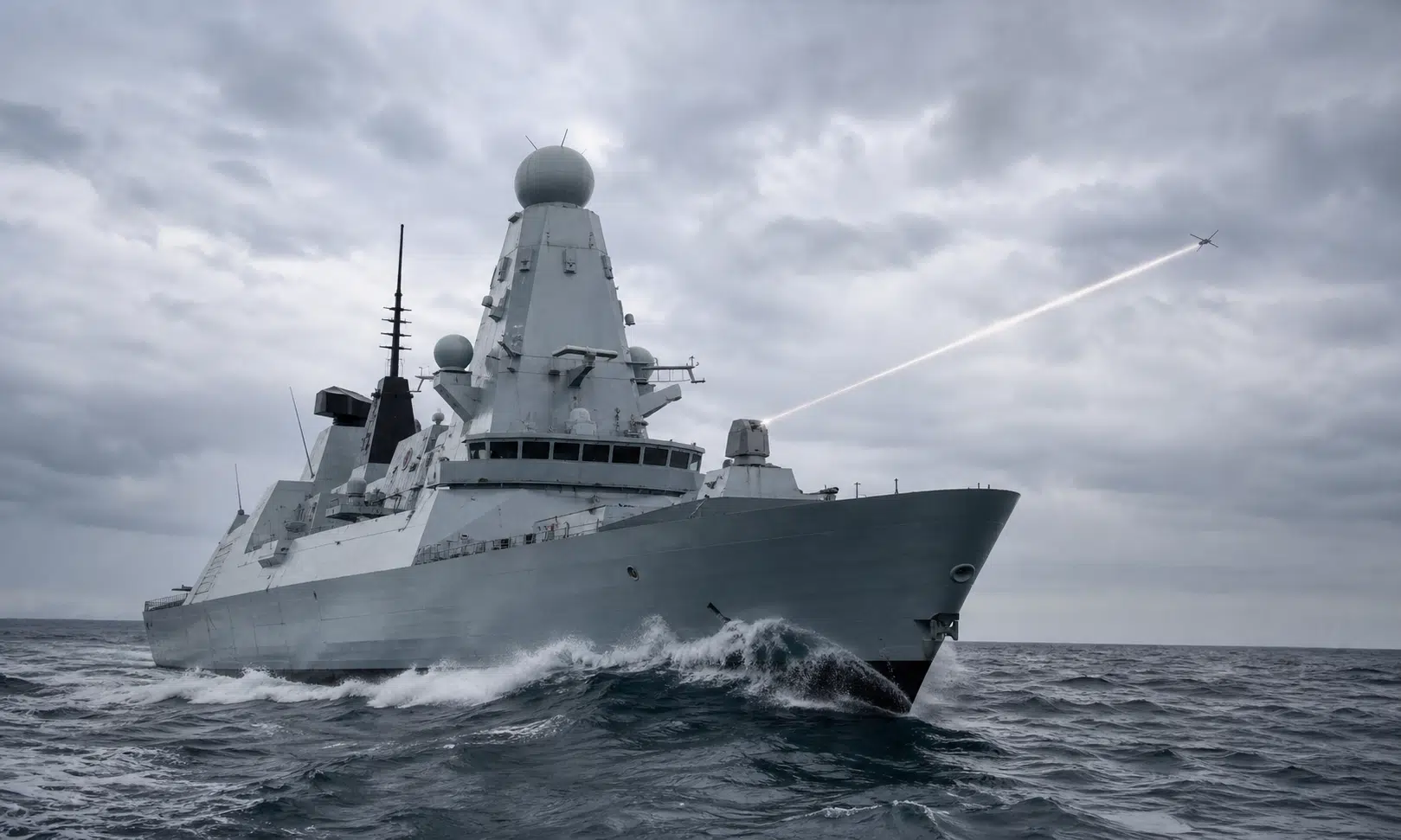

The UK’s DragonFire laser weapon effort is moving into a more practical phase: figuring out how to make the system compact, supportable, and suitable for installation on a Royal Navy Type 45 destroyer.
A firm operational timeline has not been publicly confirmed, but the program is being discussed around a possible shipboard debut before the end of 2027. If that target holds, it would mark a significant step for laser-directed energy at sea, where the hard part is not only generating enough power but building a weapon that can survive salt water, motion, weather, and the maintenance realities of a deployed warship.
The work involves QinetiQ, MBDA’s UK business, and Leonardo’s UK business, which are collaborating on DragonFire. The companies have framed the current challenge less as a clean-sheet redesign and more as a push to make the existing system practical for naval use.
Why Size Matters for DragonFire
DragonFire is being developed as a high-energy laser weapon, with attention on the beam director and the supporting equipment around it. Industry officials have not identified a public target size for the beam director, so the key question is not simply how small the system can become. It is whether the weapon can be reduced and hardened enough to fit into the Type 45 environment without creating unacceptable tradeoffs.
That matters because a destroyer is not an empty test range. Any new system has to compete for space, power, cooling, access, and maintenance time. It also has to be protected from the marine environment. Work described by the companies includes reducing the overall system footprint, understanding how the beam is produced, and planning for through-life support once the weapon is installed.
That support question is easy to underplay, but it may be one of the most important parts of the program. A laser weapon that works in a controlled test setting still has to be maintained by crews, repaired under operational constraints, and integrated into a ship’s existing combat systems. For a first naval deployment, those practical details can shape the design as much as raw performance.
The Near-Term Goal Is Getting It Aboard
The industry team’s near-term priority appears to be getting DragonFire onto the Type 45 rather than radically reworking every part of the architecture. That means making minimum deployable decisions: what has to be ready for an initial ship fit, what can be improved later, and how the software and hardware can evolve after the first installation.
That incremental approach is common for military technology that is moving from demonstration into service. The first version does not need to answer every future requirement. It needs to prove that the weapon can be integrated, operated, supported, and trusted in the conditions where sailors would actually use it.
For DragonFire, those conditions include sea spray, ship movement, vibration, and the visibility limits that come with weather. Laser weapons are line-of-sight systems, so their effectiveness depends on the target, range, atmosphere, and the ability to keep energy focused long enough to produce the desired effect. Severe weather remains one of the operational questions navies will need to understand before treating lasers as routine defensive weapons.
What DragonFire Is Meant to Add
DragonFire has been positioned for counter-drone defense, particularly against smaller uncrewed aircraft. The system is described as operating at relatively short range and within line of sight. Those details point to a defensive role rather than a broad replacement for missiles or guns.
The attraction is cost and magazine depth. The system has been associated with a claimed shot cost of less than £10, or about $13, though that figure has not been independently verified and does not capture the full cost of developing, installing, powering, and supporting the weapon.
Even with that caveat, the logic is clear. Modern ships may face cheap drones or drone swarms that are poor economic matches for expensive interceptor missiles. A laser could give commanders another option, allowing them to preserve kinetic weapons for threats that require them.
That does not make DragonFire a standalone shield. The more realistic role is as part of layered defense, where directed energy, guns, missiles, sensors, and electronic warfare all cover different parts of the threat picture. Used that way, a laser could help stretch a ship’s defensive inventory and potentially keep it on station longer.
The Bigger Test Is Confidence
The technical work around miniaturization is only part of the story. The larger test is confidence. Navies have decades of experience with missiles and guns, and commanders understand their limits. Laser weapons still have to prove how they perform outside controlled demonstrations and across the messy range of real operating conditions.
That is why DragonFire’s Type 45 effort matters. It is not just about whether a laser can hit a target. It is about whether a naval crew can rely on the system, maintain it, and fit it into the existing rhythm of ship defense.
If the UK can get DragonFire onto a destroyer and show that it works as a practical shipboard weapon, the program could help define how directed energy moves from promising technology to a regular part of naval air defense. For now, the immediate task is more concrete: make the system smaller, protect it for life at sea, and prove it belongs on the ship.