

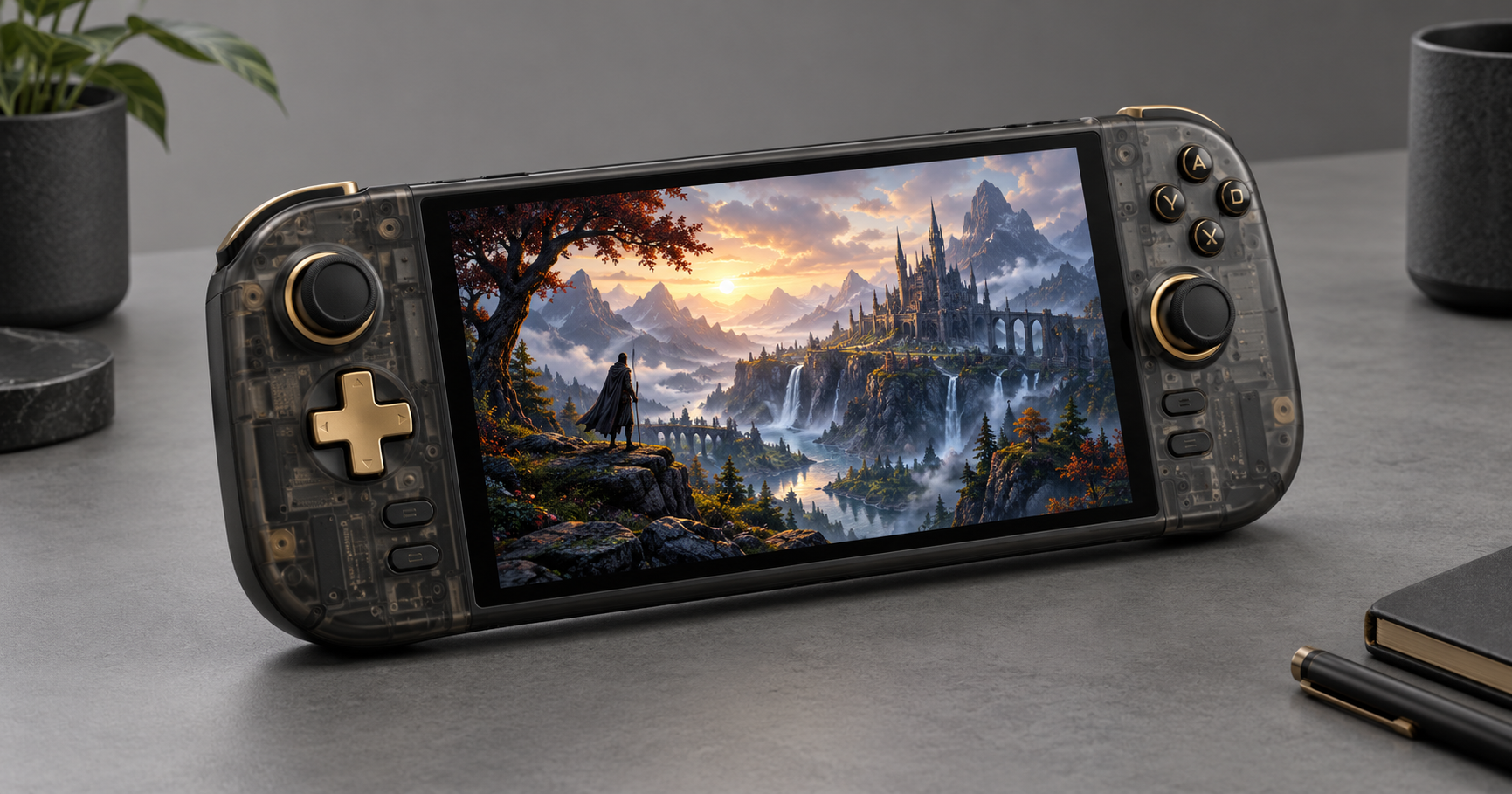

Asus announced availability of the ROG Xbox Ally X20 on October 15, 2026, adding an OLED display and revised controls to its Windows gaming handheld lineup. The company put the standalone device at US$1,299, a $300 increase over the $999 price it cited for the existing ROG Xbox Ally X.
The X20 retains the AMD Ryzen AI Z2 Extreme processor, 24GB of memory and 1TB SSD described in IGN’s comparison with the Xbox Ally X. Its principal changes concern the screen, enclosure and controls. Asus identifies the model as part of the Republic of Gamers brand’s 20th anniversary range.
IGN reviewer Jackie Thomas reported closely matched performance between the two handhelds in Cyberpunk 2077 and two 3DMark benchmarks. Her testing also recorded a modest increase in battery runtime, alongside a touchscreen-related software problem that disrupted controller input.
An OLED display leads the hardware changes
Asus specifies a 7.4-inch OLED touchscreen with a resolution of 1920 × 1080 and a 120Hz refresh rate. The company’s specifications also list Dolby Vision HDR and FreeSync Premium Pro support. These features add detail to the display change that forms the central distinction in Thomas’s hands-on account.
The manufacturer rates the panel at 600 nits for SDR content and 1,400 nits for HDR. Those are Asus’s published specifications, separate from Thomas’s observations about how games looked during her time with the handheld.
Thomas described improved visibility in dark scenes and more vivid colors compared with the Xbox Ally X. She cited Monster Hunter Rise as an example of a game whose colors appeared more distinct on the OLED panel. Her assessment was based on playing games, rather than a set of reported brightness or color-accuracy measurements.
Screen size and handling were also part of her comparison with the Lenovo Legion Go 2. Thomas said she had previously favored that device’s display but found its larger controls harder to reach with her smaller hands. She reported that the X20 was easier for her to hold over extended sessions, despite having a smaller screen than the Lenovo. Thomas said the clearer image helped offset the smaller screen during her own play sessions.
Thomas also described accidentally activating controls on the Legion Go 2, briefly causing games to register keyboard-and-mouse input. Her preference for the X20 reflected handling as well as screen quality, rather than display size alone.
IGN reports closely matched gaming performance
In Thomas’s Cyberpunk 2077 test, the X20 recorded 42 frames per second at 1080p with the High preset and FSR set to Quality. The Xbox Ally X recorded 43 fps using the same stated settings.
Her 3DMark results showed similarly small numerical differences. The X20 scored slightly lower in Steel Nomad and slightly higher in Time Spy. Neither test produced a large separation between the two devices in IGN’s reported results.
| Test | ROG Xbox Ally X20 | ROG Xbox Ally X |
|---|---|---|
| Cyberpunk 2077: 1080p High, FSR Quality | 42 fps | 43 fps |
| 3DMark Steel Nomad | 598 points | 602 points |
| 3DMark Time Spy | 4,030 points | 4,016 points |
Those figures support a narrow conclusion: the display and control changes did not coincide with a substantial performance increase in the workloads Thomas measured. They do not establish how every game will perform, and the Cyberpunk result applies to the resolution, graphics preset and upscaling mode used in that comparison.
The shared processor is an AMD Ryzen AI Z2 Extreme. Asus lists 24GB of onboard LPDDR5X memory and a 1TB PCIe 4.0 NVMe SSD for the X20, matching the capacities Thomas reported for the earlier model. The OLED version therefore does not add memory or storage capacity in that configuration.
Asus also describes changes to the cooling system, so the retained processor and capacities should not be read as meaning that every internal component is identical. The company’s product description identifies revised fans and a channel directing airflow toward the processor.
A nine-minute increase in the reported battery test
Thomas reported that the X20 ran Cyberpunk 2077 for two hours and 43 minutes, starting with a full battery and continuing until the handheld shut down. She described the device settings as stock.
The Xbox Ally X lasted two hours and 34 minutes in the comparison she cited. The difference between those recorded runtimes is nine minutes. Thomas also listed a two-hour, 14-minute result for the MSI Claw 8 EX AI+, putting the X20 ahead of both devices in her reported test results.
These are measurements from Thomas’s testing, rather than an Asus battery-life guarantee. They describe runtime while playing Cyberpunk 2077 and should not be treated as a fixed duration for other games or uses.
The results also do not isolate the OLED panel’s contribution to power consumption. The measured runtime difference alone cannot show whether the screen caused the increase. Asus’s specification sheet lists an 80Wh battery for the X20, but Thomas’s account does not separate display power use from the rest of the system.
Revised sticks, D-pad and anniversary enclosure
The X20 uses a partially transparent enclosure with gold accents, replacing the simpler appearance Thomas described on the Xbox Ally X. She reported gold menu buttons, while the volume control and standard controller inputs remained black.
The directional pad can change shape without swapping in another component. Thomas described pulling it outward and rotating it to switch between a defined four-direction pad and a concave form resembling the D-pad on Xbox Elite controllers. Asus’s product description says the mechanism changes between four-way and eight-way configurations by lifting and rotating the pad 90 degrees.
This differs from controller designs that provide separate removable D-pads. The X20’s mechanism keeps the alternative configurations within the same control, allowing the user to change its form without keeping another pad nearby.
The joysticks also move to TMR sensors. Asus describes them as magnetic sensors designed to reduce the potential for stick drift. That is a manufacturer claim about the design; Thomas’s short period of use did not establish the controls’ long-term durability.
Thomas said she did not notice a substantial day-to-day difference in the sticks during her hands-on time. Her account therefore supports the presence of different sensor hardware, but does not provide a measured lifespan improvement or a basis for describing the sticks as immune to drift.
Asus also lists rubberized grips and changes to the face buttons, bumpers and triggers. Those physical revisions extend the update beyond the display, although Thomas’s performance figures still place the two handhelds close together in the tests she reported.
A touchscreen interaction disrupted controller input
The X20 runs Windows 11 and uses the Xbox Full Screen Experience for controller-oriented navigation. Thomas reported a recurring problem when she swiped upward on the touchscreen to move to another window: the handheld behaved as though the Xbox button was being held down.
Subsequent controller inputs were then interpreted as shortcuts. In her account, button presses could open the on-screen keyboard, launch Task Manager or trigger other actions instead of performing their intended functions.
The problem affected more than navigation within a game library. Thomas said it also interrupted attempts to consult a guide in a browser and then switch back to a game. Once the behavior appeared, she reported needing to restart the handheld to restore usable controller input.
Thomas said she reduced the interruptions by avoiding touchscreen use as much as possible. That describes her workaround during testing, not a confirmed software fix. Her account does not establish how widely the issue occurs across other X20 units.
She also recalled software problems with the Xbox Ally X’s Full Screen Experience at its launch, while describing the X20 behavior as more disruptive in her own use. The reported issue concerns the interaction between touch gestures, window switching and controller commands; her account does not identify its underlying cause.
Pricing and the existing handheld lineup
Asus’s October 15 announcement said both earlier Xbox-branded handhelds remained on sale at their original suggested prices: US$599 for the ROG Xbox Ally and US$999 for the ROG Xbox Ally X. The X20 therefore joins the range at a higher price rather than replacing the Xbox Ally X.
The company had opened X20 preorders on August 25, 2026, with October 15 identified as the planned sale date. That announcement also listed the standalone handheld at US$1,299 and said final prices and availability could vary by region and local market. The October availability announcement repeated the same standalone price.