

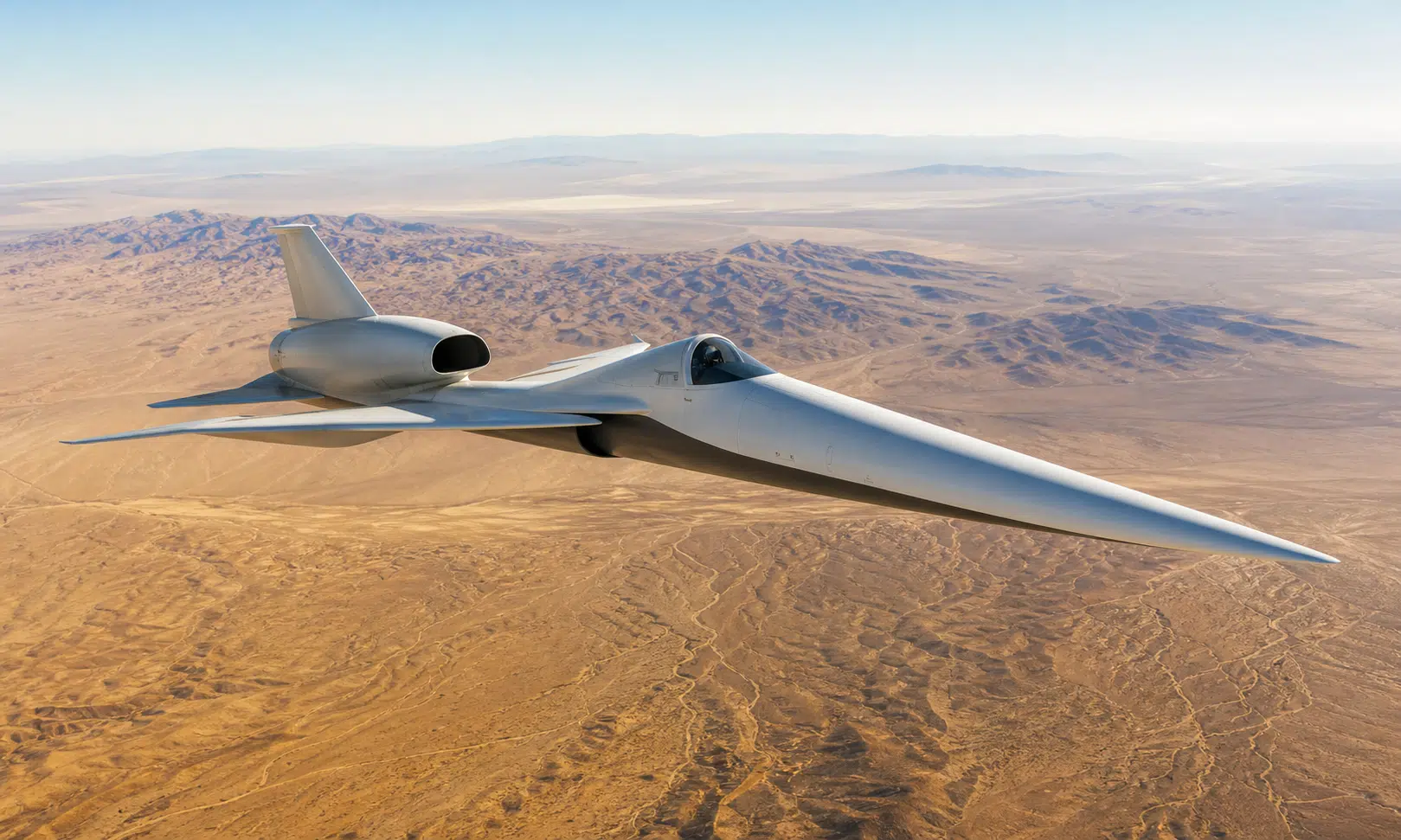

More than two decades after Concorde left commercial service, NASA’s X-59 is testing a more modest and more practical question: can supersonic flight be made quiet enough for regular routes over land?
The aircraft, formally called the Lockheed Martin X-59 Quesst, is not meant to become an airliner itself. It is a research jet, built with Lockheed Martin, that NASA intends to use as a flying testbed for quiet supersonic technology. The goal is to replace the sharp, disruptive sonic boom normally associated with aircraft flying faster than sound with a softer pressure signature that people on the ground may perceive more like a muted thump.
That distinction matters because the boom, not simply the speed, has long been the biggest regulatory and public-acceptance problem for supersonic travel over populated areas. The United States has restricted routine civil supersonic flight over land for decades, and any future aircraft maker hoping to sell a faster-than-sound passenger jet will need more than a sleek rendering and a fast cruise speed. It will need a credible noise case.
The X-59 program is designed to help build that case. NASA plans to move beyond controlled test flights and eventually fly the aircraft over selected US communities, gathering acoustic measurements and public reaction data. That feedback could help regulators decide whether a new standard for acceptable overland supersonic noise is possible.
That still leaves plenty of unresolved questions. A quieter boom would not automatically make supersonic airliners economical, efficient, or easy to certify. Fuel burn, airport operations, ticket economics, emissions, and aircraft maintenance would all remain serious hurdles. But without a way to address the noise problem, the rest of the business case barely gets to start.
A jet shaped around shockwaves
The X-59’s most obvious feature is its long, tapered nose. It gives the aircraft a stretched, almost needle-like profile, and it is central to the experiment. The aircraft’s shape is meant to manage how shockwaves form and travel as the jet moves through the air at supersonic speeds.
On a conventional supersonic aircraft, shockwaves are created by multiple parts of the airframe, including the nose, canopy, inlets, wings, and tail. As those pressure waves move away from the aircraft, they can merge into a stronger pressure change that reaches the ground as the familiar sonic boom.
The X-59 takes a different approach. Its nose, wing shape, top-mounted engine placement, and overall proportions are intended to spread those shockwaves out and reduce how sharply they combine before reaching the ground. Instead of one abrupt pressure event, the aircraft is designed to create a more gradual acoustic signature.
NASA’s target for the Quesst program is commonly described as a perceived noise level around 75 PldB, compared with the much louder boom associated with earlier supersonic aircraft such as Concorde. That does not mean every person under a flight path would hear the same thing, or that every test run would sound identical. Weather, altitude, maneuvering, terrain, and local background noise can all shape what reaches someone’s ear.
That is why the program is not just an aerodynamics exercise. The X-59 has to prove its shape works in the air, then NASA has to connect measurements from instruments with what people actually notice on the ground.
The cockpit has no forward window
The X-59’s nose creates an unusual problem for the pilot: there is no traditional forward-facing cockpit window. The shape that helps manage shockwaves also blocks the normal view ahead.
To solve that, the aircraft uses an eXternal Vision System, or XVS. The system combines camera views from the aircraft with a cockpit display that gives the pilot a forward view and flight information. The aircraft also has side windows, which help during taxi, takeoff, and landing.
That setup makes the X-59 one of the more unusual modern crewed aircraft from a pilot’s perspective. It is not exactly flying blind, but it does require the pilot to trust a display for the forward view in phases of flight where visibility is usually fundamental.
NASA pilots prepared for that with extensive simulator work before taking the aircraft into the air. The preparation matters because the X-59 is not simply trying to demonstrate a single moment of supersonic flight. NASA needs an aircraft that can fly repeatedly, operate predictably, and eventually support a more public phase of testing away from the most familiar restricted test ranges.
The XVS also points to a broader aviation question. If a camera-and-display system can provide an equivalent or improved view in some circumstances, the technology may have uses beyond quiet supersonic aircraft. Future aircraft designers are already exploring shapes that do not always match the cockpit visibility assumptions of older airframes. The X-59 gives NASA a way to test that idea in a demanding environment.
Why the “frankenjet” label fits
Experimental aircraft often mix purpose-built parts with proven components from existing aircraft, and the X-59 follows that tradition. Its nickname as a “frankenjet” reflects the way the aircraft combines a highly specialized airframe with systems adapted from other military and civil aircraft programs.
That approach is practical. Building every subsystem from scratch would add cost, time, and risk to a program that is mainly focused on one research question: whether the aircraft can produce a quieter supersonic signature. Using known components where possible lets the team focus engineering attention on the parts of the aircraft that are truly novel.
The X-59 incorporates fighter-derived hardware in areas such as landing gear, controls, hydraulics, and propulsion, while its cockpit and avionics choices are designed to support test flying and eventual operations in civilian airspace. The aircraft’s engine is a customized variant from the same family used by the F/A-18 Super Hornet, giving the X-59 the thrust needed for supersonic testing without requiring an entirely new engine program.
There is a trade-off, of course. A research aircraft built from existing parts is not optimized for comfort, maintainability, or airline economics. The cockpit is compact, the mission is specialized, and the aircraft is being flown by highly trained test pilots. That is fine for NASA’s purposes, but it is also a reminder that the X-59 is a tool, not a prototype passenger jet.
Its value is in the data it can produce. If the aircraft shows that low-boom shaping works outside computer models and wind tunnels, future manufacturers could use that evidence to design cleaner-sheet supersonic aircraft around similar principles.
Early flights are about control before noise
Before the X-59 can become a community-noise experiment, it has to complete the slower and less glamorous work of flight testing. Early flights are meant to check handling, stability, systems behavior, pilot workload, and safe operating limits.
That matters because the aircraft’s long nose and unconventional shape can affect how it responds to pilot inputs. Pitch sensitivity, or how readily the nose moves up and down, is especially important on an aircraft with this kind of profile. Test pilots train for those characteristics in simulation, then expand the real aircraft’s envelope step by step.
The early program has included subsonic flights, systems checks, and initial supersonic runs. NASA’s test plan places the aircraft in a gradual build-up phase, rather than a single headline flight that proves everything at once. That is normal for an X-plane, especially one expected to fly enough times to support later acoustic and community testing.
One early test also showed why that caution is necessary. During an initial flight sequence, a cockpit warning indicated a possible pressurization-related problem. The pilot returned safely, and the issue was later tied to instrumentation rather than an actual onboard emergency. Even when the aircraft behaves well, a research program has to treat those signals seriously until engineers understand what happened.
Supersonic flight itself can be anticlimactic from inside the cockpit. The transition through Mach 1 is not necessarily a dramatic physical event for the pilot; instruments may provide the clearest confirmation that the aircraft has crossed the speed of sound. For the X-59, the important question is not whether the pilot feels a cinematic moment, but what the aircraft’s pressure waves do as they travel away from it.
Measuring the thump is harder than making one
NASA’s next challenge is measurement. The X-59 has to be evaluated close to the aircraft, in the atmosphere, and on the ground. Each layer tells a different part of the story.
Near the aircraft, specialized instrumentation can measure the location and strength of shockwaves while the jet is flying. Higher in the atmosphere, airborne microphones can record how those waves propagate away from the aircraft. On the ground, acoustic recorders can capture what actually arrives where people live and work.
That kind of layered measurement is essential because a quiet-supersonic aircraft is not judged only by its shape or its speed. It is judged by the pressure signature that survives all the way to the ground. A design that looks promising in simulation still has to deal with real atmospheric conditions.
NASA also has to separate the X-59’s signature from other noise in the test environment. Chase planes are valuable for safety and monitoring, but supersonic chase aircraft can create their own booms. That complicates early attempts to hear or isolate the X-59’s quieter acoustic profile.
The program’s second phase is expected to focus on those controlled measurements near Edwards Air Force Base in California. That phase is the bridge between aircraft checkout and public response testing. If the data shows that the aircraft is producing the intended pressure signature, NASA can move toward flights designed around community feedback.
The public test may be the real point
The most consequential part of the X-59 program is not the first supersonic flight. It is the planned community testing campaign.
NASA wants to fly the aircraft over selected US communities and ask residents what they heard, how often they noticed it, and how annoying it was. Microphone arrays would record the sound levels at the same time. Together, those two datasets could help regulators understand the relationship between measured low-boom noise and public acceptance.
That is the missing piece in the overland supersonic debate. Engineers can design for lower noise, and aircraft makers can argue that faster travel has commercial value. But regulators need evidence about what people on the ground will tolerate in daily life.
The planned community tests are expected to vary the aircraft’s flight profile so residents hear a range of sonic thumps, from relatively quiet events that some people may miss to louder ones that could be more noticeable or irritating. Each location could experience repeated flights over a period of weeks, giving NASA a more realistic picture than a single demonstration flyover would provide.
The first community test is expected to use an area near NASA Armstrong Flight Research Center at Edwards Air Force Base, with later tests potentially moving to other regions. Any airport supporting the aircraft would need a long enough runway and the right operational environment for a research jet, which narrows the list of possible sites.
For residents, the question will be simple: is this sound acceptable if it means supersonic aircraft can cross land? For regulators, the question is more technical: can a measurable standard be written that allows quieter supersonic designs while protecting the public from disruptive noise?
What the X-59 can and cannot prove
The X-59 can help answer whether low-boom shaping works in real flight and whether communities respond differently to a softer supersonic signature. It cannot, by itself, prove that commercial supersonic travel is ready to return.
A future passenger aircraft would need to meet a much broader set of requirements. It would have to carry passengers efficiently, satisfy airport noise rules, meet emissions and safety standards, fit into airline route networks, and offer fares that enough travelers are willing to pay. Supersonic speed is valuable only if the economics work.
That is where the X-59’s role is narrower but still important. It is not trying to solve the full airliner problem. It is trying to remove, or at least reduce, one of the biggest barriers that kept civil supersonic flight away from overland routes.
If the program succeeds, the likely result would not be immediate supersonic flights over US cities. It would be data. NASA plans to provide that data to regulators, including the FAA and international aviation bodies, so they can consider whether existing rules should evolve from a simple speed-based restriction toward a noise-based standard.
That shift would be meaningful. Instead of asking whether an aircraft is flying faster than Mach 1 over land, regulators could ask whether its measured sonic signature stays below an acceptable threshold. That would give aircraft designers a target and give the public a clearer standard for protection.
A quieter future still has to earn its place
The X-59 is one of NASA’s more interesting aviation experiments because it is not chasing speed for its own sake. Supersonic flight has been possible for decades. The harder task is making it compatible with ordinary life below the flight path.
That makes the aircraft both futuristic and oddly practical. Its shape is extreme, its cockpit setup is unusual, and its mission is highly specialized. But the core question is grounded: can the sound of supersonic travel be reduced enough that people will accept it?
The answer will depend on more than decibels. It will depend on frequency, context, local expectations, time of day, and whether the benefits of faster flight feel real to the people who experience the noise. A thump that is acceptable once during a test may feel different if it becomes part of regular air traffic.
NASA’s job with the X-59 is to gather the evidence needed to have that debate with real numbers and real public feedback. If the aircraft performs as intended, it could help rewrite the rules for overland supersonic flight. If it falls short, it will still clarify how difficult the noise problem really is.
Either way, the X-59 is not just a sleek experimental jet. It is a test of whether supersonic aviation can move from a nostalgic luxury of the past toward a quieter, more regulated, and potentially more useful future.