

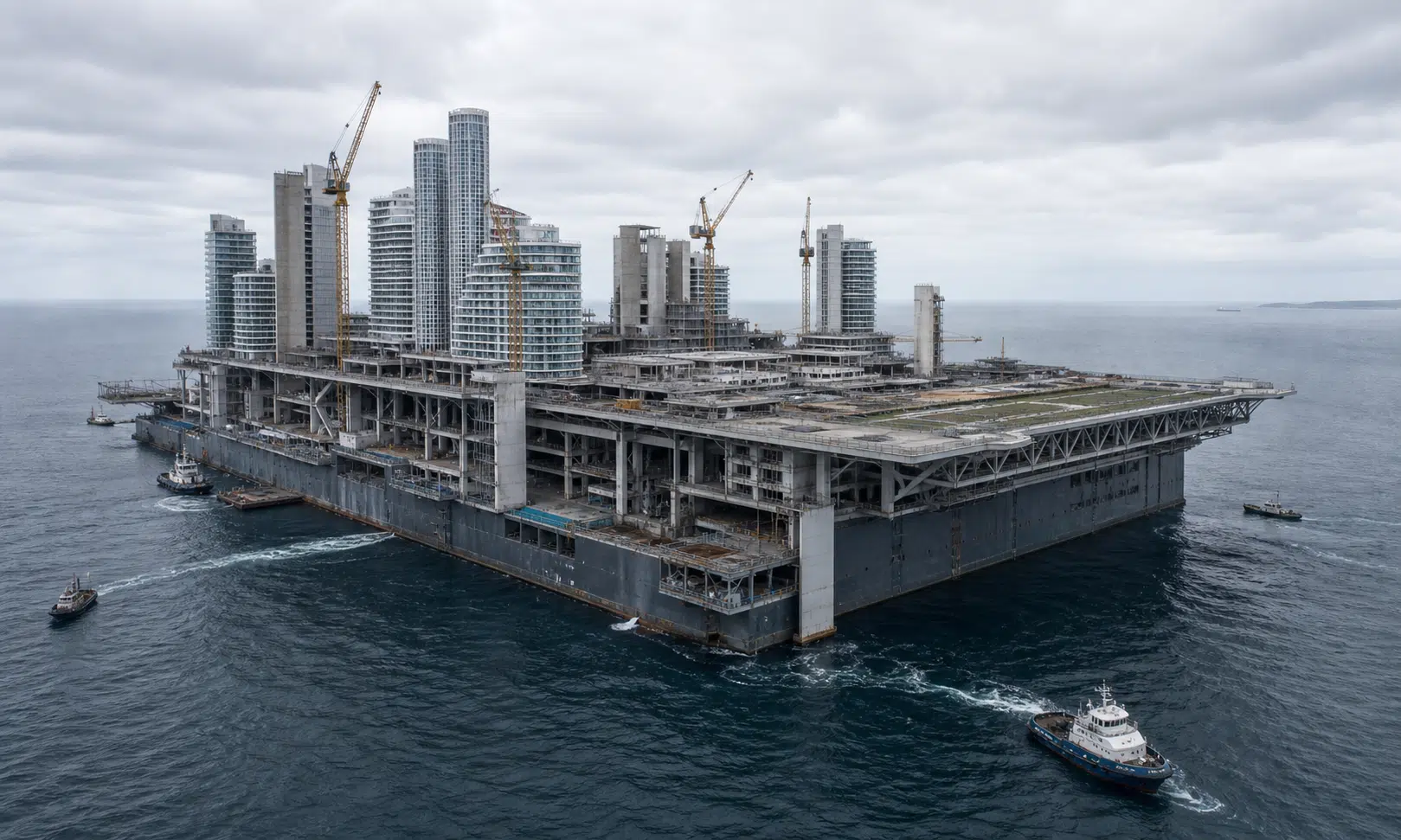

Freedom Ship, the long-discussed floating city concept, is being presented again as an ambitious alternative to conventional cruise travel and land-based development. The proposal describes a massive ocean-going platform with residences, schools, health care, shops and public spaces, but key parts of the plan remain unproven.
The project is often described in sweeping terms: a vessel roughly one mile long, about 800 feet wide and around 30 decks tall, with room for as many as 80,000 people. Those figures come from project materials and earlier public descriptions, not from a completed vessel or an independently verified build program.
That distinction matters. Freedom Ship is not a ship returning to service. It is a proposal that has resurfaced repeatedly over several decades, with supporters framing it as a permanently mobile city at sea. There is still no confirmed construction timeline, no finished vessel and no public evidence that the financing required for a project of this scale has been secured.
A floating city concept, not a working ship
The central idea behind Freedom Ship is to move beyond the model of a cruise ship built mainly for short vacations. Project descriptions present it as a residential and commercial community that would travel the world while remaining offshore from many ports.
The planned scale is what keeps drawing attention. Supporters have described a structure exceeding 2 million gross tons, with enough space for homes, businesses, schools, medical facilities and entertainment venues. The same materials have referred to a vessel around one mile long, 800 feet wide and 30 stories or decks tall.
Those numbers should be read as proposal figures. They describe what backers say they want to build, not what has been built, certified or launched.
Earlier estimates have put the cost in the range of 12 billion British pounds, commonly translated into roughly the mid-teens of billions of U.S. dollars depending on exchange rates. That estimate is also not the same as a funded construction budget. For now, the financial case remains one of the biggest unresolved parts of the story.
What the onboard city is supposed to include
Freedom Ship’s appeal rests on the promise that daily life onboard would look less like a vacation itinerary and more like a functioning city. Project descriptions have listed hotels, restaurants, shops, banks, museums, a concert hall, a water park, a convention center, a nightclub, an aquarium and a 15,000-seat stadium.
The concept also includes education and medical services. Backers have described schools, college-level programs, health care facilities and research space as part of the design. If built as described, residents would not simply be passengers moving from one destination to another. They would be expected to live, work, study and receive services onboard.
Because a vessel of that size could not operate like a normal cruise ship, the logistics would be different as well. Project descriptions have referred to ferries, visiting vessels and aircraft moving people and supplies between the ship and shore. Some accounts also describe a slow global route at about 7 knots, with the ship circling the world over an extended cycle.
Those details remain part of the concept rather than a demonstrated operating plan. A city at sea would need reliable systems for food, water, sanitation, waste processing, emergency response, maintenance, transport and governance. The larger the promised population, the more those systems become the real test of the idea.
The environmental case is still unsettled
Freedom Ship has been marketed in part around the idea that a large floating community could reduce pressure on crowded ports and use cleaner marine systems. Project statements have referred to hybrid propulsion, energy recovery and water and waste management processes. Earlier descriptions have also linked the concept to more speculative ideas, including nuclear power and ocean cleanup.
Those claims should be treated cautiously until there is a detailed, independently reviewed design. A floating city would not avoid environmental impacts simply because it operates offshore. It would still need power, fuel or other energy systems, cooling, heating, water treatment, food supply chains, waste handling and constant transport links to land.
The broader shipping industry already faces pressure to reduce greenhouse gas emissions. A very large vessel can sometimes be more efficient per person than several smaller ones, but that does not automatically make a permanent floating city low-impact. The relevant question is not only how efficiently the platform moves through the water. It is also how much energy the onboard city consumes every day.
That includes homes, hospitals, stores, schools, kitchens, entertainment venues and public services. It also includes the support traffic required to keep the community functioning. Ferries, aircraft, supply boats and maintenance operations would all add to the environmental calculation.
Funding remains the central barrier
Freedom Ship’s history reaches back to the 1990s, when the concept was associated with American engineer Norman Nixon. The idea has been revived, revised and set aside more than once since then, which is why renewed publicity around the project needs careful wording.
Roger M. Gooch, associated with Freedom Cruise Line International, has been publicly linked to recent efforts to advance the proposal. Company-facing materials describe the ship as a long-term development project that would require patient capital, technical validation, governance work and a phased approach.
That language is important because it signals that the project is not near completion. Supporters may argue that interest exists, but interest is not the same as financing, shipyard capacity, regulatory approval or a tested operating model.
If the funding were secured, project descriptions have suggested construction could begin with hull sections and continue through modular assembly. Some earlier accounts have even suggested that residents might move in before the full vessel is completed. That possibility underscores how unusual the project would be, but it also raises practical questions about safety, inspection, liability and construction management.
Offshore life would still need oversight
A floating city also raises legal and regulatory questions. A project of this size would involve housing, commerce, health care, education, transportation, utilities, waste systems and possibly research activity. Each of those areas normally depends on clear public rules and accountable oversight.
Operating offshore may appeal to investors who see flexibility beyond land-based constraints. But the ocean is not empty territory. A permanent or semi-permanent city at sea would still affect marine environments, shipping routes, coastal infrastructure and nearby communities.
That is why the Freedom Ship proposal is best understood as a high-profile test case for floating urbanism rather than a proven solution. Coastal cities are already studying floating architecture as sea levels rise and urban land becomes more expensive. Smaller floating districts, climate-adaptation projects and maritime housing concepts may become more common in the future.
Freedom Ship sits at the extreme end of that conversation. Its scale makes it compelling, but also makes every unanswered question more significant.
Why the idea keeps coming back
The concept endures because it combines several powerful ideas: mobility, private development, oceanfront living, climate adaptation and the spectacle of a self-contained city. It is easy to understand why renderings of a floating metropolis keep circulating.
But the project will not be judged by its most dramatic features. A stadium, schools, helipads or ocean views are secondary to the harder questions: Can it be financed? Can it be engineered and insured? Can it meet credible environmental standards? Can residents be protected by clear laws and public accountability?
For now, Freedom Ship remains an ambitious proposal rather than the world’s largest working floating city. Its latest round of attention shows that the dream of mobile ocean living still has an audience. Whether that dream can survive the financial, technical and environmental review required to build it is still unresolved.