

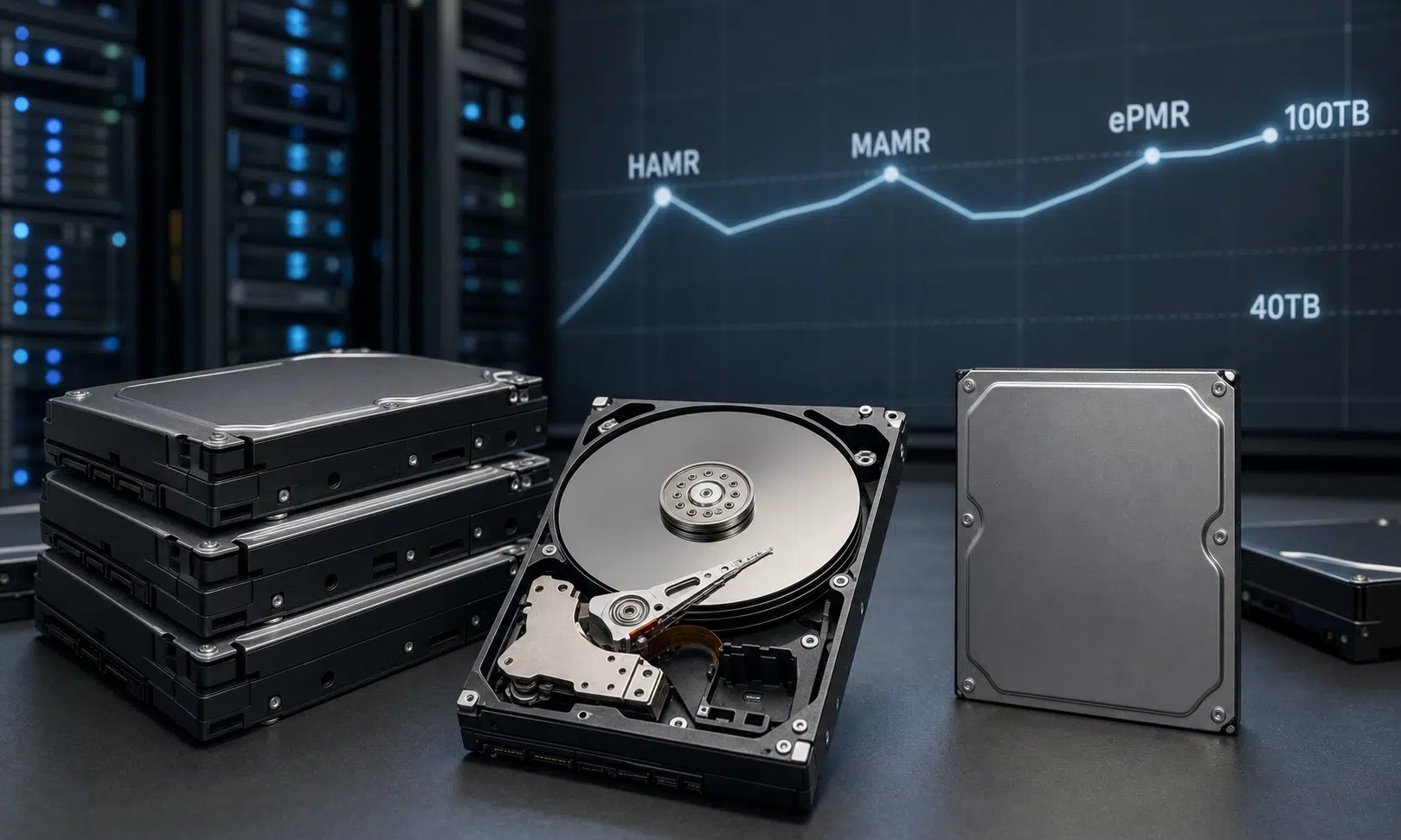

Seagate, Toshiba and Western Digital are now the only major hard drive manufacturers left standing. That makes the high-capacity HDD market unusually concentrated, but not simple. The three companies are chasing the same end point: much larger nearline drives for cloud, AI and enterprise storage. They are not taking the same route to get there.
Seagate has pushed hardest into HAMR, or heat-assisted magnetic recording, and is already positioning that technology as its long-term capacity engine. Toshiba is stretching MAMR, mechanical design and platter count before moving more heavily into HAMR. Western Digital is running a dual-path strategy, extending ePMR and UltraSMR while preparing HAMR for larger jumps later in the decade.
For buyers, the headline capacity numbers are only part of the story. A 40TB, 44TB or future 60TB drive is not automatically the right fit just because it is larger. Recording method, shingled versus conventional layout, qualification timing, power behavior, rebuild exposure, workload pattern and vendor ramp risk all matter.
The HDD Market Is Smaller, But the Stakes Are Larger
Hard drives are no longer the broad consumer storage category they once were. Laptop drives have been pushed aside by SSDs, desktop HDD demand has thinned, and high-performance enterprise HDDs have mostly disappeared as a mainstream category. The remaining center of gravity is nearline storage: large-capacity 3.5-inch drives used in data centers where cost per terabyte, density and predictable access still matter.
That shift explains why HDDs remain important even as SSDs keep getting faster and cheaper. NAND flash is the obvious choice for hot data, transactional workloads and latency-sensitive applications. HDDs still have a strong economic case for bulk storage, backup, object storage, media archives, AI training data repositories, checkpoints and other data sets that need to remain accessible without sitting on premium flash.
The market is also more specialized than unit shipment numbers alone suggest. A large share of modern HDD volume is now tied to nearline drives, while the rest is spread across NAS, surveillance, external desktop storage, remaining consumer drives and specialized enterprise models. That has changed the way manufacturers prioritize engineering. They are not designing primarily for the old PC upgrade market. They are designing for hyperscale qualification cycles, rack density, power budgets and fleet economics.
The data center side of the market is demanding more capacity, but it is also cautious. Hyperscale buyers do not adopt a new drive platform just because a vendor announces it. New recording technologies have to survive long validation windows. Firmware behavior, error rates, power draw, vibration tolerance, rebuild behavior and serviceability all have to fit into existing storage architecture.
That is why the race to 100TB is not a sprint from one product announcement to the next. It is a long qualification contest where capacity gains must arrive without breaking the economics that keep HDDs relevant.
Why 100TB HDDs Are So Difficult
A hard drive gains capacity by packing more data onto each platter, adding more platters, using more advanced heads, changing the recording method, or some combination of all four. Each lever creates its own engineering problem.
Higher areal density makes bits smaller and more difficult to write reliably. More platters require thinner media, tighter mechanical tolerances and careful control of vibration and airflow inside a helium-filled enclosure. New magnetic materials can hold smaller bits more securely, but they may also require new ways to write those bits. That is where energy-assisted recording comes in.
Modern high-capacity roadmaps are built around several related technologies:
- ePMR: Western Digital’s energy-assisted perpendicular magnetic recording approach, used to extend conventional PMR-style designs.
- FC-MAMR: Toshiba’s flux-control microwave-assisted magnetic recording technology, used to improve writability while retaining a more incremental path.
- HAMR: Heat-assisted magnetic recording, which uses localized heating to make very high-coercivity media writable for a brief moment.
- SMR: Shingled magnetic recording, where tracks overlap to increase density, often at the cost of more complicated write behavior.
- CMR: Conventional magnetic recording, generally easier to deploy across mixed workloads but lower in maximum density than SMR at the same technology level.
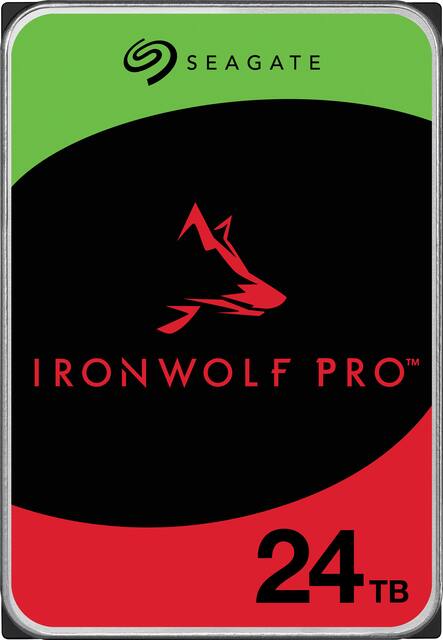
Seagate IronWolf Pro 24TB NAS HDD
For readers moving from roadmap theory to real purchases, a large IronWolf Pro NAS drive is a useful reference point. Check the exact model’s recording type and workload fit before mixing it into an existing array.
As an Amazon Associate I earn from qualifying purchases.
SMR deserves special attention because many headline capacities depend on it. Shingled drives can make excellent sense in controlled environments where writes are sequential, managed by the host or absorbed by carefully designed software. They are less attractive for random-write-heavy workloads or systems that expect conventional drive behavior. A buyer comparing 30TB, 34TB, 40TB or future larger drives should look at whether the capacity is CMR or SMR before treating it as a like-for-like upgrade.
The same caution applies to early HAMR adoption. HAMR is widely viewed as the most important path to very large future HDDs, but it changes media, head and manufacturing requirements. The technology can raise the ceiling, but product maturity and fleet confidence still determine how quickly it becomes the default option.
The Three Roadmaps at a Glance
The industry is converging around higher-density energy-assisted recording, but the near-term strategies are clearly different. Seagate is leaning hardest into HAMR. Toshiba is extracting more from FC-MAMR and platter stacking. Western Digital is keeping ePMR and HAMR alive in parallel.
| Vendor | Near-term strategy | Key technologies | Buyer takeaway |
|---|---|---|---|
| Seagate | Scale HAMR through Mozaic platforms | HAMR, FePt media, higher per-platter density | Most aggressive HAMR posture, with early hyperscale production emphasis |
| Toshiba | Extend FC-MAMR and mechanical scaling before broader HAMR use | FC-MAMR, glass substrates, 11- and 12-disk designs | More conservative path focused on incremental risk reduction |
| Western Digital | Run ePMR and HAMR side by side | ePMR, UltraSMR, HAMR, future high-platter designs | Transition strategy gives large buyers more timing flexibility |
None of these approaches is automatically superior for every customer. Seagate’s strategy may appeal to buyers that want to qualify HAMR early and ride a clearer density curve. Toshiba’s path may appeal where cautious platform evolution matters more than being first to the highest number. Western Digital’s dual-track model may be attractive to hyperscalers that want larger drives without a forced immediate jump to a different recording stack.
Seagate: Betting Hard on HAMR
Seagate has spent years positioning HAMR as the foundation of its future HDD business. The company discussed HAMR long before it was commercially ready at scale, and its roadmap has carried the burden of that early commitment. The basic argument is simple: to reach much higher capacities, the industry needs media that can hold smaller, stable magnetic grains, and HAMR provides a practical way to write to that media.
In HAMR, a tiny laser-assisted heating process briefly reduces the coercivity of the recording medium so the write head can change the bit state. After cooling, the bit remains stable. That sounds straightforward in outline, but the manufacturing reality is demanding. The head, near-field optical components, media, thermal behavior and drive reliability all have to work together over years of operation.
Seagate’s Mozaic platform is the commercial expression of that bet. The company has described its newer HAMR platform as supporting capacities up to 44TB in hyperscale deployments, with the broader objective of increasing per-disk density over time. Public roadmap language points toward future drives that move well beyond today’s capacities as per-platter density rises.
The important distinction is that Seagate is not just treating HAMR as a lab milestone. It is using HAMR as the main scaling mechanism for its largest nearline products. That gives the company a clearer story for the march toward 50TB, 60TB, 80TB and eventually 100TB-class drives, although exact timing will still depend on qualification, manufacturing yield and customer adoption.
Earlier HAMR timelines slipped over the years, and that history matters. Seagate had long aimed to commercialize HAMR-based products, including capacity targets around the 20TB era, but the transition took longer than early public expectations suggested. The commonly discussed technical hurdles included component reliability, media durability, manufacturing yield and customer qualification. Those issues are best understood as part of the broader difficulty of making HAMR economical at scale, rather than as a single confirmed failure point.
Today, Seagate’s advantage is that it has moved further into public HAMR production than its rivals. Its risk is that HAMR must continue to scale cleanly. Larger capacities will require more density, high consistency across manufacturing lots and convincing real-world reliability data. Hyperscale customers can tolerate long qualification cycles, but they will not tolerate surprises across massive fleets.
For buyers, Seagate’s roadmap is the most direct HAMR story. If the goal is to track the earliest high-capacity HAMR deployments, Seagate is the vendor to watch most closely. If the goal is conservative fleet replacement with minimal platform change, the calculation is more nuanced.
Toshiba: Stretching MAMR Before the Bigger Jump
Toshiba is the smallest of the three HDD manufacturers, and its roadmap reflects that position. Rather than trying to lead every headline capacity transition, Toshiba has tended to move in measured steps, using recording improvements and mechanical scaling to increase capacity while limiting the number of simultaneous technology changes.
Its current high-capacity strategy centers on FC-MAMR and denser disk stacks. Toshiba’s M12 generation uses glass substrates and FC-MAMR, with SMR models reaching into the 30TB to 34TB range and CMR versions planned at lower maximum capacity. The use of glass substrates is important because thinner, stiffer media can help support more disks inside the same 3.5-inch form factor.
Toshiba has also demonstrated 12-disk stacking technology and has pointed to 40TB-class drives built around MAMR and higher platter counts. That is a very different message from Seagate’s all-in HAMR stance. Toshiba is effectively saying that there is still useful headroom in MAMR plus mechanical refinement before HAMR needs to carry the whole roadmap.
That conservatism has tradeoffs. Toshiba may not control the high-capacity narrative in the same way Seagate does, and it may reach some capacity points later or in narrower customer windows. On the other hand, incremental platform changes can be attractive where reliability, qualification time and supply predictability matter more than an early claim to the largest possible drive.
Toshiba’s path also highlights an important point about the HDD industry: capacity gains do not come from recording physics alone. Sometimes the practical breakthrough is mechanical. Adding an eleventh or twelfth disk, switching substrate material, thinning components and maintaining stable head positioning can be just as important as changing the write mechanism.
For a buyer, Toshiba’s roadmap looks less like a dramatic technology leap and more like a controlled extension of known tools. That may fit NAS and enterprise buyers that value predictable product evolution. For hyperscale customers chasing the highest possible rack density, Toshiba will need to show that its eventual HAMR products can scale beyond the MAMR plateau without creating a disruptive transition.

Toshiba N300 Pro 24TB NAS HDD
A Toshiba N300 Pro drive fits readers who are thinking about practical NAS expansion rather than hyperscale qualification. Confirm enclosure compatibility and RAID rebuild planning before buying high-capacity disks.
As an Amazon Associate I earn from qualifying purchases.
Western Digital: Keeping ePMR Alive While Preparing HAMR
Western Digital’s roadmap is the most explicitly multi-track. The company is extending ePMR and UltraSMR while also qualifying HAMR. That approach lets WD keep shipping and refining a familiar platform even as it prepares for higher-density HAMR products.
WD has described a path in which ePMR-based UltraSMR drives continue scaling, with 40TB-class products in qualification and a stated plan to extend ePMR further. At the same time, the company is moving HAMR through hyperscale qualification, with production ramp language aimed at the later 2020s. WD has also presented a longer-term path toward 100TB-plus HAMR drives.
This bridge strategy makes commercial sense. Hyperscale buyers do not all move at the same pace. Some may want the largest possible capacity quickly, while others may prefer to stay with a familiar recording platform until HAMR economics are more compelling. If WD can keep ePMR competitive while bringing HAMR up carefully, it can offer customers a less abrupt migration.
There are technical limits to that approach. ePMR can be extended, especially with SMR and platform refinements, but it does not have the same long-term density ceiling as HAMR. At some point, the highest-capacity roadmap depends on new media and HAMR-style writing. WD’s challenge is to time that transition without leaving too much capacity on the table.
The company is also talking about more than capacity. WD has outlined separate drive concepts aimed at performance and power optimization. That matters because high-capacity drives create operational problems of their own. As drives get larger, rebuild times, per-terabyte IOPS and bandwidth per terabyte become more difficult to manage.
A 60TB drive that behaves like a much smaller drive from a performance perspective can create bottlenecks in some systems. A cold storage workload may accept that. An AI data pipeline or large active archive may not. WD’s answer is to separate some of the roadmap into performance-oriented and power-optimized branches rather than treating all high-capacity HDDs as one category.
For buyers, WD’s strategy may be the most flexible, but it also requires careful product reading. A WD drive’s capacity alone will not tell the full story. The recording method, SMR behavior, intended workload tier and qualification status will matter heavily.
Capacity Is Not the Only Problem: Performance Has to Scale Too
The industry’s next challenge is not simply reaching 100TB. It is making very large hard drives usable in modern storage systems without letting performance per terabyte collapse.
Traditional HDD performance improves slowly compared with capacity. Sequential throughput rises with areal density, but random I/O is still constrained by mechanical movement. If capacity doubles while IOPS barely changes, then each terabyte gets a smaller share of the drive’s performance. That can be acceptable for cold or warm storage, but it becomes a problem for active archives, object stores and AI-related data sets that need steady access.
Seagate has addressed this with multi-actuator designs such as its Mach.2 concept, where two actuator assemblies can work more independently inside one drive. That can improve IOPS and throughput characteristics compared with a single-actuator drive at similar capacity. Future multi-actuator roadmaps could become more important as capacities climb.
Western Digital is also describing performance-focused drive designs, including high-bandwidth concepts and dual-pivot designs. The goal is to let one physical drive behave more like multiple performance domains, increasing throughput and I/O scaling without abandoning HDD economics.
These ideas matter because SSDs continue to pressure HDDs from above. Flash is much faster, and QLC NAND keeps improving the cost case for some read-heavy or space-constrained data center tiers. HDD vendors need to preserve their cost-per-terabyte advantage while reducing the operational penalty of mechanical storage.
Power is the other side of the same problem. Large HDD fleets consume meaningful energy, generate heat and occupy rack space. A higher-capacity drive can reduce the number of drives needed for a fixed storage target, but only if its power and cooling profile cooperate. Power-optimized HDDs aimed at active cold storage are an attempt to defend HDD economics where data is accessed occasionally but must remain online.
What Buyers Should Watch Before Chasing the Biggest Drive
The next few years will bring a steady stream of very large HDD announcements. Some will be CMR, some SMR, some ePMR, some MAMR and some HAMR. Treating them all as interchangeable high-capacity drives would be a mistake.
For procurement teams, system builders and advanced NAS buyers, the practical checklist should include more than maximum capacity:
- Recording type: CMR and SMR drives can behave very differently under write pressure.
- Qualification status: Sampling, customer qualification and volume production are not the same thing.
- Workload fit: Sequential archive workloads are more forgiving than mixed random-write environments.
- Rebuild planning: Larger drives can extend rebuild windows unless the storage architecture compensates.
- Power and cooling: Dense storage saves space, but fleet-level energy behavior still matters.
- Vendor roadmap risk: Early HAMR and other transition products may have narrower availability or longer validation cycles.
- Software support: Host-managed or host-aware SMR requires storage software that understands the drive’s behavior.

WD Red Pro 24TB NAS HDD
WD Red Pro is a sensible reference product for readers comparing high-capacity NAS drives across vendors. It belongs near the checklist where workload, rebuild behavior and platform compatibility are already being discussed.
As an Amazon Associate I earn from qualifying purchases.
For smaller business and prosumer buyers, the lesson is simpler: do not buy a drive purely because it has the largest number on the label. A lower-capacity CMR drive may be a better fit for general NAS use than a larger SMR model. A data center SMR drive may be excellent in the right object storage system and frustrating in a conventional file server. The underlying technology matters.
The Road to 100TB Will Not Be Even
The HDD industry is clearly moving toward 100TB-class products, but the path will not be smooth or uniform. Seagate is pushing HAMR as the main vehicle. Toshiba is extending FC-MAMR and mechanical density before committing more broadly to HAMR. Western Digital is using ePMR as a bridge while preparing HAMR for the higher end of its future roadmap.
That split is healthy for the market. A single forced transition would be risky for customers and vendors alike. Multiple approaches give hyperscalers and enterprise buyers more options, even if it also makes the product landscape harder to read.
By the end of the decade, HAMR is likely to play a much larger role in the highest-capacity HDDs. The physics points in that direction, and all three vendors are preparing for it in some form. But the installed base will not flip overnight. ePMR, MAMR, SMR and CMR products will continue to coexist because storage buyers care about more than the theoretical maximum.
The most important question is not which company announces 100TB first. It is which company can deliver high-capacity drives that fit real storage systems at the right cost, with predictable performance, manageable power and reliability that satisfies large fleet operators.
Hard drives are no longer glamorous consumer hardware, but they remain central to the economics of large-scale storage. As AI, cloud services, media archives and enterprise data keep expanding, HDD vendors still have a clear job: keep pushing capacity higher without giving up the cost advantage that made the technology survive this long.