

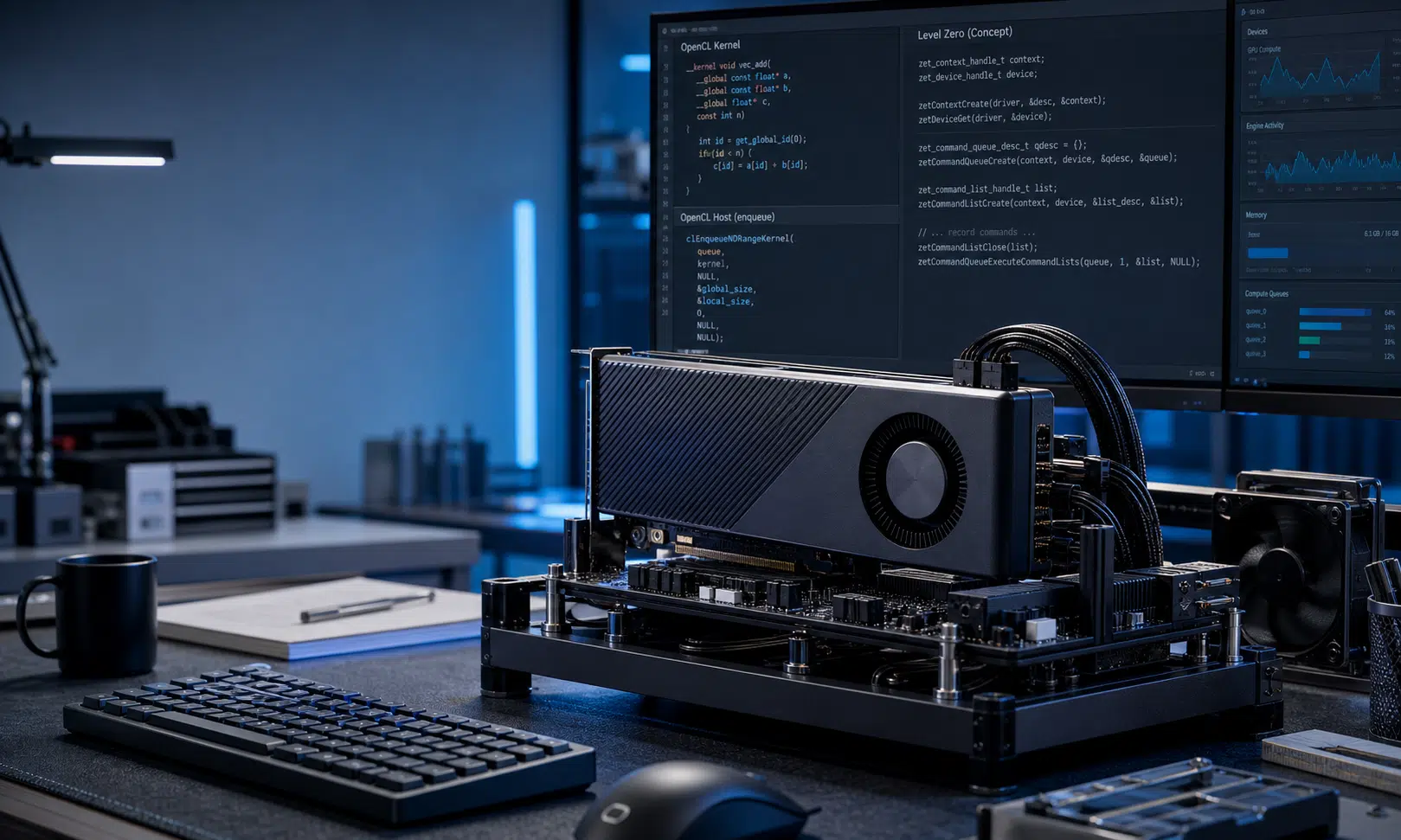

Intel has released Intel Compute Runtime 26.18.38308.1, a fresh update to its open-source runtime stack for OpenCL and Level Zero on Intel graphics hardware. For developers, workstation users, and Linux buyers watching Intel’s next GPU platforms, the notable part is not a single headline feature. It is the steady amount of enablement work landing for hardware that is still moving toward broader availability.
The release continues Intel’s software preparation for Xe3P-class graphics, including work tied to upcoming Nova Lake and the Crescent Island AI accelerator. The update also lists initial Nova Lake P support, though buyers should treat that as platform enablement rather than a signal that finished retail systems are ready or that performance expectations are settled.
What Changed in Intel Compute Runtime 26.18.38308.1
The Compute Runtime sits in a practical part of Intel’s graphics software stack. It is not the game driver most users think about first, but it matters for OpenCL workloads, Level Zero applications, compute tools, AI-adjacent development, media workflows, and software that depends on Intel GPU acceleration outside traditional display output.
This 26.18.38308.1 release follows closely after an Intel Graphics Compiler update, according to the release context, and the two are part of the same broader story: Intel is still lining up compiler and runtime support for its next graphics IP. The source material points to additional Xe3P feature and fix work in this runtime update, but without independent testing it is best read as an enablement milestone, not a measured performance claim.
The update includes several developer-facing and platform-facing changes:
- More Xe3P enablement work for future Intel graphics hardware.
- Initial support entries for Nova Lake P.
- Work associated with Crescent Island AI accelerator support.
- Level Zero support for sRGB images.
- Support for importing physical memory.
- Support for printf() in indirect functions.
- An extension interface for reading currently usable memory.
- Fixes for GCC 16 build issues.
- Removal of deprecated DG1 device code.
- Official branding for Intel Arc Pro B65 and Arc Pro B70 graphics hardware.
For most end users, that list will not change a daily desktop experience overnight. For developers, distribution maintainers, and workstation buyers evaluating Intel graphics for compute workloads, it is more relevant. It shows where Intel is spending engineering time and which hardware families are being prepared in the open runtime stack.

ASRock Intel Arc Pro B60 Creator 24GB
For developers testing Intel’s current professional graphics stack, an Arc Pro B60 card is a closer fit than a general gaming GPU. Check application, driver, kernel, and workstation compatibility before using it for production OpenCL or Level Zero workloads.
As an Amazon Associate I earn from qualifying purchases.
Why Xe3P and Nova Lake P Matter
Xe3P is the forward-looking part of this release. Intel has been landing pieces of next-generation graphics support across its open software components, and this Compute Runtime update adds another batch of that groundwork. That does not automatically answer the questions buyers care about most, such as final product availability, power behavior, application performance, or workstation stability. It does, however, show that runtime-level support is being prepared ahead of broader hardware deployment.
Nova Lake P is especially interesting because mobile and compact systems often depend heavily on integrated graphics behavior. Runtime support can affect more than synthetic compute tests. It can matter for creative tools, local AI experiments, video-related workflows, engineering applications, and any software that uses OpenCL or Level Zero as an acceleration path.
The important caveat is that initial support should be interpreted carefully. Early enablement in an open-source runtime usually means plumbing is arriving before the full platform story is public. It does not confirm how a finished laptop or desktop will perform, how broad OEM adoption will be, or whether a specific application will be stable on day one.
For buyers planning a near-term workstation or Linux system purchase, this release is a reason to keep watching Intel’s graphics software progress rather than a reason to delay a purchase by itself. If your workload depends on proven OpenCL or Level Zero behavior today, tested current-generation hardware still matters more than future enablement notes.
Runtime Optimizations and Cleanup
The release also includes smaller performance-oriented and maintenance changes. The source notes a reduction in pool size from 16MB to 2MB because a pool manager can now grow the pool dynamically as needed. It also mentions reduced IOH alignment for discrete GPUs and other smaller optimizations. Those changes sound useful, but they should not be treated as confirmed user-facing speedups without workload-specific testing.
That distinction matters. Runtime changes can improve memory behavior, reduce overhead, or make certain code paths cleaner, but the result depends on the application, GPU, driver stack, kernel, firmware, and compiler combination. A developer running Level Zero compute workloads may notice a meaningful change where a desktop user running ordinary applications may notice nothing at all.
The removal of deprecated DG1 device code is another practical cleanup. DG1 was Intel’s early discrete graphics effort, and removing stale device-specific paths can simplify the runtime over time. For modern buyers, the more relevant branding update is the official recognition of Arc Pro B65 and Arc Pro B70 hardware inside the runtime.
Level Zero, OpenCL, and Developer Impact
The Level Zero additions are among the more useful details for developers. Support for sRGB images in Level Zero can matter for applications that need color-aware image handling through Intel’s low-level compute interface. Physical memory import support and the usable-memory extension point are also the kind of changes that tend to interest runtime developers, performance-tool authors, and teams building software closer to the hardware.
Support for printf() in indirect functions is another developer convenience. Debugging GPU compute code is often more constrained than ordinary CPU-side debugging, so runtime support that improves visibility can save time even when it is not a feature that appears on a product spec sheet.
GCC 16 build fixes are more relevant to distribution maintainers and developers building the stack from source. As compilers advance, open-source projects have to keep pace with stricter diagnostics and behavior changes. Fixing those issues early helps downstream packaging and keeps the runtime easier to ship on newer Linux distributions.
Buyer Takeaway
For most PC buyers, Intel Compute Runtime 26.18.38308.1 is not a release that should drive a purchase decision on its own. It is a software-stack update, and its biggest value is in what it suggests about platform readiness for Intel’s next graphics hardware.
For Linux workstation users, developers, and buyers comparing GPU options for compute-heavy workflows, the release is worth noting for three reasons. First, Intel is continuing to land Xe3P work in the open runtime stack. Second, Nova Lake P appears in the enablement path, which matters for future mobile and integrated graphics platforms. Third, Level Zero and OpenCL improvements continue to arrive alongside cleanup for older hardware support.
| Area | What the update adds | Practical meaning |
|---|---|---|
| Future hardware | More Xe3P work and initial Nova Lake P support | Shows preparation for next Intel graphics platforms, not final product performance |
| Developer APIs | Level Zero sRGB image support, memory-related interfaces, printf() support in indirect functions | Useful for developers building or debugging GPU compute software |
| Maintenance | GCC 16 build fixes and deprecated DG1 code removal | Helps keep the runtime cleaner and easier to build on newer systems |
| Product branding | Arc Pro B65 and Arc Pro B70 branding | Improves hardware identification for Intel’s professional graphics lineup |
The short version: this is a meaningful update for Intel’s open compute stack, especially if you track Linux graphics support, OpenCL, Level Zero, or future Intel GPU platforms. It is less meaningful as a direct buying signal until real systems, mature drivers, and independent workload testing line up around the hardware this release is preparing for.