

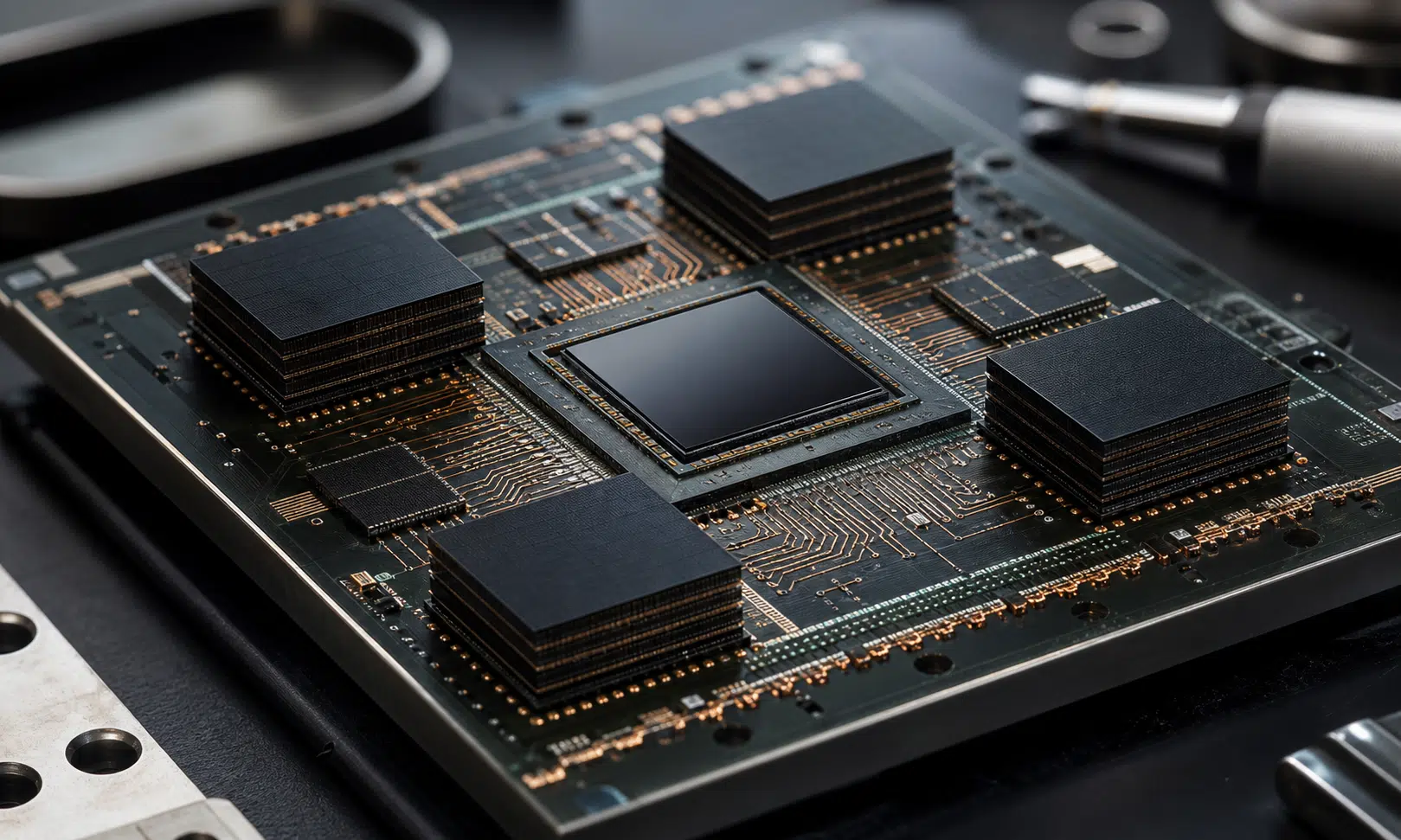

Intel and SK hynix shares moved higher after a Korean media report said SK hynix is testing Intel’s EMIB advanced packaging technology for a possible high-bandwidth memory integration project. The report described the work as research and development around 2.5D packaging, with SK hynix said to be evaluating materials and components needed for production.
That is not the same thing as a confirmed commercial deal. The practical reason investors reacted anyway is simple: HBM supply is only one part of the AI hardware bottleneck. Packaging capacity, especially for systems that bring memory close to compute logic, has become just as strategically important.
For AI accelerator vendors, cloud providers, and custom ASIC teams, the reported talks matter because they point to another possible route around a crowded packaging market. TSMC’s CoWoS remains the most visible platform for high-end AI accelerators, but demand has been heavy enough that large customers often absorb available capacity first. Smaller chip developers and late-moving custom silicon teams have reason to watch any credible alternative closely.
Why EMIB Is Getting Attention
Intel’s Embedded Multi-die Interconnect Bridge, better known as EMIB, connects multiple dies through small silicon bridges embedded in the package substrate. That differs from the large silicon interposer approach associated with TSMC’s CoWoS platform.
The appeal is not that EMIB and CoWoS are identical substitutes. They are packaging approaches with different trade-offs. EMIB can reduce dependence on a full silicon interposer and may offer cost, routing, or thermal advantages for certain package designs. CoWoS, meanwhile, has become a proven foundation for many of the most prominent AI accelerator products.
For buyers, the distinction is less academic than it sounds. A chip team planning a new AI accelerator has to think about more than raw silicon performance. It also has to lock down packaging availability, memory attach strategy, thermal design, substrate supply, test capacity, and a realistic manufacturing schedule.
That is why even an unconfirmed packaging report can move the market. If SK hynix were to use Intel EMIB in any meaningful production path, it could add another option for pairing HBM with logic dies. It would also strengthen Intel Foundry’s argument that advanced packaging can win external customers even before Intel proves broader foundry share gains at leading-edge process nodes.

NVIDIA RTX 6000 Ada Workstation GPU
For teams prototyping AI workloads locally, a professional workstation GPU can be more relevant than consumer gaming hardware. It will not replace data-center accelerators, but it can support model development, inference testing, and engineering workflows.
As an Amazon Associate I earn from qualifying purchases.
The CoWoS Capacity Problem Behind the Rumor
The AI boom has put unusual pressure on the packaging layer of the semiconductor supply chain. HBM stacks have to be placed close to GPUs, accelerators, or custom AI processors, and that makes advanced packaging capacity a strategic constraint.
Reports and analyst estimates have repeatedly pointed to tight CoWoS availability, with Nvidia believed to be one of the largest consumers of that capacity. Broadcom, AMD, and custom accelerator customers are also competing for supply. Exact customer shares vary by estimate and should not be treated as settled public numbers, but the direction of the market is clear enough: packaging has become a scarce asset.
That gives Intel an opening. Intel Foundry has been promoting EMIB, Foveros, and newer packaging variants to external customers. Intel executives have also discussed advanced packaging as a potential source of major outside revenue, though specific customer commitments remain difficult to verify without company announcements.
For a buyer building AI silicon, the commercial question is not just whether Intel can package a complex device. It is whether Intel can provide predictable capacity, acceptable yields, qualified HBM integration, and a schedule that survives volume ramp. Those are the factors that decide whether an alternative packaging path becomes useful or remains an engineering exercise.
| Packaging path | Basic idea | Why buyers care |
|---|---|---|
| Intel EMIB | Uses embedded silicon bridges to connect dies inside the package substrate. | Could offer another route for HBM-plus-logic integration if qualified at volume. |
| TSMC CoWoS | Uses a larger silicon interposer and has become a major platform for AI accelerators. | Proven at the high end, but capacity has been a recurring concern. |
| In-house SK hynix packaging | SK hynix is investing in its own advanced packaging and test infrastructure. | Could give the memory supplier more control over HBM integration over time. |
SK hynix Is Building Its Own Packaging Options Too
The reported Intel work does not mean SK hynix would be abandoning its own packaging ambitions. The company has already announced major investments in advanced packaging, including a planned facility in West Lafayette, Indiana, and a large packaging and test project in Cheongju, South Korea.
Those investments fit the direction of the HBM market. As AI systems demand more memory bandwidth, memory suppliers are under pressure to move beyond shipping stacks and become more involved in how those stacks are integrated into finished compute packages.
If the reported Intel collaboration turns into a formal production relationship, it would likely sit alongside SK hynix’s own facilities and existing ecosystem partnerships rather than replace them. That point matters for customers. Large AI hardware buyers usually want optionality, because a single packaging path can become a schedule risk when demand spikes.
For SK hynix, an additional qualified packaging partner could help it serve customers that need HBM attached to a wider range of accelerators and custom logic. For Intel, a visible HBM-related customer would help validate its advanced packaging pitch to outside chip designers.
What Is Confirmed and What Is Still Speculation
The core report says SK hynix is conducting R&D with Intel around EMIB-based 2.5D packaging for HBM and logic semiconductors. That should be treated as a report, not as a confirmed production agreement.
As of the report, there was no formal public announcement from Intel or SK hynix confirming a commercial packaging partnership. That distinction is important because the semiconductor industry often tests multiple process, packaging, and supplier options before choosing a production route.
A useful way to read the news is to separate the three layers:
- The market signal: investors are rewarding any sign that Intel’s advanced packaging business could win large external work.
- The supply chain signal: AI chip buyers are looking for alternatives or supplements to constrained CoWoS capacity.
- The execution question: a test or R&D project only matters commercially if it leads to qualified, repeatable, high-volume packaging.
That last point is where buyers should stay disciplined. Advanced packaging is not a simple drop-in commodity service. HBM integration depends on design rules, thermal behavior, interconnect density, power delivery, signal integrity, substrate availability, and yield learning. A packaging provider can look promising on paper and still face a long path to production confidence.

Samsung 990 PRO 4TB NVMe SSD
AI workstation planning is not only about the GPU. High-speed NVMe storage can help with large datasets, local model files, and repeated development runs.
As an Amazon Associate I earn from qualifying purchases.
The Labor And Profit Backdrop In Memory
The wider SK hynix story is also being shaped by the profit surge tied to HBM demand. Separate Korean media reports have described unusually large potential employee bonuses at SK hynix, based on profit-sharing formulas linked to operating profit. Those numbers depend on forecasts and should not be read as guaranteed payouts.
The same reports have described labor tension at Samsung Electronics, where union representatives have pushed for a larger share of semiconductor profits. Some reports have also mentioned planned strike activity around compensation disputes, though the exact outcome depends on negotiations and legal proceedings.
The broader point is less about any single bonus figure and more about the scale of the AI memory cycle. HBM demand has shifted memory makers from the pain of the recent downturn into a far stronger negotiating position. That affects capital spending, hiring, retention, supplier relationships, and government scrutiny.
For enterprise buyers, this labor and profit backdrop is not just a human resources story inside Korean chipmakers. It can influence supply planning. When HBM margins are high and competition for engineers is intense, memory suppliers will prioritize the most strategic customers, the most profitable configurations, and the production paths that can scale with the least friction.
What AI Hardware Buyers Should Watch Next
The reported Intel-SK hynix EMIB work is worth watching, but the next signals matter more than the initial rumor. A formal customer announcement, a qualified package roadmap, or a volume production timeline would carry far more weight than share-price reaction.
Buyers evaluating AI accelerator plans should watch for:
- Whether Intel or SK hynix confirms any EMIB-related HBM packaging work.
- Whether EMIB-T or related Intel packaging variants are positioned for HBM4-class products.
- Whether cloud and custom ASIC customers publicly broaden packaging suppliers beyond TSMC.
- Whether SK hynix’s U.S. and Korean packaging investments change customer access to HBM integration.
- Whether CoWoS availability improves enough to reduce urgency for alternatives.
The commercial takeaway is straightforward. The AI chip race is no longer only about who can design the fastest accelerator or secure the most HBM wafers. The winning suppliers also need packaging capacity that can bring compute and memory together at scale.
If Intel can turn EMIB interest into named external customers, its foundry story becomes more credible in the near term. If SK hynix can add more packaging routes while maintaining its HBM lead, it gains more control over how its memory reaches the highest-value AI systems. Until either company confirms the reported work, though, this remains a strong signal of market direction rather than proof of a completed partnership.

Crucial Pro 64GB DDR5 Memory Kit
Large system RAM can make AI development workstations more usable when juggling datasets, containers, notebooks, and preprocessing tasks. It should not be confused with HBM on AI accelerators, which serves a different role.
As an Amazon Associate I earn from qualifying purchases.