


Security teams often have more alerts, dashboards, and automation options than they used to. That does not automatically mean the work is easier.
In many network security environments, the hard part is not simply detecting a problem. It is what happens after detection: confirming who owns the issue, deciding how urgent it is, routing work to the right person, gathering context from several systems, and making sure the response is documented.
That operational layer is easy to underestimate because it sits between the tools. It is not always visible in architecture diagrams, procurement plans, or security metrics. But when it depends on manual handoffs, copied context, chat messages, ticket updates, and analyst memory, it can become a practical source of delay and error.
This is the network security workflow risk many teams run into: the environment may be technically connected, while the work needed to act on security signals remains fragmented.
The Overlooked Work Between Security Tools
When an alert fires, the first decision is rarely the final decision. A team may need to validate the asset, confirm ownership, check whether the activity is expected, compare evidence across logs or monitoring systems, decide whether the alert should be escalated, and then trigger a containment or remediation step.
That work can cross several systems, including:
- Monitoring and detection tools
- Ticketing and case management platforms
- Identity and access management systems
- Cloud, on-premises, and hybrid infrastructure consoles
- Messaging and collaboration apps
- Change management and approval workflows
Each handoff creates a small dependency. Someone has to know where to look, what evidence matters, who can approve the next step, and how to record the decision. None of those tasks is unusual on its own. The problem is the cumulative effect when they repeat across hundreds or thousands of operational events.
Manual coordination can also produce inconsistent outcomes. One analyst may enrich an alert thoroughly, while another may skip a source because the system is slow or the process is unclear. One team may document a change cleanly, while another keeps the decision in a chat thread. Over time, those differences can affect response speed, audit readiness, and confidence in security operations.
Where Workflow Gaps Create Security Risk
The risk is most visible in workflows that require several teams or systems to move in a specific order. Three areas stand out: alert triage, access and change management, and hybrid environment operations.
1. Alert Triage and Incident Response
Detection tools can raise alerts quickly, but investigation and coordination often still require human assembly. Analysts may need to pull context from endpoint tools, network telemetry, identity records, cloud logs, and ticket history before they can decide whether an alert is harmless, suspicious, or urgent.
When that process is mostly manual, the practical effects can include:
- Longer time to identify, escalate, contain, and remediate an issue
- Higher chance that an important signal is missed during alert review
- More repetitive work for analysts who are already handling noisy queues
- Inconsistent documentation of what was checked and why a decision was made
The concern is not that every manual step will fail. The concern is that security response often depends on repeatable execution under pressure. If the steps are scattered across tools and people, the process can slow down exactly when speed and consistency matter most.
2. Access and Change Management
Access requests and network changes are security-sensitive by nature. They affect who can reach systems, what privileges they hold, and how infrastructure behaves. Yet these workflows often involve separate systems for approvals, implementation, validation, and documentation.
In practice, that can lead to duplicate work and limited visibility. A request may be approved in one system, implemented through another, discussed in a chat channel, and reviewed later through logs or spreadsheets. If the process is not tightly controlled, teams can struggle to prove that the right checks happened at the right time.
Potential outcomes include:
- Access that is broader or longer-lived than intended
- Policy checks that vary depending on who handles the request
- Network changes that are not fully validated before or after implementation
- Audit gaps when approvals, evidence, and actions are split across systems
Least-privilege and Zero Trust programs depend on dependable execution, not only policy language. If access and change workflows are inconsistent, the policy may look stronger on paper than it is in day-to-day operations.
3. Hybrid and Multi-Environment Operations
Hybrid environments can make workflow coordination harder because ownership, tooling, and control points may differ across cloud services, data centers, SaaS platforms, and managed infrastructure. A team responding to one issue may need to understand several operating models before it can act safely.
Fragmentation in these environments can contribute to:
- Configuration drift between systems that are supposed to follow the same standard
- Slower response when teams need to identify the right owner or control plane
- Uneven policy enforcement across environments
- Reduced accountability when no single workflow captures the full chain of action
The more environments a team supports, the more important it becomes to define how work moves across them. Otherwise, each environment can develop its own informal process, and those informal processes may not hold up during incidents, audits, or urgent business changes.
Why Adding More Tools May Not Fix the Problem
Buying another tool can improve a specific capability, but it does not automatically solve the coordination problem. A new detection source may create better visibility, while also adding another place analysts must check. A new automation script may remove one repetitive task, while leaving the larger approval and evidence trail untouched.
The issue is not that tools are unhelpful. It is that tools usually cover only part of a process. Security operations still need a way to connect the steps: detection, enrichment, decision-making, approval, action, verification, and documentation.
This is where workflow design matters. A team should be able to answer basic operational questions:
- What happens first when this alert fires?
- Which systems provide the required context?
- Which steps can run automatically, and which require review?
- Who approves high-impact actions?
- Where is the evidence recorded?
- How does the team know the issue was resolved?
If those answers live only in individual experience or informal team habits, the process is fragile. It may work when the right people are available, but weaken during handoffs, staff turnover, high alert volume, or a fast-moving incident.
How Intelligent Workflows Can Help
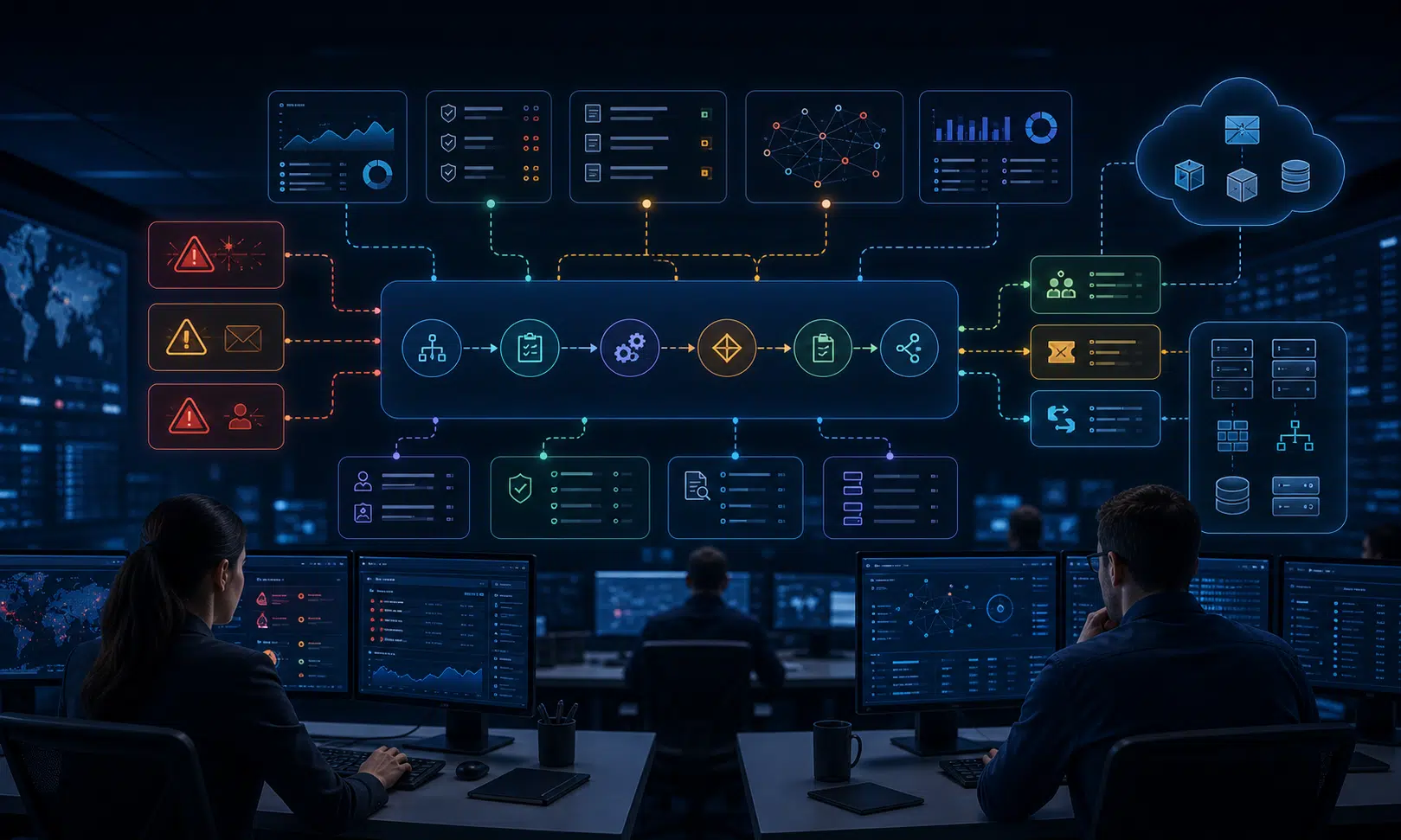
One practical response is to treat workflow orchestration as its own operational layer. In this model, the goal is not to replace existing security tools. The goal is to connect systems, people, approvals, automation, and decision points so that work moves through a defined path.
The source material describes this approach as intelligent workflows. In practical terms, that means combining three kinds of work:
- Deterministic automation for predictable tasks that need to run the same way every time
- AI-assisted steps where context gathering, summarization, or prioritization may help a human decision
- Human review for high-impact actions, ambiguous cases, and decisions that require judgment
The important distinction is that automation alone usually handles a discrete task. A workflow handles the process around that task. For example, closing a ticket automatically is a task. Coordinating alert enrichment, severity assessment, routing, approval, containment, evidence logging, and follow-up review is a workflow.
What an Alert Workflow Might Look Like
A structured alert triage workflow might run like this:
- A monitoring tool detects unusual activity and creates an alert.
- The workflow gathers relevant context from connected systems, such as asset details, identity information, recent changes, and related alerts.
- The alert is prioritized based on predefined criteria such as severity, asset sensitivity, and observed behavior.
- If the alert meets approved conditions, the workflow triggers a defined containment or remediation action.
- If the alert requires judgment, it is routed to the right analyst or approver with the supporting context attached.
- The workflow records actions, decisions, timestamps, and evidence for later review.
This kind of process does not remove humans from security operations. It makes the handoffs more explicit. Analysts spend less time collecting the same information repeatedly and more time on decisions that actually require expertise.
It also helps reduce ambiguity. If a containment step requires approval, the workflow should make that approval visible. If an automated action was taken, the evidence should show what triggered it and when it happened. If an alert was dismissed, the reason should be captured rather than buried in a chat message.
What Teams Should Standardize First
Teams do not need to orchestrate every process at once. The better starting point is to look for workflows where delay, inconsistency, or missing evidence already creates operational pain.
Good candidates often include:
- High-volume alerts that require the same enrichment steps
- Access requests that involve privileged systems or sensitive data
- Emergency network changes that need fast approval and clear documentation
- Recurring compliance evidence collection
- Incident response steps that depend on multiple teams
For each workflow, the team should define the minimum reliable path: what data is needed, what decision is required, who owns the next action, which steps can be automated, and where the record should live. That definition is more useful than a vague goal to “automate security operations.”
The strongest candidates are usually workflows with both volume and consequence. If a process happens often and mistakes matter, standardization can reduce operational drag without forcing the team to redesign everything at once.
The Practical Value of Better Workflow Coordination
Well-designed workflows can support several security operations goals:
- More consistent execution because the same steps are followed across teams and environments
- Faster coordination because ownership, routing, and required evidence are defined in advance
- Less manual documentation because actions and decisions can be logged as part of the process
- Better audit readiness because approvals and evidence are easier to reconstruct
- Lower analyst burden because repetitive context gathering can be reduced
- Clearer accountability because work is tracked across the full process, not only inside one tool
None of this guarantees better security by itself. Poorly designed workflows can simply move bad process faster. But when workflows are built around clear ownership, policy requirements, and operational evidence, they can make security work more dependable.
Closing the Gap Between Detection and Action
The hidden risk in modern network security is often not a total lack of visibility. It is the gap between seeing something and acting on it reliably.
That gap shows up in small ways: a delayed escalation, a missed ownership check, an undocumented approval, a change that was made but not verified, or an alert that required too much manual context gathering before anyone could decide what to do. Over time, those small gaps can affect response time, compliance posture, and team capacity.
For security leaders, the useful question is not only “Which tools do we have?” It is also “How does work move between them?” If the answer depends on manual effort, informal knowledge, and scattered evidence, the workflow itself deserves attention.
Improving that layer does not require replacing the whole security stack. It requires identifying the processes where coordination matters most, standardizing the path from signal to action, and using automation, AI assistance, and human judgment where each one fits.