

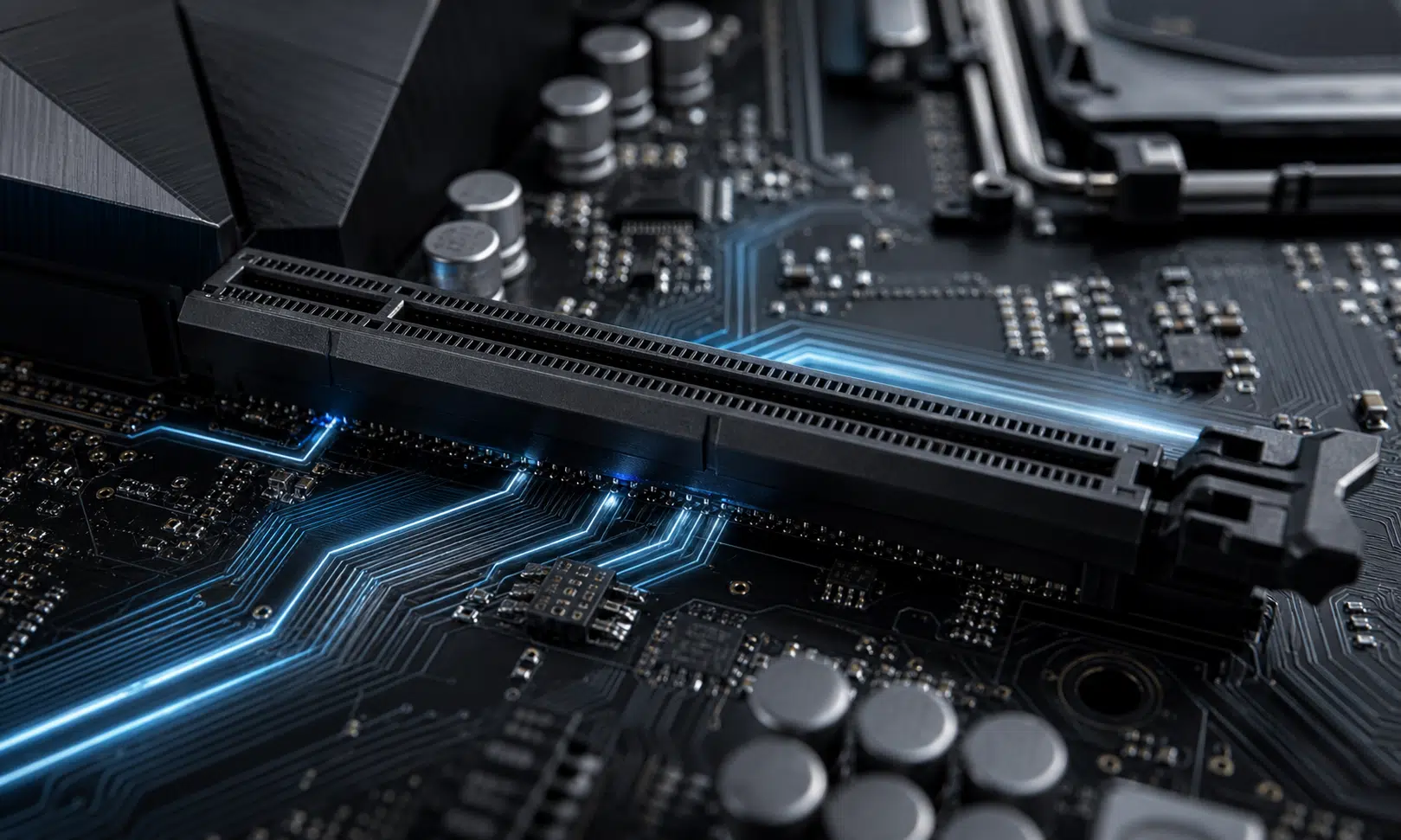

PCIe 8.0 has reached an important early milestone, and the headline number is hard to ignore: up to 1 TB/s of bi-directional bandwidth over an x16 link.
PCI-SIG, the industry group responsible for PCI Express development, has released PCIe 8.0 draft specification version 0.5. This is not the finished standard, but it is the first major draft stage where the broad architecture is defined closely enough for member companies to begin more serious design and prototyping work.
The draft keeps PCIe 8.0 on track for a 256 GT/s transfer rate. In a full x16 configuration, that target translates to up to 1 TB/s of aggregate bi-directional bandwidth, doubling the target bandwidth of PCIe 7.0 and continuing the roughly generational doubling that has defined PCI Express for years.
For buyers, system builders, and anyone watching the future of GPUs, accelerators, SSDs, and server platforms, the more practical question is not whether PCIe 8.0 looks fast on paper. It is how much of this technology will reach real products, what kinds of systems will see it first, and whether the physical connector and motherboard routing can keep up.
What PCIe 8.0 Draft 0.5 Actually Means
A version 0.5 draft is a meaningful step, but it should not be confused with final ratification. At this stage, PCI-SIG has outlined the core requirements and mechanisms of the specification, giving member companies a clearer target for early engineering work. Some details can still change before the standard is completed.
The current PCIe 8.0 draft includes several expected building blocks:
- A target transfer rate of 256 GT/s
- Up to 1 TB/s of bi-directional bandwidth using an x16 link
- PAM4 signaling
- Forward error correction
- Flit Mode encoding
- Protocol improvements intended to support higher effective bandwidth
- Backward compatibility with earlier PCIe generations
- Evaluation of new connector technology
That last item may become one of the most important parts of the entire standard. The industry can keep increasing headline transfer rates only if the physical layer can still deliver a usable signal across real boards, slots, connectors, cables, retimers, and packages.
PCIe 8.0 is still expected to move toward final ratification in 2028. That gives chip designers, IP vendors, platform engineers, and validation teams time to study the draft and prepare, while still leaving room for specification changes before the standard is locked.
The Bandwidth Target Is Huge, but It Is Not the Whole Story
The cleanest way to understand PCIe 8.0 is to compare the stated target against recent PCIe generations. Each step increases the transfer rate, but the difficulty of implementing the link also rises sharply.
| PCIe generation | Transfer rate | Notes |
|---|---|---|
| PCIe 5.0 | 32 GT/s | Already demanding for motherboard layout and signal integrity |
| PCIe 6.0 | 64 GT/s | Introduced PAM4 signaling and Flit-based operation |
| PCIe 8.0 draft target | 256 GT/s | Targets up to 1 TB/s bi-directional bandwidth over x16 |
The 1 TB/s figure applies to a full x16 connection. That kind of link is most relevant to accelerators, high-end server hardware, and future platforms where sustained bandwidth can directly affect system design. It does not automatically mean that consumer desktops will quickly receive, need, or fully exploit PCIe 8.0 x16 slots.
Desktop platforms often lag the newest PCIe standards because the cost and complexity must make sense for mainstream products. Faster PCIe links require tighter board design, better materials, more careful validation, and in some cases additional signal-conditioning components. A firm consumer rollout timeline has not been publicly confirmed.
That distinction matters for buyers. PCIe 8.0 is a forward-looking standard for future ecosystems, not a reason to delay a current PC build. Today’s CPUs, GPUs, and SSDs are still tied to the PCIe generations supported by shipping platforms. The PCIe 8.0 draft is more relevant to companies planning silicon and systems several years out than to someone comparing motherboards this quarter.

ASUS ProArt X870E-CREATOR WIFI Motherboard
For readers building now, a current PCIe 5.0 motherboard is more relevant than waiting for PCIe 8.0. Check CPU support, M.2 lane sharing, BIOS compatibility, and slot layout before buying.
As an Amazon Associate I earn from qualifying purchases.
Why Connector Technology Is Under Review
PCI-SIG’s note that new connector technology is being evaluated is a strong signal that the physical realities of PCIe are getting harder. At 256 GT/s, the link has much less room for loss, noise, reflections, and crosstalk than earlier standards.
In simple terms, the faster the signal, the less forgiving the channel becomes. The edge connector, the board traces, the package, and any intermediate components all affect whether a link can maintain data integrity at the intended speed. Engineers can compensate with equalization, retimers, redrivers, and error correction, but every tool has a cost in power, complexity, latency, board space, or validation time.
That does not necessarily mean PCIe slots will become unrecognizable. Backward compatibility remains part of the stated PCIe 8.0 direction, so any connector changes would need to be handled carefully. The more likely path is a set of physical-layer improvements that help preserve compatibility while tightening the electrical environment around the link.
Possible areas of work could include improved materials, more precise connector tolerances, shorter practical electrical paths, and platform designs that rely more heavily on active signal-conditioning components. The draft stage does not confirm a final connector design, so those possibilities should be treated as directionally relevant rather than settled details.
Who Starts Working From This Draft
A draft like this matters because large hardware companies and specialist IP vendors need years to prepare for a new interconnect generation. CPU vendors, GPU makers, accelerator designers, switch suppliers, PHY developers, test equipment companies, and server platform teams all need a target early enough to influence product roadmaps.
Version 0.5 gives those companies enough structure to begin architecture work with caveats. They can evaluate link budgets, packaging choices, validation strategy, power targets, and compatibility requirements. They can also submit feedback before later versions of the specification narrow the remaining open items.
That does not mean every company will immediately build PCIe 8.0 hardware, or that early internal work will map directly to a commercial product. It means the standard has moved from broad planning into a more practical engineering phase. For a technology expected to land first in demanding high-end environments, that early work is essential.
The first systems to benefit from a standard like PCIe 8.0 are likely to be bandwidth-hungry platforms: AI servers, HPC systems, large accelerator trays, advanced storage fabrics, and other designs where moving data between processors, accelerators, switches, and memory-adjacent devices is a central bottleneck.
What This Means for Buyers and Builders
For most PC buyers, PCIe 8.0 is not a near-term shopping feature. A motherboard claiming support for a newer PCIe generation only matters when the CPU, chipset, slot wiring, firmware, and installed device can all use it. Even then, many consumer workloads do not saturate existing PCIe links.
The more practical takeaway is that the industry is preparing for much denser, faster systems later in the decade. PCIe 8.0’s bandwidth target could help future accelerators and storage devices avoid interconnect bottlenecks, but implementation cost will determine where it appears first.
A gaming PC, workstation, or small-form-factor build has different priorities from a server board carrying multiple accelerators. In consumer systems, thermal limits, GPU performance, SSD behavior, lane counts, and platform cost usually matter more than having the absolute newest PCIe generation on a spec sheet.
In servers, the calculation is different. If a faster interconnect reduces bottlenecks between expensive compute devices, the added board complexity may be easier to justify. That is where PCIe 8.0’s 256 GT/s target and connector work could have the earliest commercial impact.

Crucial T705 2TB PCIe Gen5 NVMe SSD
A PCIe Gen5 NVMe drive can make sense for large file transfers, scratch disks, and workstation workloads. Confirm that the motherboard provides a PCIe 5.0 M.2 slot and adequate cooling.
As an Amazon Associate I earn from qualifying purchases.
The Bottom Line
PCIe 8.0 draft 0.5 confirms that the next major PCI Express target remains 256 GT/s, with up to 1 TB/s of bi-directional bandwidth over x16. It also confirms that the path to that speed is not just a protocol story. The physical connector and electrical channel are becoming central problems.
Final ratification is still expected in 2028, and important details can change before then. For now, the draft gives the industry a working blueprint: faster signaling, continued backward compatibility, protocol refinements, and active investigation into the connector technology needed to make the next jump practical.
For buyers, the message is simple. PCIe 8.0 is important, but it is not an immediate desktop upgrade checklist item. Its first real impact will likely be in the high-end systems where every lane, watt, millimeter of routing, and gigabyte per second of bandwidth is worth fighting for.