

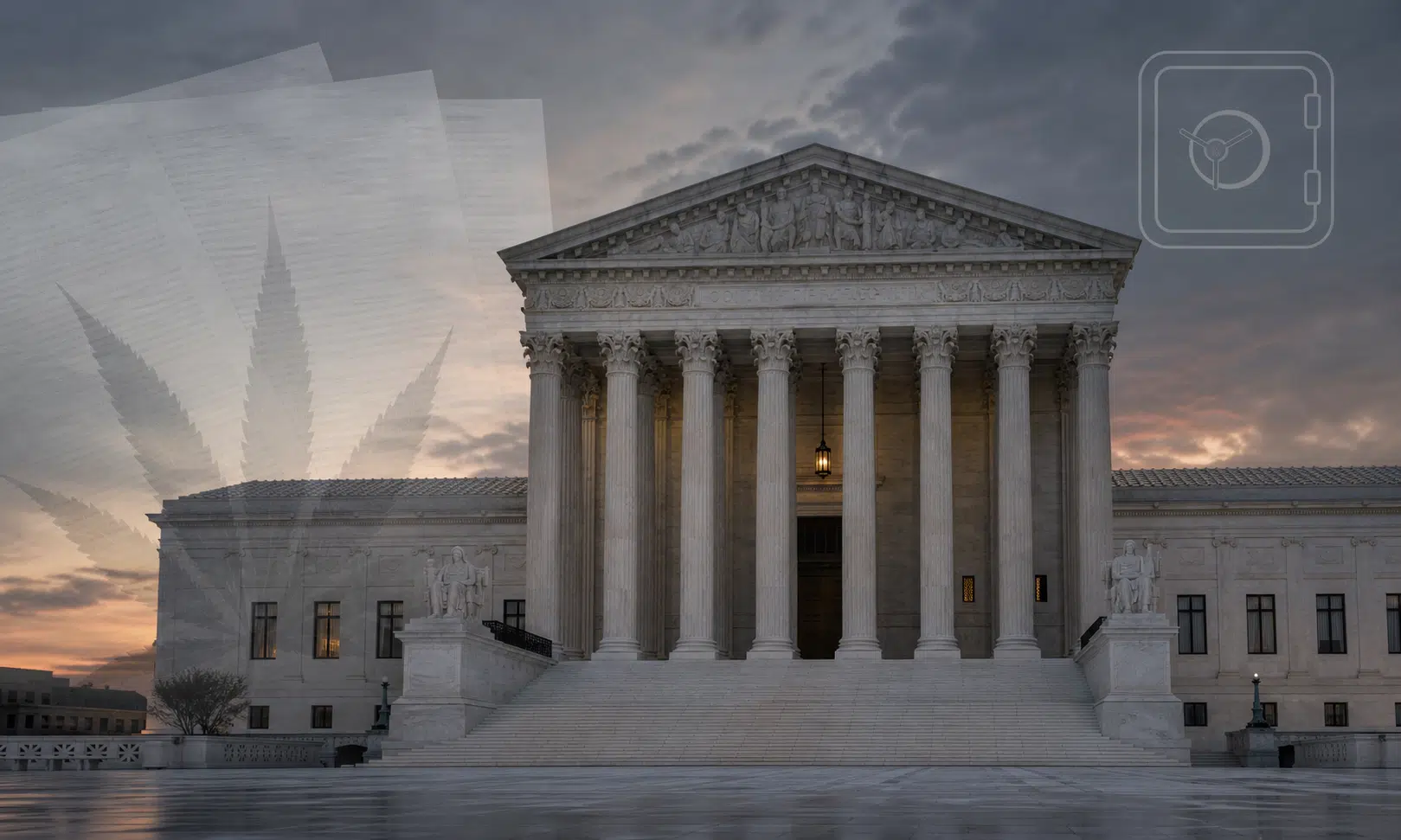

The Supreme Court Hemani ruling gives marijuana users a narrower, but meaningful, Second Amendment win.
In a unanimous decision issued on June 18, 2026, the court sided with Ali Danial Hemani, a Texas man prosecuted under a federal law that bars unlawful drug users from possessing firearms. The justices did not wipe the statute off the books. Instead, they rejected the government’s attempt to treat marijuana use, by itself, as enough to prove that a person is too dangerous to have a gun.
That distinction matters. The ruling does not say every person who uses drugs has a constitutional right to possess firearms in every circumstance. It does say the government needs more than a broad category label when it tries to disarm someone whose case is built around marijuana use rather than violence, intoxication, addiction, or some other showing of danger.
What the Case Was About
Hemani was charged after federal agents found a handgun at his Texas home in 2022. The government’s case focused on his alleged marijuana use and the federal statute that makes it a crime for an unlawful user of a controlled substance to possess a firearm.
That law carries serious consequences. A violation can expose a defendant to a prison sentence of up to 15 years, and the Justice Department has estimated that several hundred people are charged under the provision each year.
The court’s decision turns on how far the government can go when applying that law to someone whose alleged drug use does not come with separate proof of dangerousness. Justice Neil Gorsuch wrote for the court that the government could not simply classify regular marijuana users as categorically violent or dangerous without a stronger showing.
The result is a ruling that trims the reach of the law rather than erasing it. Prosecutors may still pursue cases involving people who are intoxicated while armed, addicted in a way that creates a clear risk, or otherwise shown to be dangerous. The court also left other federal firearms restrictions untouched, including laws that disarm convicted felons.
What the Ruling Does and Does Not Change
For readers trying to understand the practical effect, the most important point is that this is not a blanket legalization of guns for all drug users. It is a limit on automatic disarmament.
The decision means the federal government cannot rely only on the idea that marijuana users, as a group, are inherently dangerous. That approach was too broad for the court, especially when marijuana policy has shifted across much of the country while cannabis remains illegal under federal law.
A clearer way to read the ruling is this:
- The government cannot automatically disarm someone solely because they use marijuana a few times a week.
- The federal drug-user firearms law remains in place.
- Cases involving addiction, present intoxication, violence, or specific evidence of dangerousness may still be prosecuted.
- Other gun restrictions, including those involving felony convictions, were not disturbed.
That makes the ruling important for Second Amendment litigation, but narrower than a full strike-down of the federal statute.
Why Marijuana Policy Complicated the Government’s Argument
The government’s position ran into a practical problem: marijuana is still federally illegal, but many states have legalized cannabis in some form. That split has made federal firearms enforcement awkward in cases where a person’s drug use is legal under state law but still treated as unlawful under federal law.
The court leaned into that tension. Gorsuch’s opinion pointed to the scale of marijuana use and the government’s own shifting approach to cannabis policy as reasons to be skeptical of a rule that treats millions of users as unusually dangerous.
Justice Samuel Alito, joined by Justice Elena Kagan, wrote separately and also noted the changing legal landscape around marijuana. The broader point was not that marijuana legalization decides the Second Amendment question. It was that the government’s sweeping danger argument becomes harder to defend when public policy has moved in a different direction.
How This Fits Into the Supreme Court’s Gun Cases
The Hemani case is part of the court’s continuing effort to define the reach of the Second Amendment after its 2022 decision in New York State Rifle & Pistol Association v. Bruen. That case required the government to justify modern gun restrictions by pointing to a historical tradition of comparable firearms regulation.
Since then, the justices have been sorting through where that history-based test does and does not allow categorical gun bans. In 2024, the court upheld a federal law barring people subject to domestic violence restraining orders from possessing guns. Hemani presented a different question: whether the government could apply a drug-user ban to a marijuana user without a specific showing that he was dangerous.
The answer was no, at least on the record before the court.
That does not settle every future case under the statute. Lower courts will still have to decide what kind of evidence is enough to show dangerousness, how close in time drug use must be to firearm possession, and how the ruling applies to drugs other than marijuana.
Why the Decision Matters Beyond Hemani
The ruling also affects the legal backdrop around one of the most visible prosecutions under the same federal provision: Hunter Biden’s 2024 conviction for possessing a gun while using drugs. Biden was later pardoned by President Joe Biden in December 2024, so the Hemani decision does not function as a direct live appeal in that case. But it does weaken the government’s ability to bring similar prosecutions when the case depends on drug use alone.
The politics around the case were unusually scrambled. The Trump administration defended the federal restriction, arguing that Congress can keep habitual drug users from possessing firearms. Gun violence prevention groups supported that position. Hemani, meanwhile, drew support from the American Civil Liberties Union and gun rights groups, including the National Rifle Association.
That alignment reflects the case’s unusual mix of issues: criminal prosecution, cannabis policy, gun rights, and civil liberties. For the ACLU, the concern was the government’s ability to criminalize a large category of people based on a broad assumption of dangerousness. For gun rights advocates, the case was another test of how aggressively the court would enforce the Second Amendment after Bruen.
The Bottom Line
The Supreme Court’s ruling does not make federal marijuana law disappear, and it does not give every drug user a free pass to possess a firearm. It does, however, put a real limit on categorical prosecutions.
After Hemani, the government needs a more specific case when it tries to take away gun rights based on marijuana use. Occasional or regular use alone is not enough if prosecutors cannot connect that use to danger, intoxication, addiction, or another constitutionally relevant justification.
That leaves the federal law alive, but less automatic. For marijuana users in states where cannabis is legal in some form, the decision narrows one of the sharpest conflicts between state cannabis policy and federal gun law without resolving the larger clash between the two systems.