


A sub-minute 3DBenchy is no longer just a target for high-speed 3D printing experiments. Yan Roetz, known for the Minuteman project, has shown a 3DBenchy print completed in 59 seconds under SpeedBoatRace-style conditions, improving on his earlier 74-second result.
That number is dramatic, but the more useful takeaway for most printer buyers is how much custom engineering it took to get there. This was not a simple slicer tweak on a consumer machine. Roetz’s 20th public Minuteman iteration focused on removing the next bottleneck after the hotend and cooling system were already built for extreme throughput.
What Changed in the Minuteman Design
The previous Minuteman setup had already pushed well beyond typical desktop printer speeds, so Roetz did not treat the hotend as the main limiter for the new attempt. The machine was described as having a hotend capable of roughly 400 mm/s filament flow, paired with a cooling duct system claimed to move about 400 liters of air per minute.
For the 59-second run, the bigger focus was motion. Roetz reworked the bed movement system to cut down moving mass and reduce inertia. That included lighter components, custom-cut parts, carbon fiber, and a granite slab-mounted setup intended to keep the machine stable while accelerating hard.
| Area | Record-run focus | Buyer takeaway |
|---|---|---|
| Material flow | High-output hotend already in place | Speed claims mean little if the hotend cannot melt plastic fast enough |
| Cooling | Very high airflow ducting | Fast prints need cooling that can keep up without ruining layer bonding |
| Motion | Lower-mass moving bed system | Acceleration and vibration control matter as much as top travel speed |
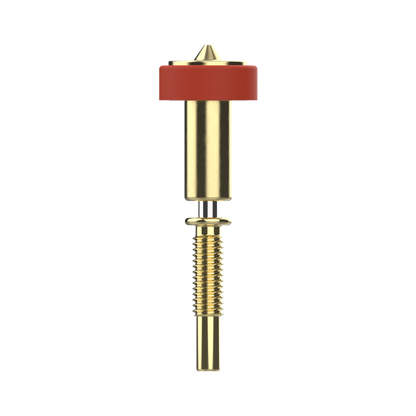
E3D Revo High Flow Nozzle
A high-flow nozzle can help a compatible printer push more filament without immediately running into melt-rate limits. Check hotend compatibility and slicer profiles before treating it as a speed fix.
As an Amazon Associate I earn from qualifying purchases.
Why This Matters for Buyers
The Minuteman result is exciting, but it should not be read as a normal expectation for off-the-shelf 3D printers. A 59-second Benchy is a specialist benchmark, produced on a custom machine tuned around a narrow goal. It is useful because it exposes the same limits that affect normal high-speed printing, just at a more extreme scale.
For anyone shopping for a fast printer, the lesson is to look beyond headline print speeds. The practical questions are more specific:
- Can the hotend maintain flow without under-extrusion?
- Does the cooling system preserve overhangs and small details at higher speeds?
- Can the frame and motion system handle acceleration without ringing or layer shifts?
- Are fast profiles available for the materials you actually plan to print?
The printed result from Roetz’s run was also shown against an earlier sub-two-minute Benchy, and the newer part appeared cleaner despite the much shorter print time. That matters because record attempts are often dismissed as novelty runs, but this one still points toward usable improvements in machine design.
The Practical Verdict
Roetz’s 59-second 3DBenchy is best understood as a technical ceiling-pusher, not a consumer buying target. It proves that the one-minute barrier can be crossed when flow, cooling, and motion are engineered together, but it also shows why buyers should be skeptical of simple speed marketing.
If you are choosing a printer for real projects, the better comparison is not whether it can chase a record Benchy. It is whether it can print your common materials quickly, repeatedly, and with acceptable surface quality. The Minuteman record is a useful reminder that speed is a full-system problem, and the fastest machine on paper is not always the most useful one on a workbench.

Bambu Lab P1S Combo
The P1S is a practical option for users who want high-speed profiles, an enclosed build area, and automated calibration in a consumer machine. It is a better fit for repeatable project printing than record-chasing benchmarks.
As an Amazon Associate I earn from qualifying purchases.