


The buyer takeaway from Tencent’s GPU comments
Tencent’s latest earnings comments make one point unusually clear for AI infrastructure buyers: not every GPU workload has the same payback curve.
The company described GPUs used in advertising technology as a comparatively fast-return investment. In plain terms, if more accelerator capacity improves targeting, click-through rates, pricing, and ad revenue, the financial feedback loop can be short. The same hardware used for foundation-model development may still be strategically important, but the commercial return is harder to measure quickly.
That distinction matters for buyers deciding whether to rent GPU cloud capacity, reserve instances, build private clusters, or wait for new accelerator supply. The question is not simply whether AI compute is useful. The more practical question is whether the workload tied to that compute has a direct revenue mechanism, a measurable cost-saving mechanism, or only a longer-term strategic rationale.
For companies buying AI infrastructure in 2026, Tencent’s position is a useful caution. GPUs can be essential and still be difficult to justify on a near-term return-on-investment basis. The strongest business case usually comes when the workload is connected to an existing profit engine, such as advertising, recommendation systems, search ranking, fraud prevention, or high-volume customer automation.

Cloud FinOps
Cloud FinOps is a useful reference for teams turning cloud usage, utilization, and accountability into a financial operating model. It fits buyers who need to compare reserved GPU capacity, on-demand spending, and workload-level ROI.
As an Amazon Associate I earn from qualifying purchases.
Why ad tech can justify GPUs faster
Advertising systems are unusually friendly to accelerator ROI because small improvements can compound across huge volumes of impressions. Better ranking, targeting, and recommendation models can change what users click, what advertisers pay, and how much inventory a platform can monetize.
Tencent’s chief strategy officer James Mitchell framed GPU spending in ad tech as a short-cycle investment. The logic is straightforward: deploy more compute, improve ad models, improve commercial performance, then observe the revenue effect in a relatively short window.
That does not mean every ad platform should buy more GPUs. It means the use case has characteristics that make ROI easier to test:
- There is a clear revenue metric, such as click-through rate, conversion rate, or ad yield.
- The model improvement can be tested against live traffic or controlled experiments.
- The system already has enough volume for small percentage changes to matter.
- The business can connect model performance to money without waiting years.
By contrast, training or improving a foundation model can be strategically necessary while still lacking a clean short-term payback calculation. A company may need the model to defend its platform, support future products, or keep pace with competitors. That is a real business reason, but it is not the same as a fast, directly attributable return.
GPU buying decision matrix
The practical move for buyers is to classify GPU workloads before committing to long contracts or large purchases. Tencent’s comments point to a simple framework.
| Workload type | Typical ROI visibility | Buyer concern | Best fit |
|---|---|---|---|
| Ad targeting and recommendation | High, if tied to revenue tests | Can the uplift be measured against compute cost? | Platforms with large ad or commerce volume |
| Foundation-model training | Lower in the short term | Is the work strategically necessary, or just competitive pressure? | Companies with deep AI product roadmaps |
| Inference for customer-facing AI | Medium to high | Will usage scale faster than margin? | Products with paid AI features or automation savings |
| Internal productivity AI | Variable | Are labor savings measurable and durable? | Large teams with repeatable workflows |
| Cloud GPU resale | Dependent on supply and utilization | Can capacity be sourced and kept occupied? | Cloud providers with committed demand |
This is where many AI infrastructure plans become fuzzy. Buyers often estimate model capability but understate utilization risk. A GPU cluster that is 90 percent utilized by revenue-producing workloads is a different investment from one that spends long periods waiting for experiments, batch jobs, or uncertain product launches.
Tencent’s cloud capacity problem
Tencent’s comments also highlight a second issue: GPU economics are not only about demand. They are about access to supply.
The company has indicated that its available accelerator capacity has been prioritized for internal services, leaving less capacity for public cloud customers. That creates a familiar tension for major cloud providers. The most profitable use of scarce GPUs may be inside the company’s own advertising, gaming, AI, or platform businesses, even while external customers want to rent the same hardware.
A firm timeline for relief has not been publicly confirmed. Tencent executives have pointed to improving supply from China-designed accelerators and ASICs, but buyers should treat that as a directional signal rather than a guaranteed procurement schedule.
For cloud customers, the lesson is simple: do not assume a provider’s headline AI strategy means there will be abundant GPU capacity available on demand. Capacity can be constrained by sanctions, fabrication limits, internal priorities, and long-term commitments to larger customers.
Questions buyers should ask cloud GPU providers
Before signing a GPU cloud contract, buyers should press for specifics. The answers will often matter more than the logo on the invoice.
- Which accelerator models are actually available now, and in what regions?
- Are capacity reservations binding, best-effort, or subject to substitution?
- Can workloads move between GPU and domestic accelerator options without major engineering work?
- What happens if reserved capacity is unavailable?
- Are networking, storage, and memory bandwidth included in performance commitments?
- Can the provider support bursty inference separately from long training jobs?
- What utilization level is required for the contract to beat on-demand pricing?
The most important commercial issue is not the hourly GPU price in isolation. A cheaper instance that sits idle, lacks the right software support, or cannot be obtained when needed may cost more than a higher-priced option with reliable capacity and better utilization.

Designing Machine Learning Systems
Designing Machine Learning Systems helps teams connect model architecture, monitoring, and deployment choices to production outcomes. It is especially relevant when GPU spend depends on whether model improvements can be measured in live systems.
As an Amazon Associate I earn from qualifying purchases.
China-designed accelerators: opportunity and risk
Tencent’s executives discussed domestic accelerator supply in the context of US sanctions and limited fabrication capacity. That is important for buyers because the Chinese AI infrastructure market is developing under constraints that differ from those faced by US hyperscalers.
If China-designed GPUs and ASICs become more available, Tencent and other Chinese cloud providers may be able to increase AI capacity for both internal use and external customers. But buyers should be careful about assuming direct equivalence with Nvidia-based infrastructure.
The commercial questions are practical:
- Does the accelerator support the frameworks your team already uses?
- Will model code need rewriting or tuning?
- Is inference performance strong enough for production latency targets?
- Can training jobs be moved without unacceptable engineering cost?
- How mature are debugging, monitoring, and orchestration tools?
- Will vendor supply be stable over the length of the contract?
For some workloads, a domestic accelerator may be a good fit. For others, software compatibility and developer productivity may outweigh the hardware savings. Buyers should test with real workloads, not synthetic claims alone.
CPU supply looks less constrained
Tencent’s finance chief Shek Hon Lo contrasted GPU procurement with CPU procurement, noting the company’s long-term relationships with Intel and AMD. That distinction is useful because it shows how different the AI accelerator market remains from the mature server CPU market.
Large buyers often have years of purchasing history, volume forecasts, and vendor relationships for CPUs. GPU and AI accelerator supply is more contested, more geopolitically exposed, and more closely tied to a small number of high-demand fabrication and packaging pipelines.
For enterprise buyers, that means CPU-heavy cloud planning and GPU-heavy cloud planning should not use the same assumptions. A standard compute contract may be relatively predictable. A high-end AI accelerator contract may need more negotiation around delivery windows, substitutions, reservations, and exit options.
What this means for AI infrastructure budgets
Tencent reported RMB196.5 billion in first-quarter 2026 revenue, up 9 percent year over year. The company also continues to invest in AI while managing the realities of scarce accelerator supply. The exact financial impact of each AI workload is not fully visible from the outside, but the direction is clear enough for buyers: AI spending needs workload-level discipline.
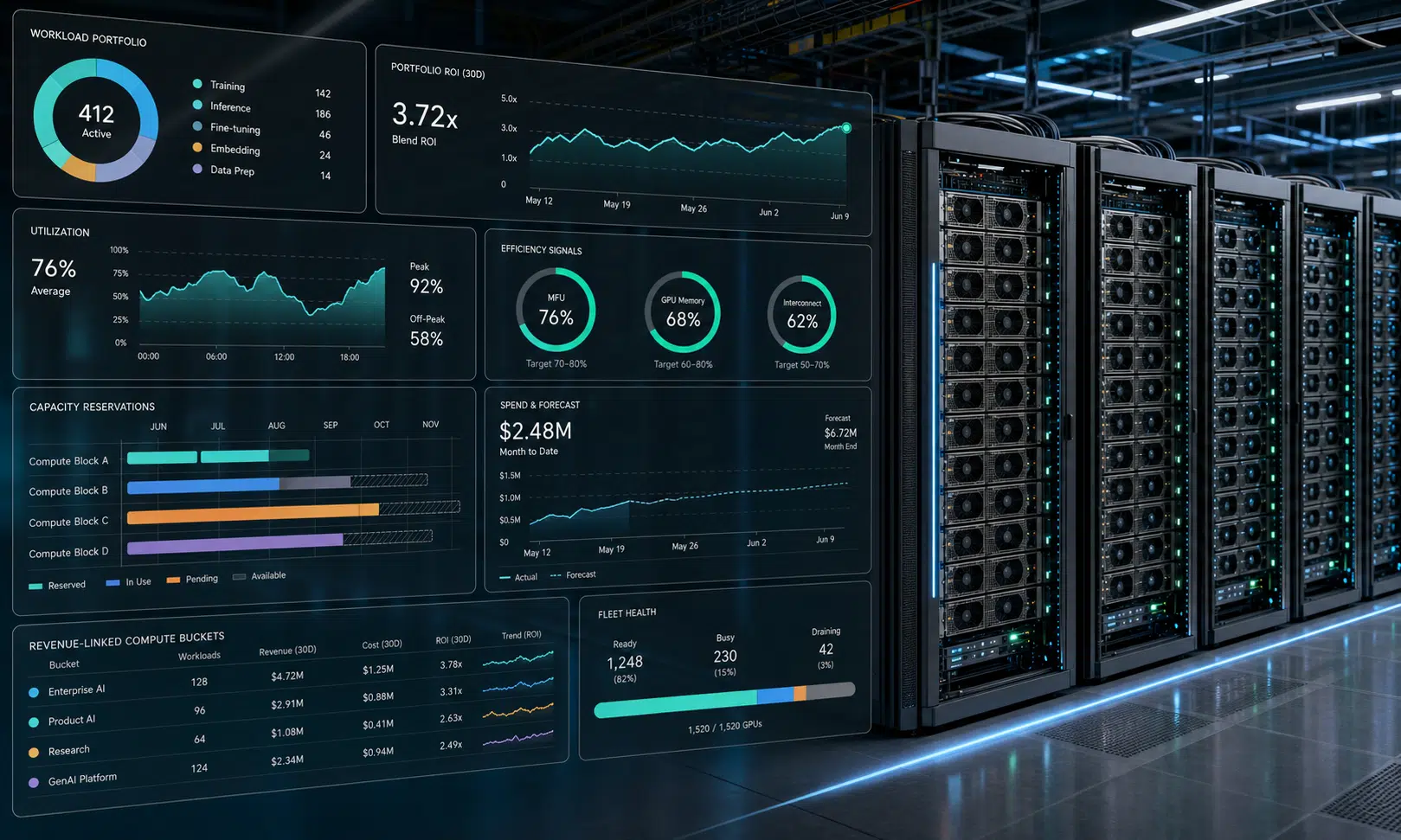
A practical budget should separate AI infrastructure into three buckets:
- Revenue-linked workloads, where compute can be connected to sales, ads, conversions, or paid product usage.
- Cost-saving workloads, where compute can reduce support time, engineering time, fraud losses, or operational overhead.
- Strategic workloads, where the company accepts a longer payback period because the capability protects or extends the business.
The mistake is blending all three into one AI budget and calling it innovation spend. That hides weak assumptions. A board, CFO, or procurement team should be able to see which workloads are expected to pay back quickly and which are longer-term bets.
Who should buy more GPU capacity now?
More GPU capacity makes sense when the buyer has a production workload with measurable upside and enough demand to keep the hardware busy. That includes ad platforms, recommendation-heavy marketplaces, large-scale inference products, and companies with proven AI features that customers already pay for.
It is a weaker case when the company is still experimenting, lacks model deployment discipline, or cannot explain how more compute changes revenue, cost, latency, or product quality.
Buy or reserve capacity if:
- You have production AI workloads that are already capacity-constrained.
- You can measure revenue lift, margin lift, or cost reduction from model improvements.
- Your team can keep reserved capacity highly utilized.
- You need predictable access more than lowest possible spot pricing.
- Your software stack is already compatible with the target hardware.
Wait or stay flexible if:
- Your AI roadmap is still mostly experimental.
- Usage forecasts are uncertain or driven by executive pressure rather than customer demand.
- You cannot yet compare GPU options against alternative accelerators.
- Your workload may be served better by smaller models, batching, caching, or local inference.
- The provider cannot give clear capacity and substitution terms.
Verdict: Tencent’s lesson is about discipline, not hype
Tencent’s GPU comments are not a general argument against AI infrastructure spending. They are a reminder that AI compute has different value depending on where it lands in the business.
For advertising systems, GPUs can connect quickly to better targeting and higher revenue. For foundation models, the case may be strategic and long term. For cloud resale, the economics depend on scarce supply, utilization, and customer demand. For enterprise buyers, the same distinctions apply.
The best AI infrastructure purchase is not the one with the most impressive accelerator spec sheet. It is the one tied to a workload that can justify the cost, survive supply constraints, and produce value quickly enough for the business case being made.

AI Engineering
AI Engineering is relevant for teams building products on foundation models and trying to control latency, evaluation quality, and serving cost. It can help buyers think beyond raw accelerator specs when planning inference-heavy workloads.
As an Amazon Associate I earn from qualifying purchases.