

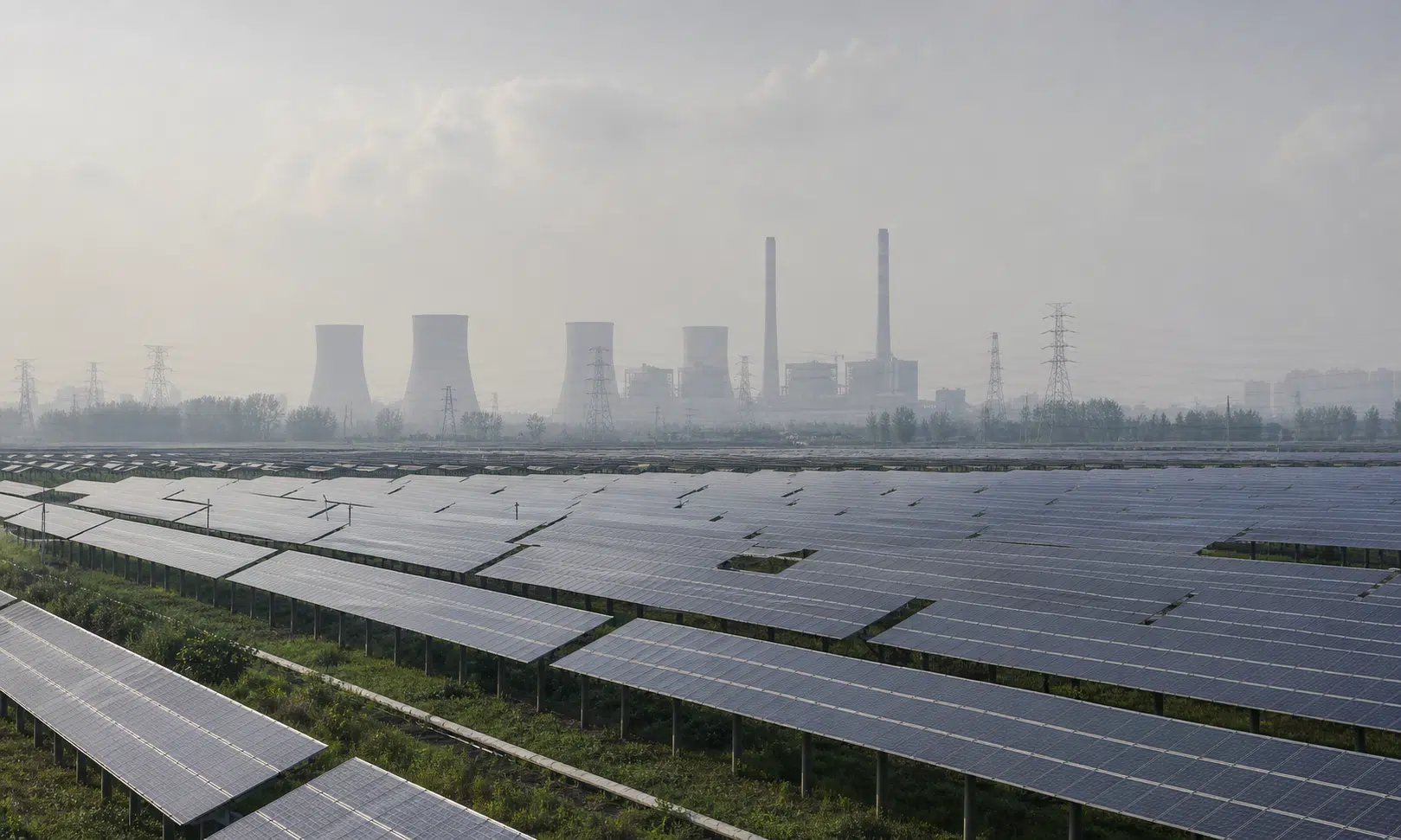

Coal already carries a long list of costs. It produces more carbon pollution per unit of energy than other major fuels, and coal combustion can release sulfur dioxide, nitrogen oxides, fine particles, and toxic residues in ash. Those impacts are usually discussed in terms of climate, public health, and cleanup liability.
A new line of research adds another practical concern for the energy market: pollution from coal and other sources may be reducing the output of solar farms. The finding matters for utilities, developers, corporate power buyers, and public agencies that are trying to forecast how much electricity a solar asset will actually deliver over time.
This is not a claim that solar power is unreliable. It is a reminder that solar projects do not operate in a clean theoretical atmosphere. Panels sit under real skies, and those skies can include clouds, dust, smoke, industrial particles, and pollution from fossil-fuel generation. The commercial question is not whether solar still works. It is how much performance is being left on the table, where the losses are greatest, and whether cleaner air should be treated as part of the solar business case.
Verdict for Energy Buyers and Solar Operators
The practical takeaway is straightforward: air quality belongs in solar planning, especially in regions where photovoltaic growth overlaps with heavy coal generation or persistent aerosol pollution. The study’s exact regional estimates should be treated as research findings rather than independently verified operating data for any one project, but the direction of risk is commercially relevant.
For a buyer comparing power purchase agreements, a developer modeling a new site, or an operator evaluating underperformance, the work supports a more careful question: are projected yields being adjusted for local atmospheric conditions, or only for panel specs, irradiance, shading, and weather?
This is especially useful for:
- Utilities comparing the system value of retiring coal assets versus keeping them online.
- Solar developers screening sites near industrial corridors or coal-heavy grids.
- Corporate energy buyers reviewing long-term solar contracts in high-pollution regions.
- Investors assessing whether modeled generation losses have been treated conservatively.
It is less useful as a project-level diagnostic on its own. A single solar farm’s output can be affected by equipment quality, soiling, inverter performance, grid curtailment, maintenance, wildfire smoke, dust, and local weather. Aerosols are one piece of that performance picture, not a substitute for site-specific analysis.
What the Study Says About Solar Losses
The researchers built their analysis around a global inventory of solar facilities. According to the study description, that inventory combined existing records with satellite imagery, AI-assisted image analysis, and crowdsourced location data. The researchers then used satellite-based facility sizing and location-linked weather data to estimate potential production.
Those methods are useful for global modeling, but they should not be mistaken for direct metering at every solar facility. The estimates depend on assumptions about facility boundaries, local conditions, and how much sunlight would have reached panels without clouds or aerosols scattering it.
Even with those caveats, the scale of the modeled losses is large enough to get the attention of anyone buying or financing solar generation. The study estimates that, in 2023, more than a quarter of potential global solar production was lost after accounting for cloud and aerosol effects. The researchers attribute most of that modeled loss to clouds, with aerosols making up a smaller but still meaningful share.
One headline figure from the paper is that aerosol-related losses could amount to hundreds of terawatt-hours per year globally. The study’s estimate for 2023 is described as slightly above 500 terawatt-hours of lost solar output when cloud and aerosol effects are combined, but that figure should be read as a modeled research estimate rather than a directly audited production total.
| Factor | How it affects solar output | Commercial implication |
|---|---|---|
| Cloud cover | Blocks and scatters sunlight before it reaches panels | Already central to yield modeling and project finance assumptions |
| Aerosols | Scatter or absorb sunlight in the atmosphere | May be underweighted in regions with heavy pollution or dust |
| Coal-related pollution | Can contribute sulfur dioxide aerosols and other particles | May reduce the productivity of nearby or downwind solar assets |
| Natural dust | Adds airborne particles, especially in dry regions | Important for desert and semi-arid siting, though not all solar growth is in deserts |
Why Coal Is a Special Problem for Solar
Coal stands out because it is both a high-emissions power source and, according to the study, a contributor to the atmospheric particles that can reduce solar generation. That makes it commercially different from a fuel that merely competes with solar on price or dispatchability.
The researchers estimate that sulfur dioxide aerosols, which are often associated with coal combustion, account for a large share of the aerosol burden considered in their analysis. They also point to carbon-rich particles from fossil-fuel sources as another contributor. Those claims should be treated as source-attributed research estimates, but they fit with the broader understanding that fossil combustion can worsen air quality in ways that affect sunlight transmission.
For grid planners, the most important point is the feedback loop. A coal plant can provide electricity while also contributing to pollution that may reduce output from solar assets in the same broad region. If that effect is material, then the economic case for retiring coal is not limited to avoided fuel costs, carbon emissions, or health impacts. Some of the lost coal generation could be partly offset by better solar productivity, depending on local conditions and grid design.
That does not mean every coal retirement automatically produces a measurable solar boost. The size of the effect will depend on plant controls, wind patterns, regional pollution chemistry, solar siting, and how much of the aerosol load comes from coal rather than other sources. But it is a factor worth including in serious planning rather than treating air pollution and renewable output as separate topics.
Regional Risk Is Not Evenly Distributed
The study’s regional discussion is where the issue becomes most relevant for buyers. Aerosol losses are not expected to be uniform. They depend on where solar farms are built, what sources of pollution surround them, and how local weather moves particles through the atmosphere.
China is presented as a major case study because it has both large solar growth and substantial coal-fired power capacity. The researchers estimate that aerosols reduce Chinese solar production by a meaningful percentage and may offset a notable share of annual solar growth. Those specific percentages should be treated as modeled estimates rather than independently verified operating facts, but the directional concern is clear: solar expansion in polluted regions may not deliver its full theoretical yield unless air quality improves too.
The study also links the geography of photovoltaic losses in China with the geography of coal-fired power capacity. Because that claim depends on the researchers’ spatial analysis, it should not be read as proof that every local loss is caused by coal. A safer interpretation is that the modeled pattern is consistent with coal pollution being an important contributor in some regions.
The United States looks different in the study because much of its large-scale solar generation is concentrated in the South and West, while coal generation has historically been more concentrated in other regions, including parts of the East and Midwest. The researchers estimate lower aerosol-related solar losses in the United States than in China. Again, that is a broad research estimate, not a substitute for site-specific production modeling.
For buyers, that distinction matters. A solar contract in a lower-aerosol region may not carry the same atmospheric risk as a project located near heavy industrial pollution. Two projects with similar panel technology, capacity, and quoted prices can have different exposure to airborne particles that affect yield.
What This Means for Solar Procurement
The study does not change the basics of solar buying. Buyers still need to evaluate project location, interconnection risk, expected annual output, degradation assumptions, maintenance standards, curtailment exposure, contract terms, and the credit quality of counterparties.
What it does change is the list of questions worth asking. Atmospheric losses are often bundled into broad irradiance and weather assumptions. That may be enough in low-risk regions, but it can hide meaningful uncertainty in areas with heavy pollution, dust, smoke, or rapid changes in industrial activity.
A more careful procurement process should ask:
- Does the yield model account for aerosol pollution separately from cloud cover?
- How much of the expected output depends on historical air-quality conditions staying the same?
- Are nearby coal plants, industrial facilities, or seasonal dust sources included in the site-risk review?
- Could air-quality improvements raise actual output above conservative forecasts?
- Does the contract define how underperformance will be measured and attributed?
These questions are especially relevant for long-term power purchase agreements, where small percentage differences in annual production can become material over a 10-, 15-, or 20-year term. They also matter for public-sector buyers that are comparing solar investments with pollution-control measures or coal retirements.
The Limits of the Finding
The study is strongest as a global and regional signal. It is weaker as a direct buying rule for any individual project. A modeled estimate that aerosols reduce output in one region does not tell a buyer exactly how a specific facility will perform next year.
There are also uncertainties around the interaction between aerosols and clouds. Aerosols can influence cloud formation, but the study treats that contribution cautiously because the relationship is harder to quantify. That means some indirect effects may be outside the cleanest part of the estimate.
Another limitation is attribution. Aerosols can come from coal plants, other fossil-fuel use, industry, transportation, wildfires, agriculture, and natural dust. Coal may be a major contributor in some regions, but it is not the only source of airborne particles that can affect sunlight.
That nuance matters because the commercial response depends on the cause. If losses come mainly from coal-related sulfur pollution, power-sector cleanup may improve solar productivity. If they come mainly from desert dust or wildfire smoke, the mitigation strategy is different and may focus more on siting, cleaning, forecasting, and operational resilience.
Bottom Line
Coal pollution has usually been evaluated as a health, climate, and environmental problem. This research suggests it may also be an energy productivity problem. By adding aerosols to the list of factors that can suppress solar output, the study gives energy buyers and planners another reason to look beyond nameplate capacity and quoted generation forecasts.
The most buyer-relevant conclusion is not that any single percentage should be treated as settled for every market. It is that air quality can have financial consequences for solar assets, and those consequences deserve attention in siting, procurement, modeling, and coal-retirement analysis.
For regions still relying heavily on coal while trying to scale solar, the two systems may be more entangled than they appear. Coal does not just compete with solar in the power market. In polluted air, it may also make solar work harder to deliver the electricity buyers expect.