


The James Webb Space Telescope is not sitting above Earth like Hubble. It works from a halo orbit around the Sun-Earth L2 region, roughly 1.5 million kilometres, or about one million miles, from Earth. From that distant station it observes the universe in infrared light while using about one kilowatt of power.
That is a striking figure because many household kettles draw more electricity than that. Webb’s solar array can produce close to two kilowatts to allow for aging and operating margin, but the observatory itself is commonly described as needing roughly one kilowatt to run its spacecraft systems and science instruments.
For readers comparing telescopes, observatories, or even serious astronomy gear, the lesson is not that power draw alone makes a system impressive. Webb is impressive because the power budget, thermal design, mirror alignment, communications and deployment all had to work together at a location where repair was not a practical option.
Verdict: a spacecraft built around constraint, not excess
Webb is often described through its headline images, but the engineering story is just as important. It is the largest space telescope ever launched, yet it was designed to unfold after launch, cool itself mostly without active refrigeration, align 18 mirror segments in deep space and operate on a power budget closer to a domestic appliance than a large industrial machine.
That makes it a useful case study for anyone weighing space technology claims. Bigger hardware does not automatically mean brute-force power consumption. In Webb’s case, the telescope’s performance depends on careful geometry, passive cooling, disciplined power management and a deployment sequence that had to succeed step by step.
Who is this article for? It is most useful for readers trying to understand why Webb cost so much, why it could not simply be serviced like Hubble, and why its early deployment was watched so closely by engineers and space followers.
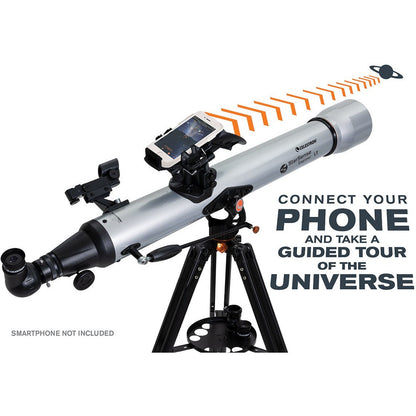
Celestron StarSense Explorer LT 80AZ Telescope
For readers who want a hands-on comparison point, a smartphone-guided refractor makes the basics of pointing, alignment and observing easier to learn. This kind of setup keeps the focus on the whole observing system rather than just aperture.
As an Amazon Associate I earn from qualifying purchases.
The basic numbers behind Webb’s operating challenge
| Feature | What it means |
|---|---|
| Operating region | Halo orbit around the Sun-Earth L2 region |
| Distance from Earth | Roughly 1.5 million kilometres, or about one million miles |
| Typical power need | About one kilowatt for the observatory |
| Solar array capability | Close to two kilowatts with margin for degradation |
| Sunshield size | About 21 metres by 14 metres |
| Primary mirror | 18 hexagonal segments adjusted by small actuators |
The power number matters because Webb is not just a camera. It has to point accurately, keep itself thermally stable, operate four science instruments, communicate with Earth, store and transmit data, manage propulsion and maintain onboard electronics. The observatory does all of that while keeping its cold side cold enough for infrared astronomy.
That cold operating environment is central to the design. Webb’s instruments need to detect faint infrared signals. If the telescope itself were too warm, its own heat would interfere with the observations. The five-layer sunshield is therefore not a decorative structure; it is part of the telescope’s core observing system.
Why the sunshield mattered so much
The sunshield was one of the most demanding parts of Webb’s design. It is roughly the size of a tennis court and made from five separated layers of thin Kapton with reflective coatings. It had to be folded for launch and then deployed in space, with each layer separated and tensioned into its final shape.
That process introduced many interactions between structures, motors, cables, pulleys and membrane material. Ground testing could reduce risk, but it could not perfectly reproduce the way the full system would behave in deep space. Gravity, scale and the delicate membrane geometry made the final deployment a genuine test of the whole design.
The deployment sequence included many mechanisms that had to release, unfold or tension correctly. Public descriptions of the mission’s risk list referred to 344 single-point failures, with a large share tied to post-launch deployment. In engineering terms, a single-point failure generally means a component, mechanism or action whose failure could compromise the mission because there is no simple backup path.
The sunshield reached its final deployed configuration on 4 January 2022. That milestone removed much of the immediate deployment risk and allowed the mission team to continue toward mirror deployment, alignment and instrument commissioning.
What the 344 risk items really tell buyers and readers
The 344 figure can sound like drama for its own sake, but it is more useful as a reminder of what complex hardware reviews often miss. A system is not only judged by its headline specification. It is judged by how many things must work in sequence, how much margin exists, and what happens when a step fails.
That same logic applies, on a much smaller scale, to serious consumer astronomy equipment. A telescope mount, camera, focuser, filter wheel, power supply and software stack can all look good in isolation. The question is whether the whole setup works reliably when the user is outside at night, managing temperature, alignment, tracking and data capture.
Webb’s situation was more extreme because there was no convenient service call. Hubble operated in low Earth orbit and was visited by Space Shuttle servicing missions. Webb’s L2 operating region made that kind of repair plan unrealistic for its original mission design. The deployment had to be treated as a one-shot sequence.
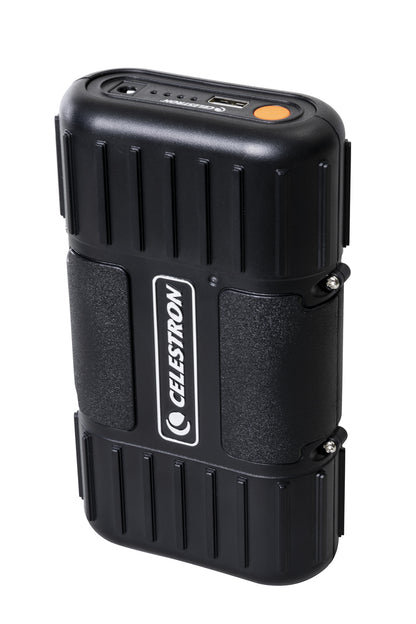
Celestron PowerTank Lithium LT Telescope Power Pack
Computerized mounts and accessories depend on consistent voltage during long observing sessions. A regulated telescope power pack is more relevant here than a generic battery bank when the setup includes a powered mount.
As an Amazon Associate I earn from qualifying purchases.
Why Webb can run cold without a huge power draw
The kilowatt power budget is tied directly to Webb’s thermal design. Much of the cooling is passive. The sunshield blocks heat and sunlight, allowing the telescope and most instruments to cool naturally. Only the coldest instrument requirements need additional active cooling.
That design avoids the need to spend large amounts of electrical power constantly fighting heat. Instead, Webb uses its position, orientation and shield geometry to create a hot side and a cold side. The solar array, antenna and spacecraft bus remain on the warm side, while the telescope optics and instruments sit on the shaded side.
This is why the comparison with a kettle is memorable but incomplete. A kettle turns electrical power directly into heat. Webb’s design is mostly about preventing heat from reaching the parts of the observatory that need to stay cold.
What remains after deployment
Completing deployment did not mean Webb became risk-free. Spacecraft always retain ongoing risks: propulsion, electronics, communications, attitude control, radiation exposure and micrometeoroid impacts all matter over time. The difference is that the most visible early sequence, the unfolding of the observatory, moved from planned risk to completed history.
After deployment, the 18 primary mirror segments had to be aligned into a single optical system using small actuators on the backs of the mirror segments. That alignment process was essential because Webb’s mirror did not launch as one rigid dish. It launched folded, then had to become a working telescope after reaching space.
For a buyer-aware reader, the practical takeaway is simple: Webb’s value is not explained by one specification. The power draw, distance, mirror size, sunshield and deployment risk only make sense together. The observatory works because every major design choice supports the same goal: keeping a large infrared telescope cold, stable and accurately pointed far from Earth.
The useful comparison
Webb is not a product anyone can buy, but it sharpens how people should evaluate high-end astronomy systems. The best comparison is not raw size versus raw price. It is capability under constraint.
A strong system should answer these questions clearly:
- What power does it need in real operating conditions?
- How does it manage heat, vibration and alignment?
- Which parts must work in a fixed sequence before useful data can be collected?
- What happens when a motor, cable, mount, controller or software step fails?
- Is the system practical to maintain where it will actually be used?
Webb’s answer to those questions was extraordinary because the stakes were extraordinary. It had to unfold in deep space, cool itself, align itself and then operate for years from a remote orbit. The fact that it does this on about a kilowatt of power is not a gimmick. It is one of the cleanest ways to see how tightly the whole observatory was engineered.