

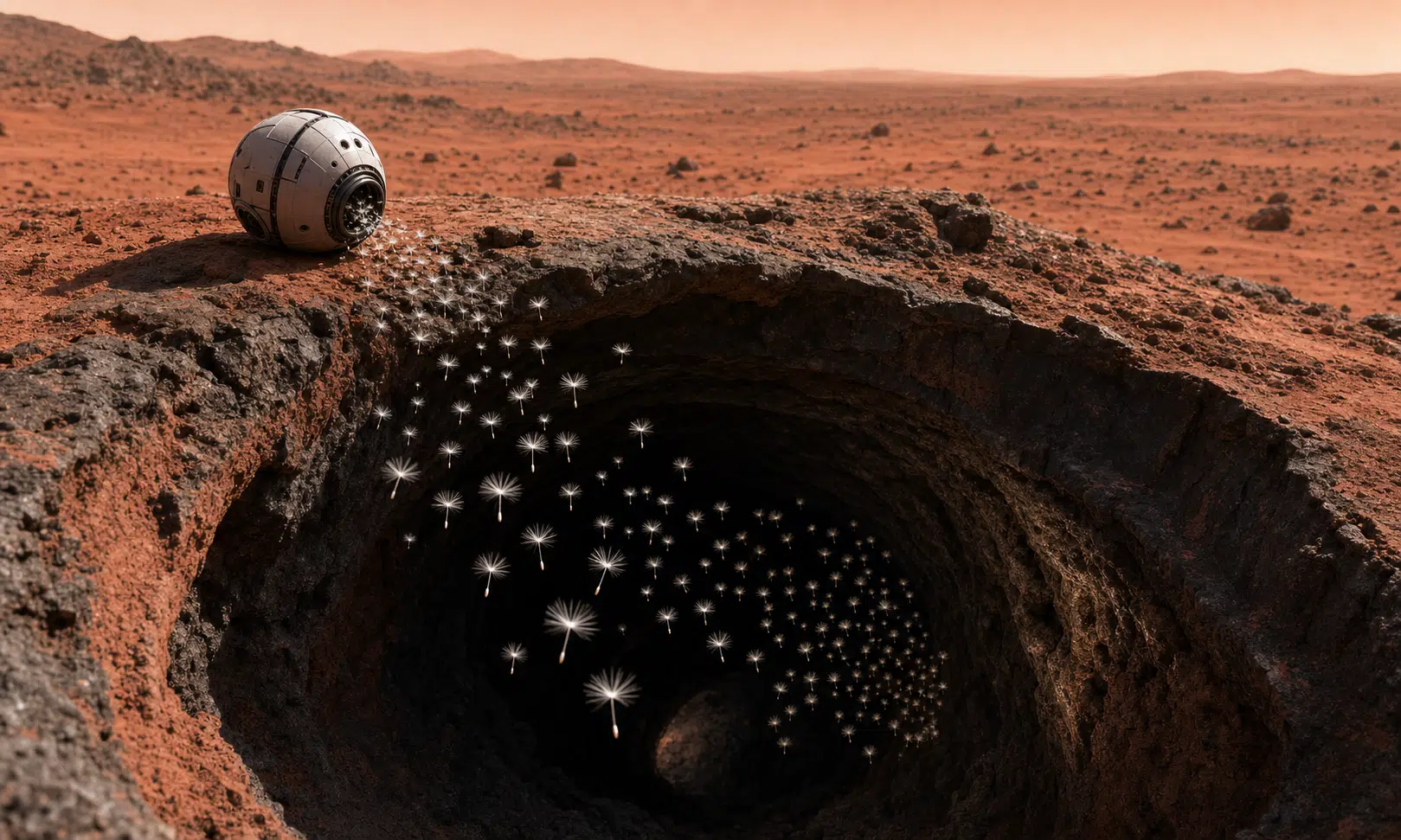

Mars exploration has mostly been a story of wheels. Rovers such as Curiosity and Perseverance have crossed ancient lakebeds, drilled rocks, photographed dust storms and helped scientists read the Red Planet’s surface history one careful meter at a time.
But some of the most interesting places on Mars may not be on the surface at all.
Researchers have identified possible lava tubes, skylights and cave entrances in volcanic regions of Mars, including around Arsia Mons in the Tharsis region. These underground spaces matter because they could preserve clues that the exposed surface cannot. They may also offer more stable temperatures and natural shelter from radiation, dust and micrometeorites, which is why caves often come up in discussions about future human missions.
The problem is access. A rover built for open terrain is not the right tool for a dark, uneven tunnel reached through a collapsed volcanic roof. That is where a stranger idea comes in: a rolling carrier robot that drops into a Martian cave and releases thousands of tiny, seedlike drones designed to drift through the tube like dandelion fluff.
Why Mars Caves Are So Hard To Explore
Lava tubes form when flowing lava drains away or cools in a way that leaves behind hollow channels. Earth has them in volcanic landscapes, including places such as northeastern California and Lanzarote in Spain. Mars, with its long volcanic history and enormous shield volcanoes, appears to have produced far larger versions.
Some candidate Martian lava tubes are associated with long, collapsed channels and dark circular openings known as skylights. These are places where the roof may have fallen in, exposing a tunnel or void below. From orbit, scientists can measure shape, shadow and temperature patterns, but orbiters cannot tell researchers what the full interior looks like.
That missing interior view is the hard part. A rover could struggle with the entrance itself. It would also have to operate without sunlight, with limited communications and with no guarantee that the cave floor is smooth enough to cross. Even if a rover reached the bottom, a single machine could only inspect one path at a time.
A cave is not just a road under a roof. It can branch, narrow, climb, drop and hide hazards around every bend. For a future mission, the ideal scout would be small, cheap enough to risk, and able to spread through a tunnel network quickly.
The Roly-Poly Robot And Its Dandelion Payload
Mostafa Hassanalian, an associate professor at New Mexico Tech, has been working on a concept shaped by biomimicry, the engineering practice of borrowing useful ideas from nature. Instead of building a miniature helicopter or a conventional rover, the proposal draws inspiration from two very different organisms: pillbugs and dandelions.
The first part is a rolling carrier robot modeled loosely on a roly-poly, or pillbug, the small creature known for curling into a ball. In the Mars concept, that ball-like robot could be dropped through a skylight into a lava tube. A parachute or similar descent system would help it survive the fall and reach the cave floor.
Once inside, the carrier would release its payload: thousands of tiny dandelion drones. These would not be drones in the familiar quadcopter sense. They would be more like drifting sensor seeds, using the movement of air inside the tunnel to travel through spaces that would be difficult for a wheeled robot to reach.
The concept depends on scale. Dandelion seeds work because they are extremely light and shaped to stay aloft. Hassanalian’s team is applying that same logic to tiny flying sensors. A small machine can take advantage of aerodynamic effects that would not work the same way for a larger robot.
The idea is not to steer each drone like a remote-controlled aircraft. Instead, the swarm would spread through the cave, gathering basic environmental data and helping create a map of the tunnel system. Readings could include temperature and humidity, with radio signals used to send information back through the network.
Wind Is The Big Unknown
For the dandelion-drone idea to work well, the cave needs moving air. Researchers suspect that skylights and tunnel openings may create ventilation inside some lava tubes, but no human-made spacecraft has entered a Martian lava tube to measure those conditions directly.
That makes wind one of the key uncertainties. If air movement inside a tube is weaker than expected, the seedlike drones may not travel far enough on their own. The carrier concept includes a fan that could help push the drones into motion or keep them moving when natural airflow is limited.
That detail matters because Mars has a thin atmosphere. The planet can produce strong winds at the surface, but Martian air is much less dense than Earth’s. A breeze that sounds dramatic in miles per hour does not push with the same force it would at sea level on Earth. Any flying or drifting Mars robot has to be designed around that difference.
There is also the issue of power. Solar panels are useful on the surface, where spacecraft can harvest sunlight, but a lava tube is dark. A cave explorer has to rely on stored energy, energy harvested from movement or another non-solar approach.
The dandelion-drone design includes the use of piezoelectric materials, which can generate electrical charge when flexed or stressed. In a seedlike drone, that could allow motion in the airflow to contribute to powering sensors or communications. It is a clever fit for the concept, though it would still have to survive the practical demands of a real mission: launch, landing, deployment, dust, cold and radio communication through rock.
Why Scientists Want A Swarm Instead Of One Robot
A swarm approach has a simple advantage: coverage. One rover can make careful measurements in one place. Thousands of tiny sensors could scatter through many branches of a cave system at once.
That does not mean the dandelion drones would replace larger robots. A more realistic future mission could use several layers of machines, each doing a different job.
- An orbiter could identify candidate skylights and map the surrounding terrain.
- A lander or rover could reach the entrance and act as a communications base.
- A rolling carrier could enter the cave and release the sensor swarm.
- Tiny drifting drones could spread through the tunnel and return environmental readings.
This kind of layered strategy is common in space exploration planning because no single robot is good at everything. Ingenuity, NASA’s small Mars helicopter, showed that powered flight is possible in the thin Martian atmosphere, completing 72 flights before its mission ended in 2024. But Ingenuity was designed for open-air scouting near Perseverance, not for navigating underground lava tubes.
Future cave scouts may need to be stranger and more specialized. They may roll, hop, crawl, glide or drift. They may also be disposable by design, because the first mission into a Martian cave will carry unusual risks.
What Mars Lava Tubes Could Reveal
The scientific appeal of Martian lava tubes is broad. They could help researchers understand the planet’s volcanic past, including how lava moved through regions such as Tharsis and how large subsurface voids formed. Their walls and floors may preserve materials that have been less exposed to surface radiation and weathering.
For astrobiology, caves are interesting because they offer protection. That does not mean they contain life, and no mission has found evidence of living organisms on Mars. But sheltered environments are reasonable places to investigate when scientists are looking for preserved chemistry, ancient habitability or conditions that differ from the harsh surface.
For future astronauts, lava tubes are also practical targets. A stable underground space could, in theory, provide part of the shielding that a long-term base would need. Before anyone could seriously consider using such a place, though, robots would have to answer basic questions: How wide is it? How stable is the ceiling? What is the floor like? Is there dust, ice, loose rock or dangerous terrain inside?
Those are mapping questions first. The dandelion-drone proposal is one way to think about answering them without sending a heavy rover blindly into a hole.
A Small Idea For A Very Large Tunnel Network
The dandelion-drone concept is still a proposal, not a scheduled Mars mission. It sits in the same early category as many space robotics ideas: promising, technically interesting and full of unanswered engineering questions.
That is normal. Mars exploration advances through tested pieces. Ingenuity began as a technology demonstration and ended up reshaping expectations for aerial scouting. Lava-tube robots being tested on Earth, including experiments in volcanic caves, are helping researchers learn what machines need to do before they ever face Martian terrain.
The dandelion approach stands out because it does not try to fight the cave environment with a bigger vehicle. It tries to use the environment, especially airflow, as part of the mobility system. If that can be made reliable, a future mission might map places that are currently visible only as dark holes from orbit.
The next great Mars landscape may not be a crater rim or an ancient river delta. It may be a tunnel under an extinct volcano, reached by a rolling robot and explored by a cloud of tiny white sensor seeds.