

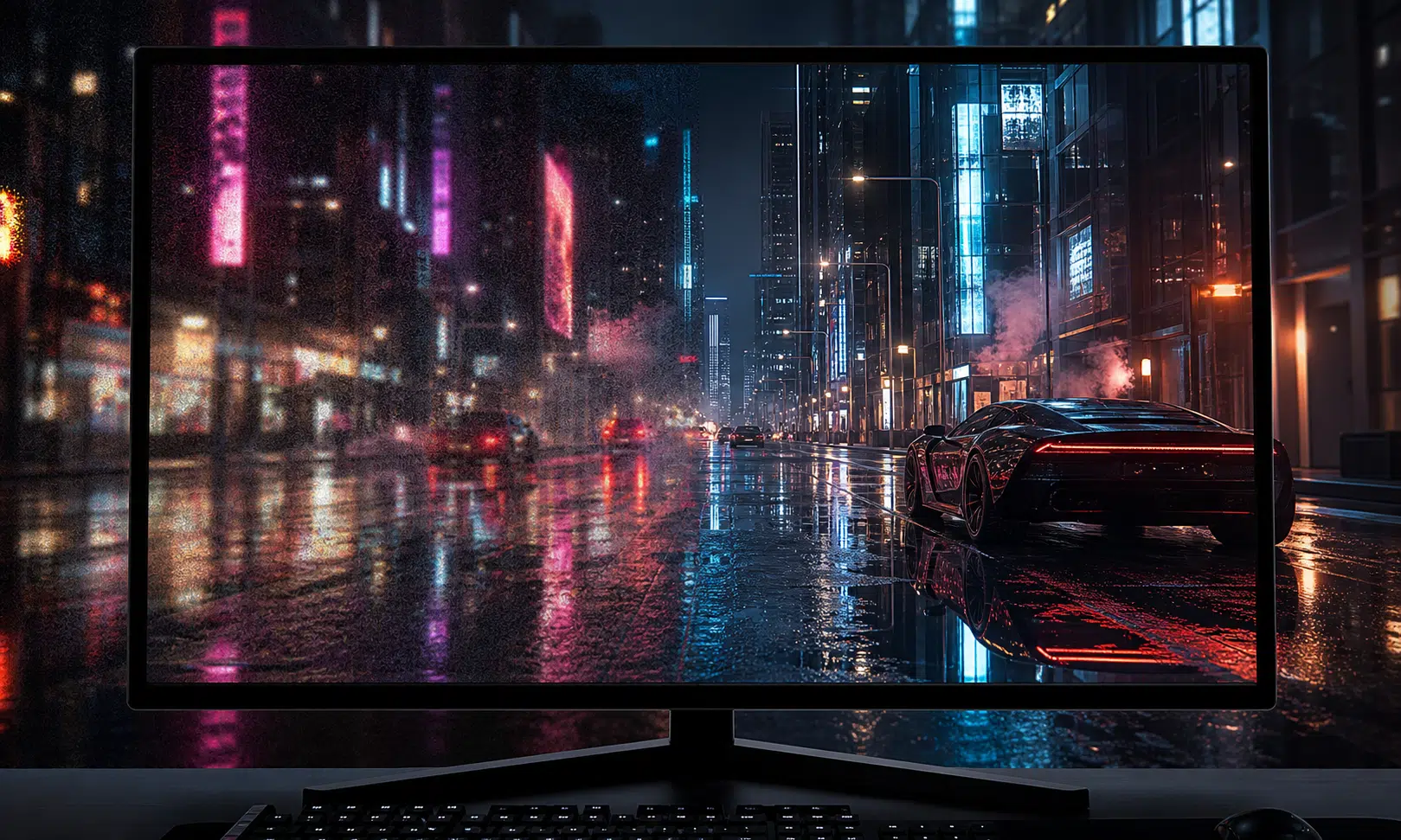

Nvidia’s next DLSS 4.5 update is aimed less at raw frame-rate gains and more at the parts of ray tracing that can still look unstable in motion. DLSS 4.5 Ray Reconstruction is scheduled for August, according to Nvidia, and the company is positioning it as a quality-focused update for ray-traced and path-traced games.
For buyers, the important point is not simply that another DLSS version is coming. It is that Ray Reconstruction is one of the features that can make heavy ray tracing feel more worthwhile, especially in games where reflections, indirect lighting, smoke, glass, or neon-heavy scenes expose the limits of traditional denoising.
What Ray Reconstruction Actually Changes
DLSS Ray Reconstruction is Nvidia’s neural replacement for conventional denoisers in supported ray-traced games. In simple terms, ray tracing often works with incomplete lighting information because a game cannot cast unlimited rays every frame. A denoiser tries to clean up that noisy result. Nvidia’s approach uses an AI model to reconstruct the image using game-engine data, motion information, and prior frames.
The DLSS 4.5 version uses a second-generation transformer model. Nvidia says the updated model processes more parameters while staying in a similar performance range to the previous Ray Reconstruction model. The company also says it has been trained on a larger dataset and has better spatial awareness inherited from the broader DLSS 4.5 Super Resolution work.
That matters because Ray Reconstruction is not just about sharpness. It is also about whether lighting reacts correctly when objects move, whether reflections smear, and whether effects leave lingering artifacts after they should disappear.
Why This Matters for RTX Owners
The update is expected to work across GeForce RTX GPUs, including older RTX 20-series and RTX 30-series cards. That is a meaningful distinction from some DLSS features that depend more heavily on newer hardware generations.
Nvidia’s current positioning suggests DLSS 4.5 Ray Reconstruction is more of an image-quality upgrade than a reason to buy a new GPU by itself. If you already own an RTX card and play supported games, the update could make demanding ray-traced modes look cleaner without requiring a full hardware upgrade. If you are shopping for a GPU, it is another reason to weigh RTX-specific features when comparing cards for games that lean heavily on path tracing.
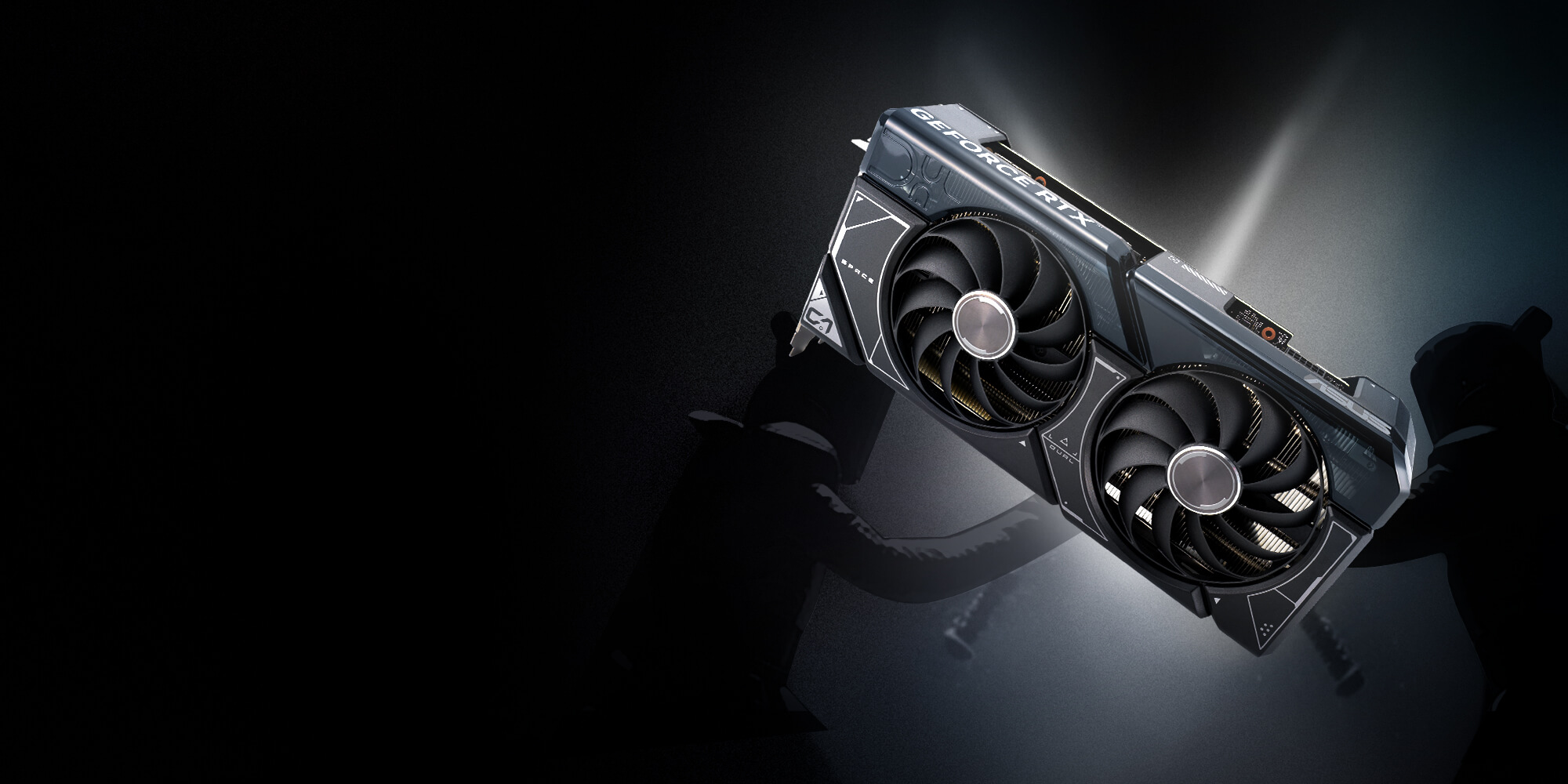
ASUS Dual GeForce RTX 4070 SUPER OC
A card like the ASUS Dual GeForce RTX 4070 SUPER OC is a sensible RTX option for 1440p gaming with ray tracing and DLSS features in mind. It is most relevant if your current GPU struggles with supported ray-traced games rather than as an upgrade for Ray Reconstruction alone.
As an Amazon Associate I earn from qualifying purchases.
| Reader question | Practical takeaway |
|---|---|
| Will this raise frame rates? | That is not the main pitch. The update is focused on ray-traced image quality and stability. |
| Do I need an RTX 50-series card? | Nvidia says Ray Reconstruction support remains available across GeForce RTX GPUs. |
| Is this useful without ray tracing? | No. Ray Reconstruction matters most in games using ray tracing or path tracing. |
| Should I upgrade now because of it? | Not on this feature alone. Look at the games you play, target resolution, and broader GPU performance. |
Early Examples: Alan Wake II, Pragmata, and More
Nvidia’s examples focus on scenes where denoising problems are easy to spot. In Pragmata, the company highlights a laser-trap scene where fast-changing light should appear and disappear cleanly. In Alan Wake II, the example centers on a wall of TVs showing static, along with reflections on the nearby floor.
Those are sensible test cases. Fine noise, fast lighting changes, and glossy reflections are exactly where reconstruction quality can make the difference between a convincing ray-traced image and one that looks smeared, delayed, or artificially softened.
Nvidia says the August rollout will cover 27 games through the Nvidia App, including Cyberpunk 2077, Hogwarts Legacy, Pragmata, and Resident Evil Requiem. Until the update is available broadly, the safer read is that these are Nvidia’s expected supported titles rather than independent proof of how each game will look in everyday play.
Blender Support Could Be the Bigger Productivity Story
Nvidia is also bringing DLSS 4.5 Ray Reconstruction to Blender. The company says the goal is to improve viewport responsiveness by reducing the delay that can happen when a scene has to re-stabilize after a camera move.
That could matter for artists more than the gaming headline suggests. In creative work, waiting for a viewport to settle can interrupt lighting, framing, and material decisions. If Ray Reconstruction can provide a closer-to-final preview while navigating a scene, it may make GPU rendering workflows feel more interactive.
The Blender angle is still one to evaluate carefully once it ships. Game demos and viewport production work are different environments, and creators will want to compare image quality against their existing denoising pipeline before trusting it for client-facing previews or final decisions.

PNY NVIDIA RTX 4000 Ada Generation
The PNY NVIDIA RTX 4000 Ada Generation is more relevant to Blender and workstation users than to pure gaming builds. Its 20GB graphics memory and professional RTX positioning make it worth considering for heavier viewport, rendering, and creator workflows.
As an Amazon Associate I earn from qualifying purchases.
Verdict: A Quality Upgrade, Not a Standalone Upgrade Reason
DLSS 4.5 Ray Reconstruction looks like a practical update for players who already care about ray tracing. It targets visible problems: unstable reflections, noisy lighting, lingering artifacts, and soft reconstructed detail. Those issues are especially relevant in path-traced games where the visual payoff can be high but the image can fall apart under motion.
It is not a reason to buy a new graphics card by itself. The better question is whether your current or next GPU will run the games you care about at the resolution, ray-tracing settings, and frame rate you expect. DLSS 4.5 Ray Reconstruction may improve the visual side of that equation, especially on supported RTX hardware, but it should be treated as part of a broader buying decision rather than the whole case.