

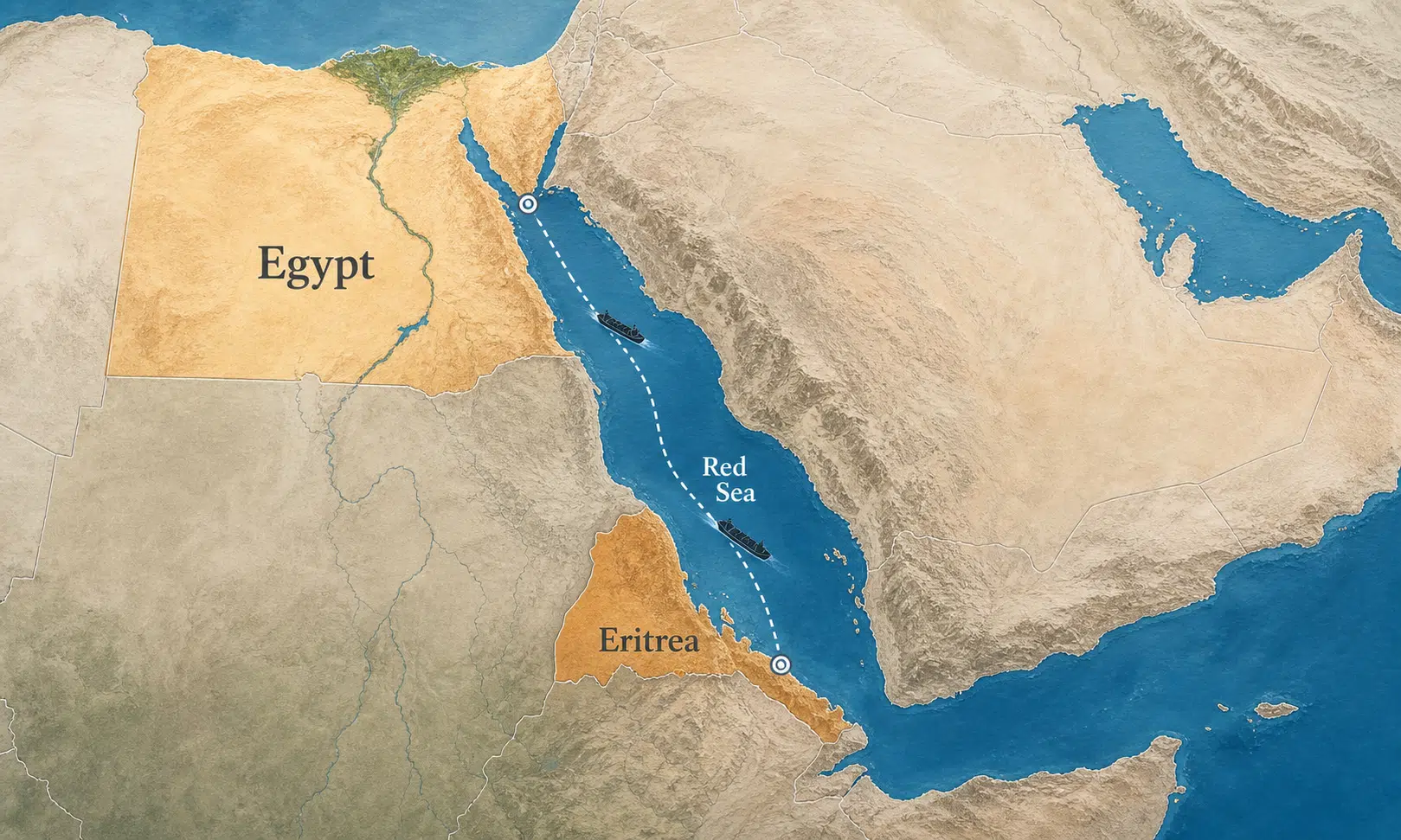

Egypt and Eritrea have agreed to launch a new shipping line connecting ports on their Red Sea coastlines, a move aimed at improving trade and logistics links between North Africa and the Horn of Africa.
The agreement was finalized on May 16, 2026, during an official Egyptian delegation visit to Eritrea. Egypt’s Foreign Minister Badr Abdelatty and Transport Minister Kamel al-Wazir met Eritrean President Isaias Afwerki as part of talks directed by Egyptian President Abdel Fattah al-Sisi.
For businesses, the announcement matters because it points to a more formal maritime connection between two countries with strategic Red Sea frontage. But the commercial value of the route will depend on practical details that have not yet been fully disclosed, including schedules, port handling capacity, customs processes, freight rates and the timing of actual operations.
What the agreement covers
The central commitment is the creation of a shipping line linking Egyptian and Eritrean Red Sea ports. The stated objective is to improve the movement of goods, support regional trade and strengthen economic cooperation.
The talks also covered broader transport and infrastructure cooperation. Egyptian officials signaled interest in sharing experience tied to railways and port development, although a firm timeline has not been publicly confirmed. That distinction matters for companies assessing the announcement: the shipping line is the immediate headline, while wider infrastructure support appears to be a longer-term area of cooperation rather than a completed project.
Private Egyptian business owners also joined the delegation and explored possible investment opportunities in Eritrea. That points to a wider commercial agenda around the shipping agreement, though no specific private-sector projects were confirmed in the source material.

Tracki GPS Tracker
For companies testing a new freight lane, a compact GPS tracker can help monitor sample shipments or high-value cargo during inland and port-adjacent movement. Confirm carrier rules, battery life and coverage before using any tracker in commercial shipments.
As an Amazon Associate I earn from qualifying purchases.
Why the route could matter for trade
A regular maritime link between Egypt and Eritrea could give exporters, importers and logistics providers another option along the Red Sea, especially for cargo moving between North Africa, the Horn of Africa and nearby markets.
The appeal is straightforward: shorter regional shipping links can reduce friction when they are backed by predictable schedules, reliable port handling and clear documentation rules. For traders, the question is not only whether a route exists, but whether it can be used consistently at a cost and speed that improves on current alternatives.
Potential users may include:
- Egyptian exporters looking for more direct access to Eritrea and nearby Horn of Africa markets.
- Eritrean importers seeking steadier maritime links with Egyptian suppliers.
- Freight forwarders assessing new Red Sea routing options.
- Infrastructure and logistics investors watching port, warehousing and inland transport opportunities.
This is where the announcement becomes a commercial decision rather than a diplomatic headline. A new route can open possibilities, but buyers of freight services will still need operational proof before shifting volume.
Business decision checklist
Companies considering the route should treat the agreement as an early signal and build their assessment around verifiable operating details.
| Decision factor | What to verify | Why it matters |
|---|---|---|
| Launch timing | When sailings begin and how often vessels run | Irregular service limits usefulness for time-sensitive trade |
| Port pairing | Which Egyptian and Eritrean ports are included | Port choice affects inland transport cost and delivery time |
| Cargo scope | Whether the line handles containers, bulk cargo, breakbulk or mixed freight | Not every shipping line serves every cargo type |
| Customs process | Documentation, inspection rules and clearance timelines | Border delays can erase savings from a shorter route |
| Security framework | How Red Sea security and port risk are managed | Insurance, routing and reliability depend on risk controls |

Incoterms 2020 Reference Guide
When evaluating a new shipping lane, teams should confirm who carries cost, risk and documentation responsibility at each stage of the shipment. An Incoterms reference can help align sales, logistics and customs conversations before cargo moves.
As an Amazon Associate I earn from qualifying purchases.
Security and regional politics remain central
Security was a major theme in the talks. Abdelatty said countries bordering the Red Sea are responsible for ensuring security along their own shores and argued that outside countries should not be involved in those arrangements.
Egypt also reaffirmed its support for Eritrea’s sovereignty and encouraged countries across the Horn of Africa to support regional stability. Eritrea’s president, in turn, praised the longstanding relationship with Egypt and said his country was willing to coordinate political and economic decisions that benefit both sides.
That political language is important because shipping corridors do not operate in isolation. Maritime insurance, port calls, carrier appetite and investor confidence can all be shaped by regional stability. Businesses should therefore watch both the technical rollout of the shipping line and the diplomatic environment around the Red Sea.
Verdict: promising, but not yet a plug-and-play trade route
For traders, logistics managers and investors, the Egypt-Eritrea shipping line is best viewed as a promising corridor under formation. It may improve regional connectivity if it moves from agreement to dependable operations, and it could support wider investment around ports, transport and trade services.
The practical next step is to monitor official route details, vessel schedules, eligible cargo types and port procedures. Companies with existing Red Sea exposure may want to map where the route could reduce cost or transit time, but it is too early to treat it as a proven replacement for current logistics arrangements.
The strongest commercial takeaway is cautious interest: the political agreement is in place, the strategic geography is clear, and private-sector attention is already present. What buyers still need is operational evidence.