

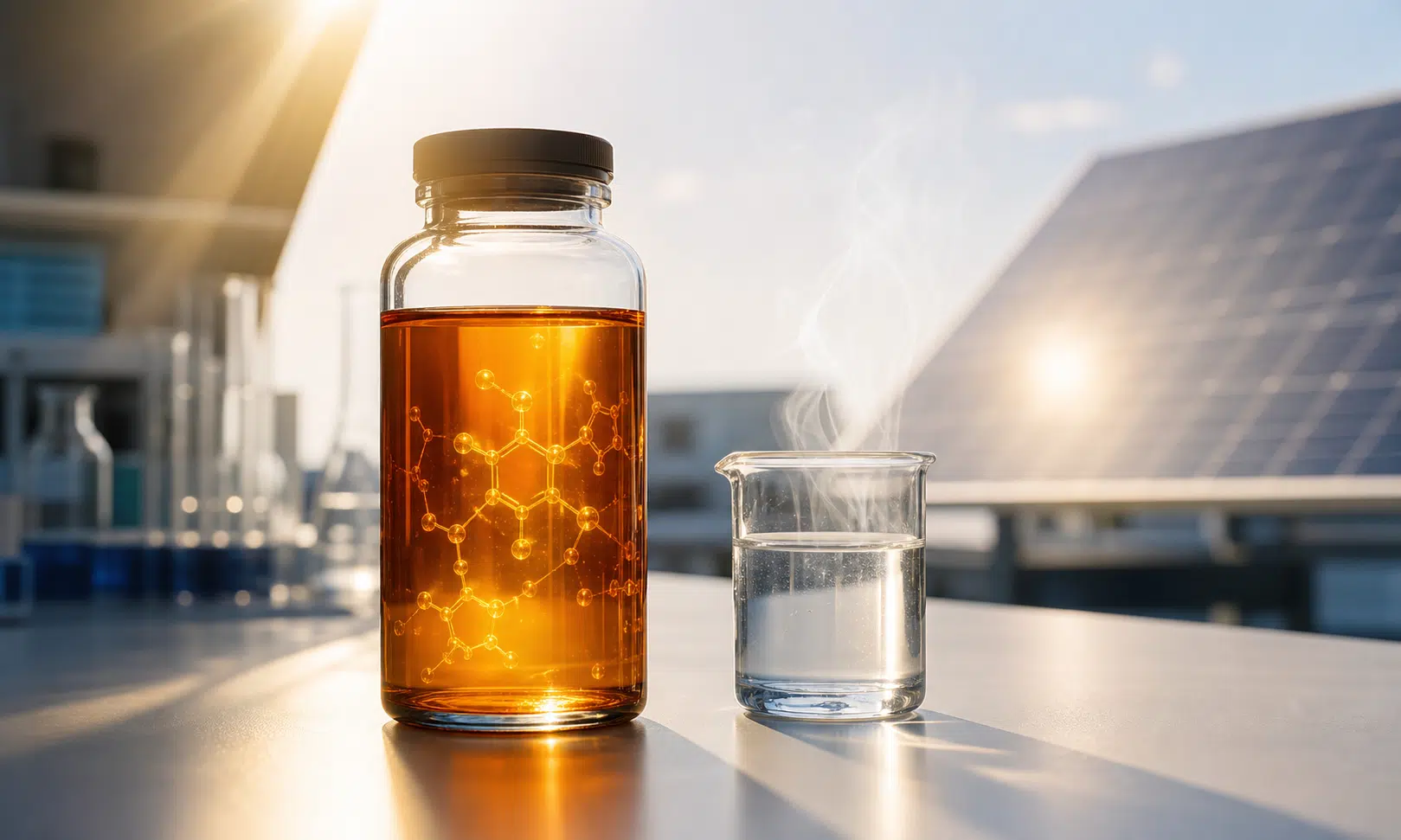

Scientists are working on a different kind of solar storage: not a panel, not a wall-mounted battery, and not a power bank in the usual sense. It is a liquid material that absorbs sunlight, stores that energy inside its molecular structure, and releases it later as heat.
The work, led by researchers at UC Santa Barbara and published in Science, centers on a modified organic molecule called pyrimidone. The team describes it as part of the wider field of Molecular Solar Thermal energy storage, often shortened to MOST. Instead of converting sunlight directly into electricity, the molecule changes shape after absorbing light. That changed form holds energy until a trigger prompts it to return to its original state and give off heat.
That makes the idea especially relevant for one of solar energy’s most familiar problems. Solar panels can produce electricity when sunlight is available, but households, cabins, campsites, and heating systems often need energy later, after clouds move in or the sun goes down. The UCSB work does not mean liquid solar batteries are ready for the hardware aisle. It does suggest a possible route toward storing solar heat in a compact, reusable material.
For buyers and homeowners, the practical question is not whether this replaces today’s solar batteries tomorrow. It does not. The more useful question is where a heat-storing solar liquid might eventually fit beside solar panels, lithium-ion batteries, hot-water systems, and other off-grid equipment.
What the Researchers Built
The researchers developed a molecule that acts a little like a rechargeable heat battery. In sunlight, the molecule shifts into a higher-energy form. Later, when exposed to a trigger such as heat or a catalyst, it returns to its lower-energy form and releases the stored energy as heat.
That basic pattern is the core of molecular solar thermal storage. The energy is not stored as electricity. It is stored in chemical bonds.
The team’s material is based on pyrimidone, a structure related to chemistry found in DNA. According to the researchers, the molecule was designed to be compact and lightweight, which matters because energy storage is partly a density problem. A storage material that holds more energy per kilogram can be easier to move, contain, and integrate into real systems.
The study reports an energy density above 1.6 megajoules per kilogram. For context, the researchers compare that figure with roughly 0.9 megajoules per kilogram for a conventional lithium-ion battery. That comparison is useful, but it needs care: the systems deliver energy in different forms. Lithium-ion batteries provide electricity. This MOST material releases heat.
That distinction shapes where the technology could matter most.
How a Liquid Solar Battery Differs From a Regular Solar Battery
A typical home solar setup uses photovoltaic panels to make electricity. If the homeowner wants to use that electricity later, the system usually needs a battery. That battery stores electrical energy and can power lights, appliances, electronics, pumps, or backup circuits.
The UCSB material points in another direction. It is built to store sunlight as potential heat. That makes it more relevant for thermal jobs: boiling water, heating water, supporting off-grid heat, or feeding a system where the final demand is warmth rather than electricity.
| Storage approach | What it stores | Best fit | Main limitation |
|---|---|---|---|
| Solar panels with lithium-ion batteries | Electricity | Homes, backup power, appliances, electronics | Requires battery hardware and electrical system integration |
| Conventional solar thermal systems | Heat collected from sunlight | Water heating and building heat | Storage and timing depend on system design |
| Molecular solar thermal liquid | Sunlight stored in molecular bonds, released as heat | Future heat-focused storage, water heating, off-grid thermal uses | Still experimental and not a consumer product |
This is why the phrase “solar battery” can be both helpful and misleading. It is helpful because the material can be charged by sunlight and discharged later. It is misleading if readers assume it works like the lithium battery in a phone, power station, or home backup unit.
A better way to think about it is as a rechargeable solar heat material.

Jackery Explorer 1000 v2 Portable Power Station
For readers who need electricity rather than stored heat, a portable power station is the current practical category to compare. Look at capacity, AC output, solar input compatibility, battery chemistry, and whether the unit can support the devices you actually need to run.
As an Amazon Associate I earn from qualifying purchases.
Why Heat Storage Matters
A lot of daily energy use is not really about electricity itself. It is about heat. Water heaters, space heating, cooking, industrial processes, and sanitation all require thermal energy. If sunlight can be stored directly as heat, some applications may not need to convert sunlight into electricity first and then convert electricity back into heat later.
That does not make electrical batteries unnecessary. It means heat-focused storage could solve a different part of the renewable energy puzzle.
In the UCSB demonstration, the material released enough heat to boil water under ambient conditions. That is an important lab result because boiling water is energy-intensive and easy to understand. If a stored solar material can produce that kind of heat on demand, it becomes easier to imagine practical systems built around water heating or portable thermal use.
The researchers have discussed possible future uses such as off-grid heating for camping and home water heating. Because the material dissolves in water, one proposed direction is a system where liquid circulates through rooftop solar collectors during the day, then sits in a tank until heat is needed later.
That remains a research pathway, not a ready-made installation plan.
What Buyers Should Take From This Now
For anyone shopping today, this technology should not change a near-term solar purchase. Homeowners comparing solar panels, battery backups, portable power stations, or solar water heaters should still evaluate products that are already available, warrantied, permitted, and supported.
The new material is more useful as a signal of where solar storage may be heading. It suggests that future systems may separate energy storage into more specialized categories instead of asking one battery type to do every job.
A future home might use one system for electricity and another for heat. That could be more efficient in cases where the goal is hot water rather than running electronics.
- If the goal is backup electricity, today’s lithium-ion or similar home battery systems remain the relevant category.
- If the goal is lower water-heating costs, solar thermal water heating and high-efficiency electric water heaters are more immediate options.
- If the goal is camping or off-grid heat, portable stoves, solar showers, insulated storage, and power stations are the current practical tools.
- If the goal is long-term energy research, molecular solar thermal storage is worth watching because it targets stored heat directly.
The Tradeoff: Heat Is Useful, but It Is Not Electricity
The strongest part of this approach is also its boundary. The material releases heat. That is valuable when heat is what you need. It is less useful if the job is charging a laptop, running a refrigerator, or keeping medical devices powered during an outage.
That makes the technology complementary rather than directly competitive with most home batteries.
A lithium-ion battery can feed an inverter and power household circuits. A molecular solar thermal liquid would need a system designed around heat transfer. If a future version were used in a home, it would probably connect to water tanks, collectors, heat exchangers, or heating loops rather than a standard electrical panel.
This matters for buyer decision support because “energy storage” is not one category. The right product depends on what kind of energy you need at the end.
| Reader need | Most relevant current option | Where this research could eventually fit |
|---|---|---|
| Run lights and appliances after sunset | Solar battery or portable power station | Not the primary use unless paired with another conversion system |
| Store daytime sun for hot water at night | Solar thermal water heater or efficient electric water heater | Potentially relevant if developed into a practical thermal storage system |
| Carry stored solar energy for camping heat | Portable stove, solar cooker, insulated water system, power station | Possible future use if the material becomes safe, packaged, and reusable in consumer gear |
| Reduce grid dependence at home | Solar panels plus battery backup, efficiency upgrades, load management | Could supplement heat demand, not replace full electrical storage |
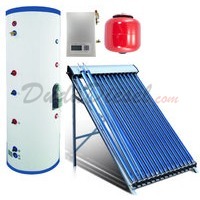
Duda Solar 200L Solar Water Heater System
Solar water-heating systems are the practical comparison point for readers interested in storing or using solar energy as heat. They require more planning than portable gear, so installation, climate, plumbing compatibility, and local permitting matter.
As an Amazon Associate I earn from qualifying purchases.
Why the Molecule’s Design Matters
The research team focused on a compact molecular design. In energy storage, that kind of detail is not cosmetic. Extra molecular weight can reduce energy density because part of the material is effectively along for the ride without contributing useful storage.
The pyrimidone-based molecule changes into a strained, higher-energy structure after absorbing light. The stored-energy form can persist until triggered. The study’s computational work helped explain why the molecule can remain stable in that charged state.
That stability is central to the concept. A solar storage material is not useful if it leaks away its stored energy too quickly. It also needs to survive repeated charging and discharging. The researchers describe the concept as reusable and recyclable, but those claims still have to be understood in the research context. Long-term commercial durability, safety, cost, and manufacturing scale are separate hurdles.
The material’s ability to dissolve in water is also important. A liquid system is easier to imagine in pipes, tanks, collectors, and heat-transfer equipment than a fragile solid material would be. Still, moving from laboratory samples to real-world plumbing is a major engineering step.
What Has Been Demonstrated So Far
The most concrete achievements are narrow but meaningful.
- The researchers created a pyrimidone-based molecular solar thermal material.
- The material stores sunlight in chemical bonds rather than in an electrical battery cell.
- The reported energy density is above 1.6 megajoules per kilogram.
- The stored energy can be released as heat when triggered.
- In experiments, the released heat was enough to boil water under ambient conditions.
Those points are enough to make the work scientifically interesting. They are not enough to claim that the material is ready to replace home batteries, grid storage, or rooftop solar systems.
The gap between a strong lab result and a consumer product includes many practical questions: material cost, stability through many cycles, safety, container design, heat recovery efficiency, sunlight charging speed, installation complexity, and performance in real weather.
That is the difference between a promising storage chemistry and a product a homeowner can buy with confidence.
Where This Could Make the Most Sense
If molecular solar thermal liquids mature, they may first make sense in places where heat is the main requirement and electrical infrastructure is limited or expensive.
Camping is one simple example. A safe, sealed, rechargeable heat-storage liquid could be useful if it allowed people to collect sunlight during the day and use the heat later. Home water heating is another. Water heating is a steady energy demand, and tanks already provide a natural place to store thermal energy.
Industrial heat could be another long-term possibility, although the source material does not establish a commercial pathway for that use. The nearer and more cautious framing is that heat-heavy applications are a better conceptual match than general electricity backup.
For now, the research mainly adds another option to the broader menu of solar storage ideas.
Bottom Line for Solar Shoppers
This liquid solar battery research is not a reason to delay a current solar installation. It is not a drop-in replacement for a home battery, and it is not a retail product. Anyone making a buying decision today should still compare available solar panels, battery systems, solar water heaters, and efficiency upgrades based on real specifications, warranty terms, installer support, and local utility rules.
The reason to pay attention is different. The UCSB work shows that sunlight can be stored directly in a molecular liquid and released later as meaningful heat. If the chemistry can be made durable, safe, affordable, and easy to integrate, it could eventually help solve a specific problem that standard solar batteries do not address perfectly: storing solar energy for heat rather than electricity.
That is a narrower claim than “bottling the sun,” but it is also the more useful one. The technology points toward a future where solar storage is not one-size-fits-all. Electricity may go into batteries. Heat may go into molecules, tanks, or thermal materials designed for that job from the start.

Advanced Elements 5-Gallon Solar Shower
For camping or short off-grid trips, a solar shower is a low-tech way to use sunlight for warm water today. It is not energy storage in the research sense, but it fits the same practical need: turning available sun into useful heat.
As an Amazon Associate I earn from qualifying purchases.