


The TCL QM8L is the kind of TV that makes the ultra-premium model above it a little harder to justify.
That does not mean it is the best TV TCL makes. The X11L still sits above it with more aggressive hardware, a higher-end speaker system, and a more extreme Mini-LED backlight. But the QM8L takes the part most people will notice first, the big, bright, color-rich picture, and puts it in a TV that is positioned much closer to the premium mainstream.
The result is a large-format Mini-LED set that feels less like a watered-down flagship and more like the practical version of TCL’s best ideas. It uses TCL’s SQD panel approach, supports the major HDR formats, runs Google TV, and offers four HDMI 2.1 ports for people with multiple modern gaming devices. It also makes a few tradeoffs: HDR accuracy is not as tight as it could be without calibration, the built-in audio is good rather than exceptional, and the stand feels more cost-conscious than the screen does.
For buyers looking at a big, bright living-room TV, though, the QM8L lands in a very appealing place. It is built for rooms where OLED brightness can feel limiting, for sports and streaming, and for anyone who wants a premium picture without stepping into the highest-priced Mini-LED tier.
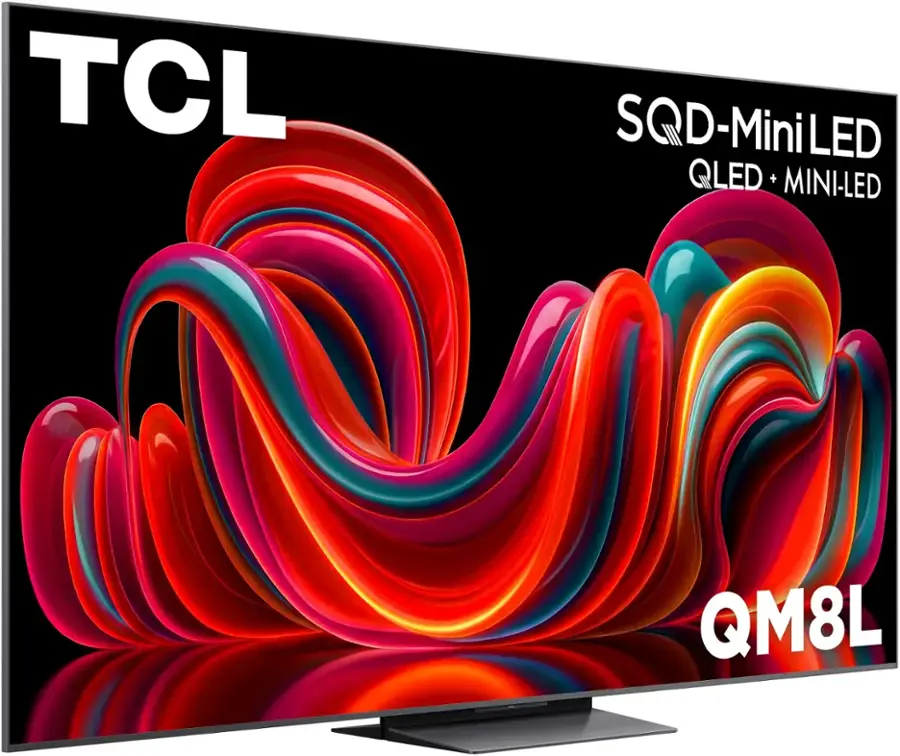
TCL QM8L 65-Inch Mini-LED Google TV
The QM8L is the TV this review is centered on, with Mini-LED brightness, Google TV, broad HDR support, and four HDMI 2.1 ports. It is the most natural pick for readers who want the reviewed model rather than a higher-priced flagship.
As an Amazon Associate I earn from qualifying purchases.
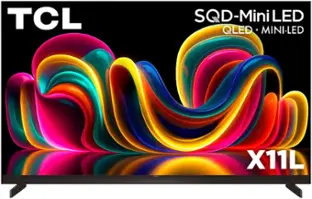
TCL X11L 75-Inch Mini-LED Google TV
The X11L is the higher-end TCL alternative for shoppers who want the brand’s more advanced Mini-LED hardware and stronger built-in audio. It makes the most sense if the extra speaker system and flagship backlight are worth paying for.
As an Amazon Associate I earn from qualifying purchases.
LG C5 OLED 4K TV
The LG C5 is a useful comparison point for buyers who mostly watch in darker rooms and care more about perfect blacks and wide viewing angles than maximum brightness. It is the clearest alternative path for readers not fully sold on Mini-LED.
As an Amazon Associate I earn from qualifying purchases.
TCL QM8L at a glance
The short version: the QM8L is a high-brightness Mini-LED TV with wide color, strong local dimming, full HDMI 2.1 support across all four ports, and a Google TV interface that feels quick enough for daily use.
Its strengths are obvious. SDR content looks extremely bright and lively, HDR highlights have real impact, and the TV’s local dimming keeps dark scenes controlled enough that blooming is rarely distracting in normal viewing. Its color performance is one of the main reasons to pay attention, since TCL’s SQD technology is intended to preserve saturation as brightness climbs.
Its weaknesses are more specific. HDR accuracy out of the box can be improved, viewing angles are still limited by the VA-style panel, and the built-in sound system is not at the same level as TCL’s more expensive flagship implementation. None of those are deal-breakers for the right buyer, but they matter if you are shopping for reference-level picture accuracy or a TV that can replace a proper audio setup.
| Category | QM8L takeaway |
|---|---|
| Best for | Bright rooms, big-screen movie nights, sports, gaming, and premium TV shoppers who do not want the most expensive TCL model |
| Main strength | High brightness with strong color and controlled local dimming |
| Main weakness | HDR accuracy may need calibration for the most demanding viewers |
| Gaming | Four HDMI 2.1 ports with 4K 144Hz support |
| Smart TV platform | Google TV with Gemini voice features |
| Audio | B&O-branded system with clearer, fuller sound than many built-in TV speakers, but still not a dedicated home theater setup |
Design: familiar, clean, and mostly practical
The QM8L does not try to reinvent TCL’s premium TV design language. It has the nearly bezel-free look that has become common on higher-end TVs, with a thin frame, a restrained finish, and a slightly thicker lower edge that houses the logo, microphones, and sensor hardware.
From the front, it looks modern and quiet. That is the right call. A TV this large should disappear into the room once the picture is on, and the QM8L largely does that. The panel is not as physically dramatic as TCL’s top-end model, but it still presents as a premium set when viewed head-on.
The center pedestal stand is one of the more practical choices here. Many large TVs use wide-set feet that demand furniture nearly as wide as the panel itself. The QM8L’s pedestal design makes it easier to place on narrower consoles, and the adjustable height gives buyers room to fit a soundbar below the screen. The 98-inch version is described differently, using feet rather than the pedestal approach, so buyers considering the largest size should check placement carefully before ordering.
The stand itself is less impressive than the screen. It uses plastic construction, and while it may be functionally fine, it does not have the weight or finish some buyers will expect at this price level. That is not something you will think about while watching a movie, but it is one of the visible places where TCL appears to have kept costs in check.
Wall mounting should be straightforward for most setups, with VESA support and basic cable-management accommodations built into the rear design. As always with a very large TV, the practical questions are less about compatibility and more about weight, wall structure, cable access, and whether your room can handle the screen size comfortably.
The remote is a genuine highlight. TCL’s brushed silver remote has a more premium feel than the generic plastic controllers bundled with many TVs, and the automatic backlight is useful in a dark room. A side-mounted brightness control is also a smart touch, because Mini-LED TVs this bright can benefit from quick backlight adjustments between daytime and nighttime viewing. A dedicated picture-mode button and programmable shortcut make it feel built for people who actually change settings rather than leave everything buried in menus.
Ports and connectivity: built for modern setups
The QM8L’s port selection is one of its clearest buyer-friendly upgrades. All four HDMI ports support HDMI 2.1 features, including 4K at 144Hz, with eARC handled through HDMI 1. That matters if your setup includes more than one console, a gaming PC, a streaming box, and a sound system.
A lot of TVs still make buyers choose which devices deserve the best ports. The QM8L is much less restrictive. For households with a PlayStation 5, Xbox Series X, gaming PC, and receiver or soundbar, that flexibility is not just a spec-sheet win; it changes how much cable juggling you have to do.
Other connectivity includes USB 3.0, USB 2.0, Ethernet, optical audio output, and an ATSC 3.0 tuner for next-generation over-the-air broadcasts. Wireless support includes Wi-Fi 6 and Bluetooth 5.4. TCL’s Dolby Atmos FlexConnect support is also part of the package, giving buyers a path to add compatible wireless speakers and a subwoofer over time.
For gaming, the headline is 4K at 144Hz through HDMI. The TV also supports higher-refresh 1080p play through TCL’s Game Accelerator feature. That is useful for players who want frame rate flexibility, though competitive players chasing the lowest possible latency will still be better served by a dedicated gaming monitor. For couch gaming, single-player titles, and console use, the QM8L checks the boxes a premium TV should.
Picture quality: big brightness is the point
The QM8L’s picture is built around the thing Mini-LED still does better than OLED in many living rooms: brightness. This is a TV meant to fight daylight, reflections, and high-impact HDR scenes without looking strained.
In SDR, that brightness makes the set feel effortless. Sports, YouTube, cable, and streaming shows all benefit from a picture that can push through a bright room without needing the blinds closed. The glossy screen can still show direct reflections, so it is not magic, but the available light output does a lot of work.
Color is the other major story. TCL’s SQD approach uses smaller quantum dot particles and a revised color-filter strategy to help maintain color volume at high brightness. The practical result is that bright scenes do not look as washed out as they can on some TVs when the backlight is pushed hard.
Measured SDR accuracy in Filmmaker Mode at 100 nits was described around a Delta E of 3.0 with processing disabled. That is not perfect, but it is respectable for a TV in this class and close enough that most viewers will not be distracted by obvious color errors in normal content.
Coverage is also strong, with DCI-P3 in the high 90-percent range and Rec. 2020 around 90 percent. The Rec. 2020 figure is more about headroom than everyday benefit, because most streaming content still targets DCI-P3 inside an HDR container. Still, wide color coverage gives the panel room to age well as content and mastering practices evolve.
Viewing angles are the expected compromise. The QM8L uses a VA-type panel, so contrast is strong when viewed head-on, but the image can lose punch and consistency from sharper side angles. Moderate off-axis viewing should be fine for many living rooms, but wide seating arrangements remain a reason to compare carefully against OLED or other wide-angle LCD designs.
Upscaling is handled by TCL’s TSR AI Pro processor. Lower-resolution content, including cable sports, looks clean enough that the TV does not feel punished by older broadcast standards. That matters because even the best panel can only do so much if everyday TV feeds look rough.
HDR performance: strong highlights, better after tuning
HDR is where the QM8L feels closest to a flagship experience. Highlights can look searing, dark scenes hold together well, and the local dimming system does a strong job keeping halos and raised blacks under control.
TCL rates the QM8L at up to 4,000 local dimming zones depending on screen size, controlled by a 26-bit backlight system. That is far fewer zones than the X11L’s stated 20,000-plus-zone setup, but zone count is not the whole picture. Processing, panel behavior, and dimming algorithms matter just as much, and the QM8L’s real-world performance sounds far more refined than its position below the flagship might suggest.
In dark HDR scenes, the important thing is control. Bright objects should not flood the surrounding black level, and shadow detail should not be crushed into a flat smear. The QM8L appears to handle that balance well, delivering bright highlights without turning the rest of the image gray.
Format support is broad. The TV supports Dolby Vision, including Dolby Vision IQ, along with HDR10, HDR10+, HLG, and IMAX Enhanced. TCL has also said Dolby Vision 2 support is planned through a firmware update later in 2026. Because firmware timelines can move, buyers who specifically care about Dolby Vision 2 should treat that as a planned feature rather than the reason to buy on day one.
The main picture caveat is HDR accuracy. Out of the box, the QM8L is not positioned as a reference display for viewers who want the most exact HDR tracking without adjustment. A calibration can address that, but most buyers do not calibrate TVs. For them, the question is whether they value technical accuracy above the immediate impact of brightness, contrast, and color.
For most living-room use, the QM8L’s HDR strengths are likely to matter more than its calibration flaws. For home theater purists, especially those watching in a dark room, OLED remains the cleaner choice if perfect blacks, viewing angles, and tighter tone behavior matter more than raw brightness.
Audio: better than basic, not a soundbar replacement
The QM8L includes a B&O-branded audio system, but it is not the same full-width speaker array used in TCL’s higher-end model. Here, the setup includes down-firing speakers along the bottom edge and rear-mounted woofers.
That gives the TV more body than the thin, harsh sound many large flat-panel TVs produce. Dialogue is clear, the low end has some real presence, and everyday viewing does not immediately demand an external speaker system.
That said, there is a difference between acceptable built-in TV sound and a proper home theater experience. For news, sports, sitcoms, and casual streaming, the QM8L’s audio should be fine for many users. For movie nights, big action scenes, or anyone who cares about spatial effects, a soundbar or speaker setup still makes sense.
The good news is that buyers have options. Dolby Atmos and DTS:X support are included, and FlexConnect support gives TCL a wireless expansion path for compatible speakers and a subwoofer. That could appeal to people who want to build audio gradually rather than buy a full sound system immediately.
Google TV and Gemini: fast enough, with AI if you want it
The QM8L runs Google TV on Android 14, and the experience is described as quick and responsive. App launches are fast, navigation is smooth, and the quick settings menu makes common adjustments easier without forcing users to leave what they are watching.
Google TV remains one of the better smart TV platforms because it is familiar, app-rich, and less awkward than many proprietary TV interfaces. It also supports Google Cast, AirPlay 2, and Apple HomeKit, which makes the QM8L easier to fit into mixed-device households.
Gemini voice features are built in through the TV’s far-field microphones. The assistant can handle more conversational requests than older TV voice systems, including follow-up questions and multi-step commands. That may be useful for accessibility, search, and smart home control, though voice assistants on TVs still feel optional rather than essential for many viewers.
There are also AI-adjacent extras such as generated screensavers and news briefings. Those features are less central to the TV’s appeal than the basics: fast apps, stable navigation, good input handling, and settings that are easy to reach. On those fundamentals, the QM8L seems to hold up well.
Many buyers will still plug in a Roku, Apple TV, or game console and ignore most of the built-in platform. That is fine. A good TV should not require its native OS to be the center of your setup. But if you do plan to use the built-in smart platform, Google TV is a strong starting point.
QM8L vs. X11L, QM8K, and OLED alternatives
The QM8L’s biggest internal comparison is the TCL X11L. Both sit in TCL’s premium Mini-LED world, but the X11L is the more extreme model, with a much higher dimming-zone count, a slimmer physical design, a higher brightness ceiling, and a more ambitious Bang & Olufsen speaker array.
The QM8L counters with the more practical pitch: it keeps much of the visual appeal buyers want from a high-end Mini-LED TV while stepping down from the highest price tier. If you want TCL’s most advanced Mini-LED hardware and built-in sound matters a lot, the X11L still has a clear reason to exist. If the main goal is a huge, bright, colorful picture, the QM8L is the easier recommendation.
The older QM8K is also worth thinking about if discounts are aggressive. It remains a strong TV, and its higher-end built-in audio may appeal to buyers who do not want a separate soundbar. The QM8L’s advantages are its SQD color system, improved HDMI flexibility, and newer backlight control.
Then there is OLED, particularly something like LG’s C-series. OLED still wins for perfect black levels, pixel-level contrast, wide viewing angles, and dark-room movie watching. It also tends to have a cleaner look in difficult near-black scenes. The tradeoff is brightness and screen size value. If you watch during the day, have a bright living room, or want a very large screen without paying a premium OLED price, Mini-LED remains compelling.
| Option | Why consider it | Why skip it |
|---|---|---|
| TCL QM8L | Big brightness, strong color, four HDMI 2.1 ports, practical premium pricing | HDR accuracy may need tuning; built-in audio is not flagship-level |
| TCL X11L | Higher-end Mini-LED hardware and stronger built-in audio | Much more expensive at comparable sizes |
| TCL QM8K | Potential discounts and strong built-in audio | No SQD color system and fewer full-spec HDMI ports |
| LG C5 OLED | Perfect blacks, wide viewing angles, excellent dark-room performance | Less brightness and usually higher cost per inch |
Who should buy the TCL QM8L?
The QM8L makes the most sense for someone who wants a large, premium TV for a real living room rather than a light-controlled theater. If you watch sports during the day, stream HDR shows at night, play console games, and want the screen to look punchy without constant fussing, this TV is built for that use case.
It is also a strong fit for buyers who want Mini-LED brightness but do not want to pay for TCL’s most expensive hardware. The QM8L does not erase every reason to buy the X11L, but it narrows the everyday picture gap enough that the more expensive model becomes a more specialized choice.
The QM8L is less ideal if you want the most accurate HDR image without calibration, if your seating is spread far to the sides, or if you expect built-in TV speakers to replace a serious sound system. Those are not failures so much as the normal boundaries of this kind of TV.
For most premium TV shoppers, the verdict is straightforward: the TCL QM8L looks like one of the strongest big-screen Mini-LED values in TCL’s lineup. It delivers the brightness, color, gaming support, and scale people buy this category for, while keeping the compromises in places many viewers will rarely notice.
FAQ
What sizes does the TCL QM8L come in?
The QM8L lineup includes 65-inch, 75-inch, 85-inch, and 98-inch sizes. Launch pricing is listed at $2,499, $2,999, $3,999, and $5,999, respectively, though TV prices often change after launch.
Does the TCL QM8L support Dolby Vision?
Yes. The QM8L supports Dolby Vision IQ, HDR10, HDR10+, HLG, and IMAX Enhanced. TCL has also planned a Dolby Vision 2 firmware update for later in 2026.
What is the difference between the TCL QM8L and TCL X11L?
The X11L is the higher-end model, with more dimming zones, a higher brightness ceiling, a thinner design, and a more advanced Bang & Olufsen speaker array. The QM8L is the more attainable option and keeps many of the picture-quality features buyers are likely to notice most.
Is the TCL QM8L good for gaming?
Yes. The QM8L has four HDMI 2.1 ports with 4K 144Hz support, plus a 1080p high-refresh option through Game Accelerator. For console and couch gaming, it is well equipped.
Should I buy the TCL QM8L or an OLED?
Choose the QM8L if you want a very bright TV for a living room, especially at larger sizes. Choose OLED if you mostly watch in a dark room and care more about perfect blacks, wide viewing angles, and pixel-level contrast than maximum brightness.