

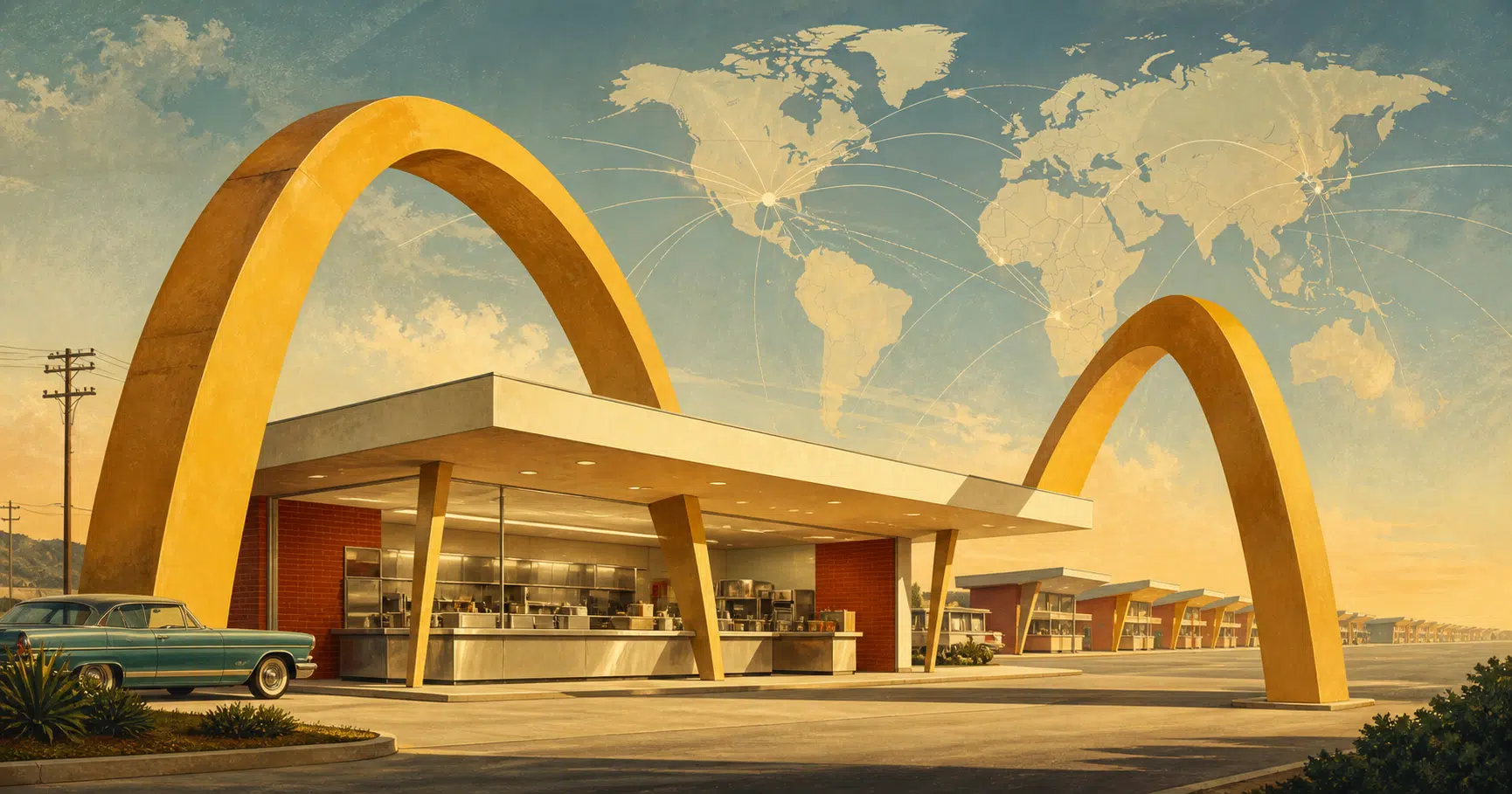

McDonald’s did not become a global restaurant brand because it invented the hamburger. Its breakthrough was turning a familiar meal into a repeatable system—one designed around speed, consistency, recognizable architecture, and an increasingly disciplined relationship between the company and its franchisees.
That system also defined the deal offered to customers. McDonald’s traded a sprawling menu and leisurely restaurant experience for quick ordering, familiar food, and a format that could be reproduced from one market to another. The details have changed repeatedly, but that basic exchange has remained central to the company’s identity.
The early history is less tidy than the polished corporate myth suggests. It is generally traced to Richard and Maurice McDonald, known as Dick and Mac, and a restaurant operation in San Bernardino, California, in 1940. Some details about the family’s earlier ventures and the precise sequence of events differ among historical retellings, so the origin story is best understood as an evolution rather than a single moment of invention.
What became unmistakable by the late 1940s was the brothers’ interest in efficiency. They reduced the menu, reorganized food preparation, and designed the operation around serving large numbers of customers quickly. That decision supplied the operating logic Ray Kroc would later take far beyond Southern California.
The original bargain: less choice in exchange for more speed
The decisive early version of McDonald’s emerged in 1948, when the brothers closed and reworked their restaurant around a tightly controlled service system. Hamburgers, cheeseburgers, drinks, coffee, potato chips, ice cream, and apple pie formed the kind of deliberately narrow menu that made specialization possible.
A smaller menu meant fewer ingredients to manage, fewer preparation methods to teach, and less variation between orders. Work could be divided into repeatable tasks, with employees concentrating on individual stages of production instead of preparing an entire meal from beginning to end. The customer gave up customization and table service, but the restaurant could deliver food more quickly and at higher volume.
That tradeoff is familiar today, but it represented a major change from the drive-ins that surrounded motorists with carhops, broad menus, and a more social experience. The brothers treated the restaurant less like a conventional diner and more like a production line. Every movement, piece of equipment, and step between an order and a finished meal became a candidate for refinement.
The approach was operational as much as culinary. McDonald’s was not trying to win through an elaborate recipe that competitors could not copy. It was creating a process that could make an ordinary product reliably and rapidly. The value sat in the system surrounding the hamburger.
For buyers, that distinction still matters. A fast-food purchase is rarely evaluated as food alone. Waiting time, order accuracy, convenience, familiarity, and price all contribute to the perceived value. McDonald’s early model bundled those attributes into one proposition and made them easier to reproduce.
The same logic would eventually influence restaurant automation and operational efficiency across the industry. Limited menus, specialized workstations, standardized equipment, and tightly measured preparation times became defining features of modern quick-service restaurants.
How the Golden Arches turned a building into an advertisement
Efficiency alone could make a restaurant productive, but it could not make one location instantly recognizable from a moving car. The brothers therefore paired their service model with architecture designed to function as advertising.
In 1952, they began planning a new building intended to improve workflow and create a stronger roadside presence. Architect Stanley Clark Meston worked on the design, which used bright surfaces, glass, stainless steel, colored sheet metal, neon, and two large yellow arches.
The design was difficult to ignore. Its red, white, and yellow palette projected cleanliness and energy, while the arches made the restaurant visible at a distance. Rather than treating signage as an accessory attached to a building, the design effectively turned the building into the sign.
The restaurant environment was also shaped around customer turnover. Seating, temperature, spacing, and even drink containers were considered in relation to how long customers might remain. The aim was not to create a lounge. It was to keep people and orders moving.
That reveals an important part of the original McDonald’s deal: speed depended on more than the kitchen. The building, service method, menu, and customer behavior all had to support the same goal. The concept worked because its components reinforced one another.
A roadside character named Speedee represented the brand during this period. The name communicated the operating promise directly, while the architecture gave that promise a physical form. Ronald McDonald would later become the more famous mascot, but Speedee captured the early company’s priorities with unusual clarity.
The Golden Arches eventually outlasted the individual buildings that inspired them. They became a portable symbol that could identify a McDonald’s even when local construction, planning rules, and restaurant layouts changed. That adaptability helped the mark survive as the chain expanded into shopping districts, airports, food courts, and international markets where the original roadside design was not always practical.
Early franchising showed both the appeal and the limits of the model
The McDonald brothers began looking for franchisees while the new architectural concept was still taking shape. Early locations demonstrated that the operating system and visual identity could be reproduced beyond San Bernardino, though several details about the first franchise agreements and their exact sequence remain uncertain.
A Phoenix restaurant opened in 1953 using the standardized Golden Arches design. Another early location opened that year in Downey, California. The Downey restaurant later became notable for preserving the look of the chain’s early architectural era.
The initial franchise program was not yet the tightly controlled national network McDonald’s would become. The brothers had created a compelling restaurant format, but managing distant operators required a different kind of organization. A recipe, floor plan, and set of procedures were not enough on their own. Someone had to recruit franchisees, select sites, protect standards, train operators, and make expansion economically attractive to everyone involved.
This is the point where the history of McDonald’s shifts from restaurant design to organizational design. The brothers had solved much of the problem inside the restaurant. Ray Kroc focused on building the machinery around it.
Ray Kroc saw a national platform, not just a successful restaurant
Ray Kroc entered the McDonald’s story in 1954 as a seller of Multimixer milkshake machines. The San Bernardino operation attracted his attention because it required an unusually large amount of mixing capacity, signaling the volume the restaurant could produce.
Kroc recognized that the system could become the foundation of a national franchise network. The brothers had already licensed restaurants, but they were cautious about aggressive expansion. Kroc was prepared to take responsibility for recruiting and supporting franchisees across much of the United States.
That difference in ambition eventually became the defining tension among the partners. Dick and Mac McDonald had built a successful operation with a disciplined method. Kroc wanted to transform that method into an institution capable of expanding continuously.
The challenge was not simply opening more restaurants. Each new location risked weakening the promise that made the concept valuable. A poorly operated franchise could damage the brand for every other restaurant bearing the name. National growth therefore required rules, training, oversight, and a financial structure that rewarded expansion without abandoning consistency.
Kroc’s approach treated the franchise as more than permission to use a logo. Operators were expected to follow a system. That made the opportunity more restrictive than an independent restaurant, but it also gave franchisees access to a recognizable concept, established operating methods, and a growing national identity.
This remains the central tradeoff in franchise ownership. An operator receives a playbook and a brand, but gives up a substantial degree of independence. The McDonald’s system became powerful because it made that bargain explicit and enforced it at scale.
The structure helped establish one of the most influential franchise business models in the restaurant industry. It also separated McDonald’s from companies that expanded primarily by licensing a name without exercising comparable control over the customer experience.
The real-estate model changed the economics of expansion
Fast national expansion required capital, and restaurant royalties alone did not initially provide Kroc’s organization with enough financial stability. Harry J. Sonneborn, a former Tastee-Freez finance executive, proposed an answer that would reshape the company: connect the franchise system to real estate.
Franchise Realty Corporation was formed to secure sites and arrange control of the land and buildings used by future restaurants. Those properties could then be leased to franchisees, with the occupancy arrangement becoming another source of revenue and control.
The model did several jobs at once. It created income linked to restaurant locations, gave the company a stronger position in its relationship with operators, and made site selection part of the franchise system rather than leaving every operator to solve it independently.
Real estate also gave McDonald’s a lever that went beyond a conventional brand license. If a franchisee failed to meet operating expectations, the company’s role in the restaurant property could matter as much as its ownership of the trademarks and procedures.
This arrangement is sometimes compressed into the claim that McDonald’s is a real-estate company that happens to sell hamburgers. That line is memorable but incomplete. Customers generate demand by buying food, franchisees operate most restaurants, and the brand coordinates the system. Real estate is powerful because it connects those parts; it does not replace them.
Kroc and Sonneborn later disagreed over the pace and direction of expansion, ending a partnership that had helped establish the company’s financial engine. The larger lesson survived: a scalable restaurant chain needs more than a popular menu. It needs a durable method for choosing locations, financing growth, controlling standards, and allocating risk.
The 1961 transition remains more complicated than the movie version
By the start of the 1960s, McDonald’s restaurants were generating tens of millions of dollars in annual sales. Suburban growth, rising automobile use, and the interstate highway system created favorable conditions for a roadside chain built around fast service and highly visible locations.
Kroc’s relationship with the McDonald brothers had also deteriorated. Their disagreement was not about whether the restaurants were successful; it was about how aggressively the system should grow and who should control its future.
The conventional timeline places Kroc’s purchase of the brothers’ interests in 1961. The exact negotiations and tone of the transition remain disputed. Popular retellings often frame it as an uncompromising takeover, while other descriptions present a more voluntary sale between partners whose goals had diverged.
What is clear is the result. Kroc gained control of the company and could pursue expansion without needing the brothers’ approval. The transaction cleared the way for a more centralized organization and, eventually, a public company.
That transition also explains why McDonald’s has two overlapping founding narratives. Dick and Mac created the restaurant system and visual concept that made the business distinctive. Kroc built the corporate apparatus that made it enormous. Treating either side as the sole founder flattens a history in which product design and organizational scale were equally important.
The tension is still relevant to entrepreneurs and franchise buyers. Inventing a good format and scaling that format are separate capabilities. The first requires insight into customers and operations. The second requires capital, management, real estate, quality control, and a willingness to standardize decisions that an independent owner might prefer to make locally.
Menu inventions gave customers reasons to return
Standardization did not mean the menu could remain frozen. McDonald’s needed new products that fit its operating system without making that system unmanageable.
The Filet-O-Fish arrived in 1962, showing how a franchise-led product could address local customer demand while still becoming part of a broader menu. The Big Mac followed later in the decade. It was created by franchisee Jim Delligatti in Pennsylvania and joined the national menu in 1968.
Those products illustrate a recurring McDonald’s pattern. Useful ideas could emerge from franchisees close to local customers, but national adoption depended on whether the item could be prepared, supplied, priced, and marketed across a large network.
The balance is delicate. Too little menu change makes a restaurant feel stale and leaves customer needs unanswered. Too much change adds ingredients, equipment, training requirements, and opportunities for mistakes. Every addition has an operational cost even when it looks simple from the counter.
The Extra Value Meal, introduced in the 1990s, packaged a burger, fries, and drink as a single purchasing decision. The idea reduced the amount of comparison required at the register while making the total offer easy to advertise. A customer did not need to assemble a meal item by item or calculate whether the combination made sense.
The McFlurry, created by Canadian franchisee Ron McLellan in 1995, became another example of a locally developed product that could fit the larger system. McDonald’s also experimented with pizza during the decade, but not every attempt became a permanent global fixture.
These examples show why the best fast-food product is not necessarily the most elaborate. It is the one that customers want and restaurants can execute consistently under real operating pressure.
International expansion tested how portable the system really was
McDonald’s opened its first restaurant outside the United States in Richmond, Canada, in 1967. That move began a period in which the company tested whether its operating model could cross national borders without losing its identity.
Expansion accelerated during the 1970s. A restaurant opened in San José, Costa Rica, in 1970. In 1971, McDonald’s entered the Netherlands through a joint venture, opened in Tokyo, established a restaurant in what was then West Germany, and launched its first Australian location in Yagoona.
By 1976, the chain had more than 3,600 restaurants in the United States and Canada and had also entered markets including France, Sweden, Britain, Hong Kong, and New Zealand. Its first New Zealand restaurant opened in Porirua after negotiations that included an arrangement involving New Zealand cheese and the cost of importing restaurant equipment.
Further expansion brought McDonald’s to Singapore in 1979, the year it also opened in Brazil. The company entered Malaysia in 1982 and Mexico in 1985. A restaurant opened in Shenzhen in 1990 as McDonald’s moved into mainland China.
The Middle East became another significant expansion region during the 1990s, with openings in Israel, Saudi Arabia, Kuwait, Oman, Egypt, Bahrain, and the United Arab Emirates. A kosher McDonald’s opened in Israel in 1995. In 2000, a Dearborn, Michigan, restaurant began offering halal food for Muslim customers.
| Year | Expansion milestone | Why it mattered |
|---|---|---|
| 1967 | First restaurant outside the United States opened in Canada | Established the first step beyond the domestic market |
| 1970 | Costa Rica location opened | Extended the chain beyond North America |
| 1971 | Restaurants opened in the Netherlands, Japan, West Germany, and Australia | Demonstrated expansion across Europe, Asia, and Oceania |
| 1976 | First New Zealand restaurant opened | Showed how supply and equipment constraints could shape market entry |
| 1979 | Restaurants opened in Singapore and Brazil | Expanded the chain into Southeast Asia and South America |
| 1990 | Mainland China restaurant opened in Shenzhen | Marked entry into a major long-term growth market |
| 1993–1994 | Expansion accelerated across the Middle East | Required adaptation to local commercial and dietary conditions |
International growth was not a simple process of copying an American restaurant and changing the address. McDonald’s had to work with local partners, build supply chains, meet religious and regulatory requirements, and decide how much menu adaptation the brand could absorb.
The company’s value proposition depended on familiarity, but familiarity has limits when tastes, ingredient availability, dietary rules, and eating habits vary. The scalable answer was a controlled blend: preserve the recognizable system while allowing selected local changes.
Not every market produced a durable success
Global reach can make expansion look inevitable in hindsight, but McDonald’s did not succeed everywhere. The company opened in Bolivia in 1997 and closed its restaurants there in 2002 after the operation accumulated losses. Burger King later acquired the former locations.
The Bolivian exit is a useful counterweight to the idea that a standardized global brand automatically travels well. Recognition can attract attention, but it cannot guarantee enough repeat business to support a restaurant network. Local food culture, pricing, franchise economics, supply costs, and public sentiment all influence whether a market works.
New Zealand initially drew skepticism from Ray Kroc as well, yet the first restaurant there performed better than the corporation had expected. The contrast between New Zealand and Bolivia demonstrates why market entry remains a bet rather than a mechanical extension of a successful formula.
For customers, international adaptation can produce a version of McDonald’s that is recognizable without being identical. For operators, however, each adaptation creates practical questions: whether ingredients can be sourced consistently, whether equipment needs to change, and whether the product can be produced without slowing the kitchen.
The result is a global brand held together by operating standards more than by a perfectly uniform menu. The arches, ordering structure, service expectations, and core products create continuity, while local items give individual markets room to respond to demand.
McDonald’s kept experimenting with formats and payment
The company’s history includes repeated attempts to reduce friction beyond food preparation. In 1988, McDonald’s Japan tested prepaid cards at three Tokyo restaurants in denominations of 1,000, 3,000, and 5,000 yen. The stated objective was faster payment—a natural extension of the company’s longstanding fixation on throughput.
The experiment anticipated a much broader shift toward contactless payments and digital wallets. Although the technology has changed, the commercial logic is consistent: fewer steps at checkout can shorten queues and allow a restaurant to process more orders.
McDonald’s Express locations, introduced in 1991, applied similar thinking to physical space. These smaller restaurants could be placed in prefabricated structures or urban storefronts, though their limited facilities meant that some familiar menu items were unavailable.
Express restaurants made the tradeoff visible. A smaller footprint could put the brand in locations that might not support a full restaurant, but customers received a narrower version of the menu. Convenience increased while choice decreased—the same bargain that had shaped the company’s early service system.
The prepaid-card test and Express format also show that restaurant technology is not restricted to kitchen machinery. Payment methods, building size, menu architecture, and ordering flow all affect how quickly a location can serve customers and how economically it can operate.
Promotions could be powerful—and expensive when assumptions failed
McDonald’s marketing helped turn standardized food into a cultural product, but scale amplified mistakes as effectively as successes.
The company’s promotion tied to the 1984 Summer Olympics promised free menu items when American athletes won medals. A Soviet-led boycott reduced competition, and the United States won 174 medals. Thousands of participating restaurants faced shortages, while the giveaway became far more costly than the promotion’s assumptions had anticipated.
The episode is a classic example of promotional risk. A campaign can appear bounded when it is designed around an expected outcome, but the economics change quickly if that outcome falls outside the forecast. A national chain multiplies the error across thousands of locations.
The lesson applies to contemporary deals as well: the headline offer is only one part of the decision. Redemption rules, eligible products, inventory, timing, and the business assumptions underneath the promotion determine whether it works for both customers and operators.
McDonald’s continued to use bundled pricing, licensed entertainment, mascots, and limited promotions, but the Olympic campaign remains unusually memorable because it exposed the cost of getting the underlying probability wrong.
Franchise ownership opened doors while creating new tensions
In 1968, Herman Petty became McDonald’s first Black franchisee. He later helped establish the National Black McDonald’s Operators Association, founded in 1972 to represent Black franchise owners within the system.
The development mattered because franchise ownership offered a path into a growing national business while still requiring operators to work within rules established by the corporation. For Black entrepreneurs facing discrimination in lending, property, and other parts of the economy, access to the system could be valuable—but participation did not eliminate disputes over opportunity, location quality, financing, or corporate power.
The association created a collective voice for operators whose interests did not always align perfectly with those of McDonald’s management. That dynamic is inherent in franchising. The company wants consistency and network-wide growth; individual operators need viable locations, manageable costs, and enough flexibility to protect their own businesses.
Franchisees have also been an important source of product innovation. The Big Mac, Filet-O-Fish, and McFlurry all demonstrate how local operators could identify an opportunity that eventually benefited the wider chain.
This dual role makes franchisees more than local managers. They are both customers of the corporate system and the people responsible for delivering it to diners. When a major operational change is introduced, the corporation may see a strategic opportunity while franchisees see new equipment, training demands, slower service, or additional labor.
All-day breakfast exposed the cost of operational complexity
By the middle of the 2010s, McDonald’s was dealing with declining profits and pressure to make the menu more appealing. In 2015, it began offering a limited selection of breakfast items throughout the day.
Customers had long wanted greater access to breakfast, but the change initially frustrated some franchisees. Preparing breakfast and the regular menu at the same time placed new demands on kitchen space, equipment, and employees. An apparently simple extension of serving hours created a complicated operational problem behind the counter.
The initiative ultimately helped sales and contributed to quarterly results that exceeded analyst expectations. Its success did not erase the implementation burden; it demonstrated that customer demand could sometimes justify accepting more complexity.
All-day breakfast therefore represents a reversal of the earliest McDonald’s instinct. The original system improved speed by removing options. The later company tried to increase demand by making an additional category available for longer. Both decisions were rational responses to different commercial conditions.
For customers, the benefit was straightforward: breakfast became available beyond the conventional morning window. For franchisees, the calculation involved throughput, staffing, equipment, and whether additional sales compensated for the extra strain.
That is why menu announcements can be misleading when judged only from the customer side of the counter. Every new choice has consequences for storage, preparation, order accuracy, and service time. The operational question is not simply whether people want an item, but whether thousands of restaurants can deliver it without weakening the rest of the experience.
Growth also brought tragedies that belong in the company’s history
A history of McDonald’s cannot be reduced to expansion milestones and product launches. Its restaurants have also been the sites of devastating violence and accidents.
In 1984, a gunman killed 22 people and injured 19 at a McDonald’s in San Ysidro, California. The restaurant was later demolished, and a memorial was placed on the property.
In 1992, bombs planted in or near McDonald’s restaurants in Taiwan during an extortion attempt killed a police officer and injured four civilians. The incidents led to the temporary closure of all 57 McDonald’s locations in Taiwan.
Days later, a robbery at a McDonald’s in Sydney River, Nova Scotia, resulted in the murders of three employees and left a fourth employee permanently disabled. That year also included the electrocution of Mark Hopkins at a McDonald’s in Manchester, England.
In 2016, a gunman opened fire at and around a McDonald’s near Munich’s Olympia shopping center before killing himself. Nine victims died and 16 people were injured.
These events were not products of McDonald’s operating model, but they became part of the histories of the affected employees, customers, and communities. Treating them as brief curiosities would understate their human cost.
The Russia exit showed the limits of global continuity
Russia had been one of the most symbolically important markets in McDonald’s international expansion. That chapter changed sharply after Russia invaded Ukraine in 2022.
On March 8, 2022, McDonald’s suspended operations at its roughly 850 Russian locations. The restaurants later relaunched under local ownership as Vkusno & tochka, translated as Tasty and That’s It.
The transition illustrated a fundamental limitation of global brands. A company can standardize menus, buildings, training, and supply chains, but it still operates within political and legal environments it cannot control. A familiar restaurant network can be separated from its original brand even when many of its locations and employees remain.
McDonald’s also bought Caspers Company, a major Florida franchisee, in 2022. That transaction pointed to another feature of the system: the balance between corporate and franchise ownership is not fixed. The company can expand through franchisees, acquire an operator, or reorganize its presence when circumstances change.
What the history means for customers evaluating the McDonald’s deal
There is no single timeless McDonald’s deal. Menu prices, promotions, products, and availability vary, and this is not a guide to a live discount. The more durable offer is the system itself: recognizable food delivered through a format designed to reduce uncertainty.
That proposition fits customers who prioritize several things:
- Fast ordering and preparation over a leisurely restaurant experience
- A familiar core menu over extensive customization
- Predictability across multiple locations
- Convenient locations and formats
- Bundles that simplify the purchasing decision
The model is a weaker fit when the buyer values a highly personalized meal, a quiet environment for lingering, local culinary identity, or service centered on the table rather than the counter or drive-through.
Those are not necessarily flaws. They are consequences of the product McDonald’s chose to build. A system optimized for speed and replication will make different decisions from an independent restaurant optimized for creativity, hospitality, or a singular dining experience.
The company’s history also suggests four useful questions for evaluating any fast-food offer:
- What is the real total? A bundle can simplify ordering, but its value depends on the items included and whether the customer wanted all of them.
- What is being traded for convenience? Faster service may come with a narrower menu, less customization, or a smaller restaurant format.
- Can the location execute the offer? A heavily promoted product has little value if demand creates shortages or slows the kitchen substantially.
- Does familiarity matter for this purchase? A standardized chain is most useful when predictability is worth more than discovery.
The same framework explains many of McDonald’s biggest decisions. The 1948 operating redesign traded variety for speed. The Golden Arches traded architectural subtlety for roadside visibility. Franchising traded operator independence for a tested system. Express restaurants traded menu breadth for access to smaller locations. All-day breakfast accepted more complexity in return for additional customer demand.
Seen that way, McDonald’s is not simply a story about selling more hamburgers. It is a long experiment in deciding which compromises customers and operators will accept for convenience, familiarity, and scale.
Why the McDonald’s system became more important than any one menu item
Individual products helped McDonald’s grow, but none fully explains the durability of the business. Hamburgers can be copied. So can fries, milkshakes, bundled meals, and breakfast sandwiches. The harder thing to reproduce is a coordinated network of locations, franchise agreements, suppliers, property arrangements, operating procedures, marketing, and recognizable visual cues.
That network transformed the Golden Arches from an architectural flourish into a promise. A customer approaching an unfamiliar McDonald’s could reasonably expect a recognizable ordering process and a familiar set of core products. The promise did not require every restaurant to be identical. It required the differences to remain within boundaries the brand could sustain.
Scale created disadvantages as well. National promotions could produce national shortages. A menu change could frustrate thousands of operators. A failure at one restaurant could affect perceptions far beyond that location. International expansion exposed the company to cultural, political, and economic conditions that no kitchen procedure could standardize away.
McDonald’s endured by repeatedly renegotiating the balance between uniformity and adaptation. It added products without abandoning its core format, entered new countries while making local adjustments, tested smaller restaurants, experimented with payment systems, and changed operating hours when customer demand justified the disruption.
The company that emerged is far removed from the early San Bernardino operation, yet the underlying questions remain recognizable: How many choices should customers receive? How quickly can an order move? Which tasks can be standardized? What must be adapted locally? And how can the economics work for the company, the property system, and the franchisee at the same time?
Those questions—not a secret hamburger recipe—sit at the center of the history of McDonald’s. The company’s most influential product was the repeatable restaurant itself.